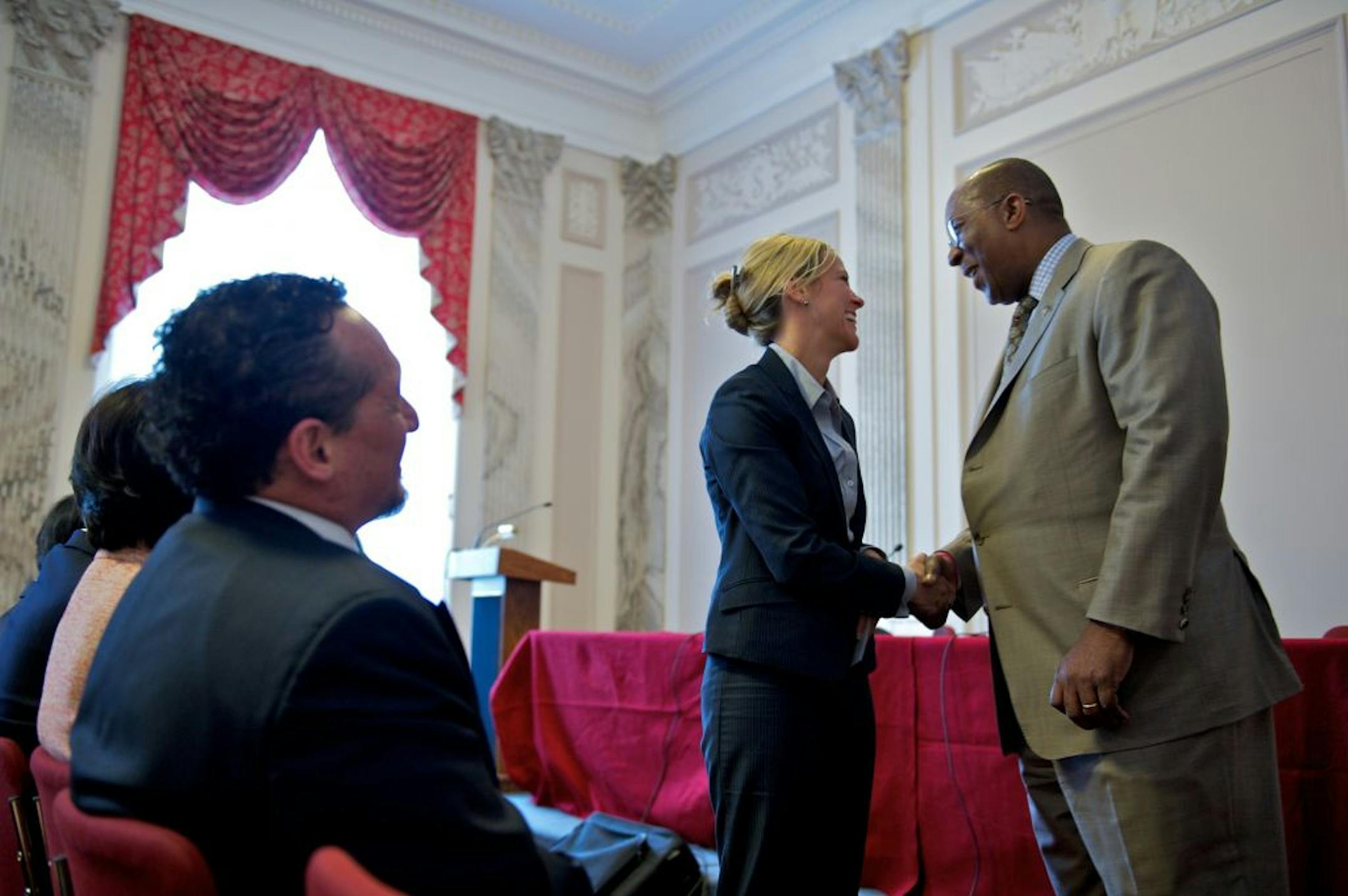
WASHINGTON - Devry Boughner sits under a portrait of Ho Chi Minh in the home of Vietnam's ambassador to the United States and pitches the virtues of open markets to a communist diplomat.
Boughner, Cargill Inc.'s chief free trade lobbyist, knows the future growth of the Minnetonka-based agribusiness giant depends on foreign markets. She also knows that trade restrictions can keep Cargill from investing and moving around the world as easily as it would like.
Cargill does business in 65 countries. It ships U.S. commodities abroad, but it also buys and ships 70 percent of Vietnam's cocoa crop and provides feed for the country's pig farms. These and other international ventures helped Cargill earn a record $2.69 billion in profits on revenue of $119.5 billion in 2011. Business is booming, and Boughner aims to keep it that way.
"The benefits of trade," she says, "far outweigh the fear."
This is the heartfelt view of a 38-year-old former Future Farmer of America, who grew up in central California's so-called "salad bowl" of vegetable fields and earned an Ivy League master's degree with a thesis titled "The Impact of Two-Tier Tariff Rate Quotas on Agriculture."
Boughner (pronounced Boof-ner) worked for the World Bank when she came to Washington out of grad school at Cornell. She jumped to the U.S. trade representative's office for a job with the arcane title of "cocoa, sugar, confectionery, ethanol and all natural sweeteners analyst." Her work attracted the attention of Deanna Okun, chairwoman of the International Trade Commission (ITC), who made her a senior economist. She settled at Cargill 7 1/2 years ago.
"Cargill," she says, "has the ability to impact change on a grand scale, much quicker than the government."
The problem is that with outsourcing and the Great Recession, not everyone shares Boughner's -- or Cargill's -- faith in free trade.