

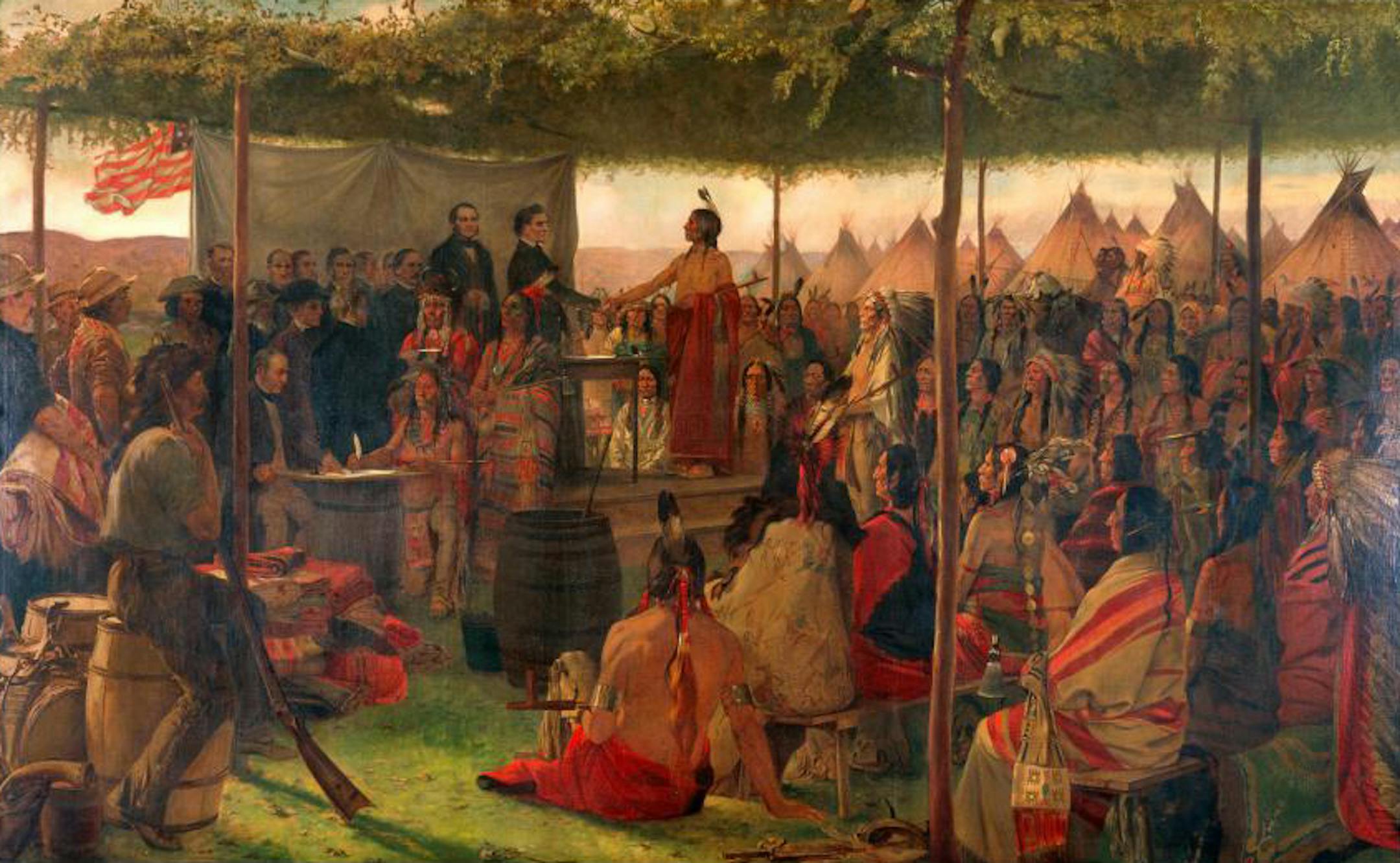
We were very encouraged to read that Gov. Mark Dayton wants to rethink the paintings in the Governor's Reception Room at the State Capitol ("Dayton ponders Civil War murals," Jan. 22). He focused on the number of paintings depicting Civil War battles. We want to build on his questions with a particular eye on Capitol art that portrays early meetings between Native Americans and explorers and settlers. These paintings reflect a problematic mythology around Minnesota's creation story and they deserve discussion.
Let's set the scene. The Governor's Reception Room has powerful symbolic importance. This is where the governor receives dignitaries and makes major announcements.
When the Capitol was built in 1905, architect Cass Gilbert and the Minnesota Historical Society intended the Reception Room art to illustrate the state's most important historic events. The room has six large paintings. Four show Civil War battles; they hang on two facing walls. The painting at the far end of the room is called "Father Hennepin Discovering the Falls of St. Anthony." The image includes the Native guides who showed Father Hennepin the way to the falls. The most prominent painting, "Treaty of Traverse des Sioux," hangs behind the governor's podium.
Signed in 1851, the treaty in question secured a third of the land for the future state of Minnesota. The painting depicts what seems to be a fair and formal negotiation between two sovereign nations. Lying on a table, the treaty document appears to radiate light, like a holy object in religious paintings.
Despite the painter's image, in reality the two sides did not have equal power. With virtually all of the Dakota land at stake, the Dakota wanted more time to gather their leaders to consider their options. Territorial Gov. Alexander Ramsey refused. In desperation, the Dakota signed the treaty.
Historian William Lass explains their decision. "As the treaty's terms were explained to them, the chiefs and headmen realized they were being presented with an ultimatum. Collectively, they concluded it was better to sign and get something for their land rather than refuse and run the risk of simply having it taken from them."
A review of Capitol art raises many questions. First, is the Capitol simply a museum for the artwork that always has hung there or can we update our state's story? If we were going to tell Minnesota's story — our most important events — with public art today, is this how we would tell it?
Second, existing Capitol art has very few images of people of color or women. The state is becoming more diverse. The thousands of schoolchildren who tour the Capitol each year include African-American, Hispanic, Hmong and Somali students and those from other backgrounds. Should they (and their parents) see themselves in public art as people having a place at the decisionmaking table?


