

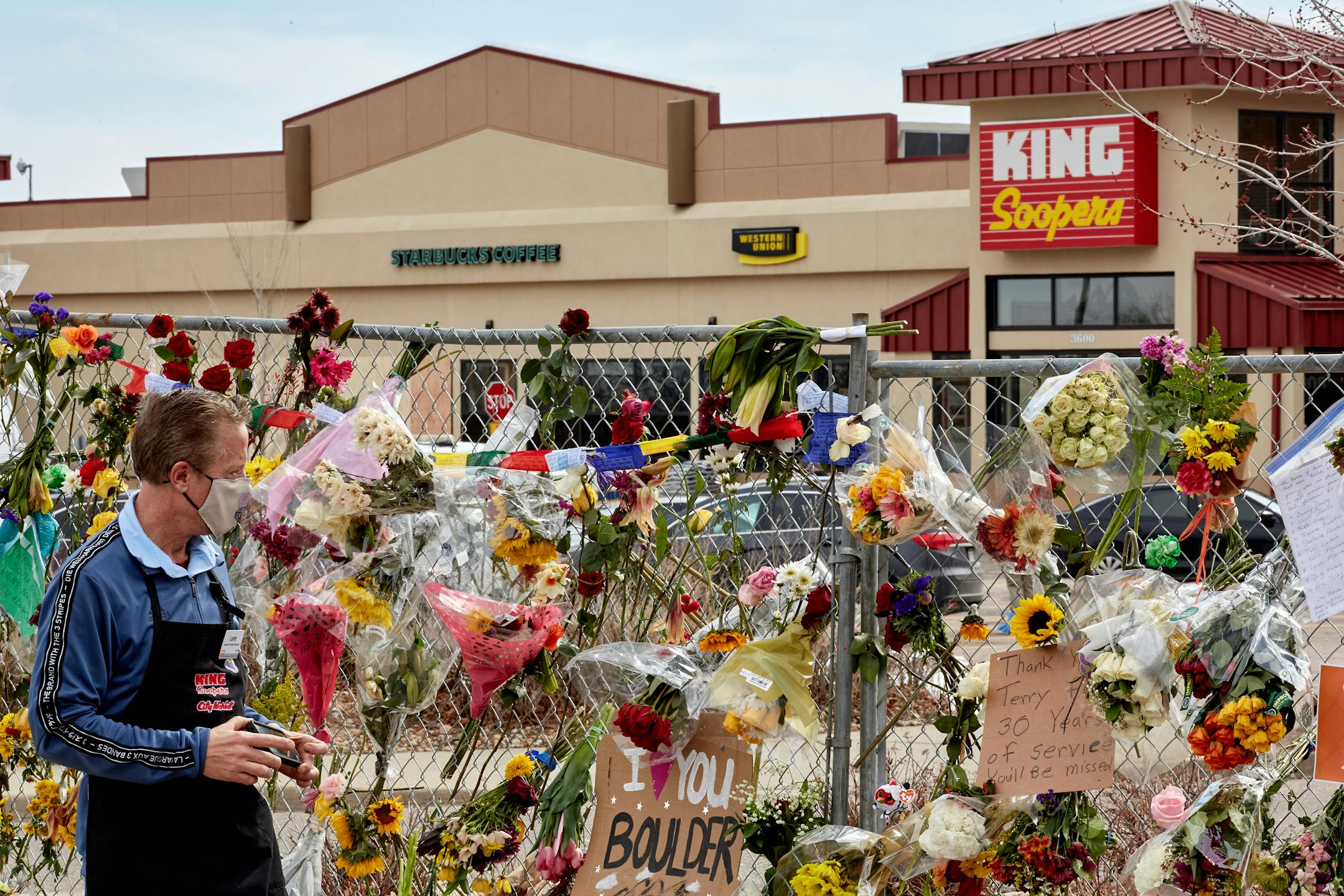
In many ways, the young gunmen who shattered families and broke the hearts of metro Atlanta and Boulder, Colo., in separate, high-profile killing sprees represented very different variations on the American story.
In the sprawling exurbs north of Atlanta, the alleged March 16 mass killer of eight people — six of them women of Asian descent who worked in spas — grew up deeply connected to the fundamentalist Christian church, and was seemingly unable to reconcile his years of Sunday school with the pornography he frequently watched, fueling his belief — apparently endorsed by his religious parents — that he had a sex addiction.
Raised in Arvada, Colo., a sprawling, affluent suburb of Denver, the man police took into custody last week for gunning down 10 people inside a supermarket, including the first police officer who responded, is the child of immigrants from Syria who came to the U.S. in 2002 at age 3 and who, as he grew, complained he was the victim of bullying over his Islamic name and heritage, according to family members who said he suffered from increasing paranoia.
But what strikes me about America's two newest suspected mass murderers are the things they had in common. In both cases, their life stories seem to trail off and become increasingly vague after they graduated from high school. There's evidence that both young men spent a lot of time on their computer — the Georgia gunman with his porn habit and the Boulder shooter posting some of his grievances on social media accounts that have been taken down. It was insanely easy for them to walk into a gun store and buy their weapons of mass destruction. And stating the obvious — even if it's an obvious we don't like to discuss much — they were both young men.
In fact, both were 21 years old. That's the exact same age as the gunman who entered an El Paso, Texas, Walmart in 2018 with the goal of shooting people of Mexican descent, killing 23. The perpetrator of 2012's Newtown, Conn., slaughter of 27 people, mostly first-graders and kindergartners, was 20. Similar to the ages of the mass murderers at Tucson (22), Virginia Tech (23), Dayton (24), and Aurora (25).
You've probably noticed that I haven't used the names of the gunmen. An increasing number of journalists — like CNN's Anderson Cooper — share that policy, and for good reason. No one wants to glorify the perpetrators of mass slaughter — and possibly inspire copycat killers in the process. And after the heartbreak of mass shootings happening again and again (and only in America), the instinct to instead elevate the tragic stories of their innocent victims is a good, proper and moral one.
But we also need to acknowledge a risk in walking the tightrope of endlessly covering tragedies like Atlanta and Boulder while minimizing any broader discussion of who stands behind these assault weapons. In the race to our familiar everyday political battle stations, are we ignoring an obvious crisis of among America's young men — one that occasionally erupts in mass shootings but more frequently plays out in opioid abuse, or rising suicide rates, or other forms of anti-social behavior? Is there a way to justifiably avoid any empathy for individuals who turn their grievances into senseless violence, yet compassionately look at a better way for their generation that appears increasingly adrift, in order to stop the next 21-year-old ticking time bomb?
I've watched the news coverage over the last few weeks, and beyond profiling the victims it falls largely into two categories. Both are necessary conversations. The first is about gun control, in a nation with more guns than people, with such easy access to buy human killing machines like the AR-15-style weapons used in Atlanta and Boulder. The second involves seeing these incidents through our complex lenses of race, or ethnicity, or religion. Progressives and others amplified the details of the Atlanta killing to call overdue attention to the spike in violence toward people of Asian descent during the pandemic, while the brand of right-wing media that usually downplays mass shootings perked up upon learning the Boulder gunman is a Muslim.


