

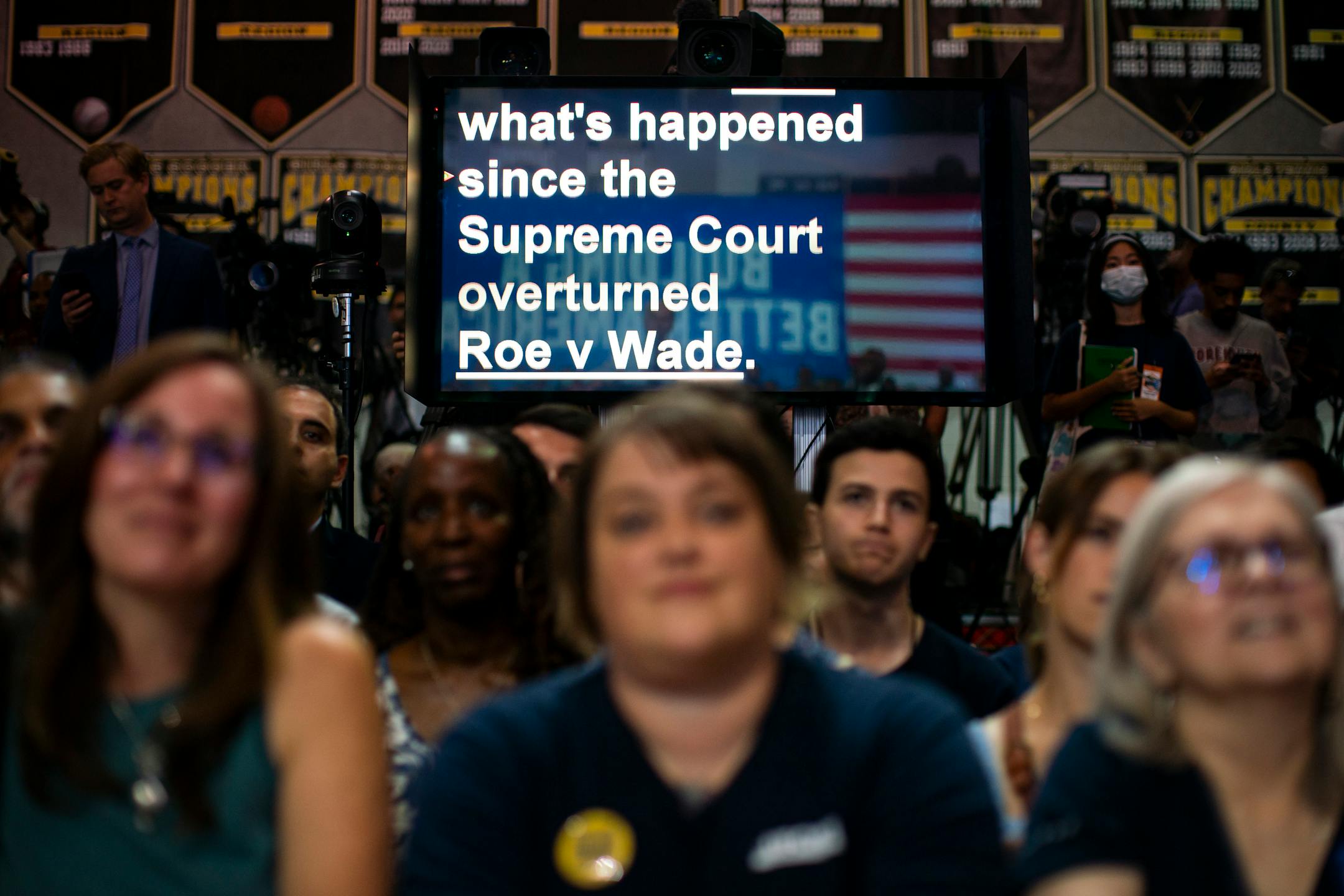
In addition to granting new political hope to Democrats, the Supreme Court decision overturning Roe v. Wade has clarified the ground of public argument about abortion. As abortion rights supporters have pressed their sudden political momentum, three pro-choice arguments have loomed particularly large: an argument about abortion in life-threatening circumstances; an argument about the unique physical costs of pregnancy in general; and an argument for the virtues of the Roe-era cultural status quo.
Each merits its own analysis, so this will be the first of a series of columns taking each in turn. (Notably, none are really arguments about the question of when life, personhood or human rights begin; they all tend to present reasons that, even if the unborn child did have a moral claim on us, some other interest necessarily overrides it. So I'll try to address them on those terms rather than just rehashing the debate about whether unborn human beings are also human persons.)
In terms of what conflicted Americans might fear most from an abortion ban, the most immediately potent argument is the first one, which focuses on pregnancies gone so terribly wrong that the mother's life can only be saved at the expense of the unborn child.
These cases are treated as exceptions in every existing state abortion ban. But such exceptions, abortion rights advocates have been arguing, simply aren't broad or flexible enough to protect women from real peril. Instead, by limiting abortion strictly to medical emergency, they create situations where a woman with a doomed and dangerous pregnancy must wait and wait for her own health to worsen before intervention becomes legally possible — waiting on doctors and hospitals fearful of lawsuits and prosecution, waiting in a kind of torture for the situation to grow dire enough to act.
The pro-life counterargument calls this legal misinformation. The life-of-the-mother exception in, for instance, Texas' abortion ban doesn't require that the risk of death or "substantial impairment" be imminent or immediate; it just requires a doctor to certify that such a risk exists. So doctors and hospitals have the latitude to intervene earlier, not just wait for the threat to metastasize before they act. To the extent there is a problem here, in the real cases of women denied help, pro-lifers argue that it's mostly a problem of medical professionals misreading the new laws, officials failing to clarify their meaning — and sometimes-irresponsible liberal media outlets misleading on what the law actually allows.
The pro-life side is right that some high-profile cases of women stuck in medical limbo do seem to reflect a misunderstanding of what these laws allow — even if the pro-choice side can respond that doctors may be reasonably uncertain how pro-life prosecutors will interpret them. But just having a debate over the scope of a life-of-the-mother exception inevitably redounds to the pro-choice side's benefit, because it focuses public attention on a fraught gray area, a zone of ambiguity in which even opponents of abortion won't all agree with one another about what pro-life principle requires.
That ambiguity takes two forms. There's the inherent uncertainty of situations that might be life-threatening or physically devastating, where the evidence is provisional and there's no simple medical answer. There's also the ambiguity about whether a particular means of ending a dangerous pregnancy satisfies anti-abortion commitments. In Catholic moral theory, for instance, what's permitted in medical emergencies are "indirect" abortions, which kill the embryo or fetus only as secondary effect of a treatment meant to save the woman's life. But there is considerable debate even among conservative Catholics about what "indirect" means and what kinds of abortions it allows.
In the two kinds of gray-area cases, two pro-life doctors might disagree about the gravity of the pregnant woman's situation or two pro-life moral theorists might disagree about the licit means of ending the pregnancy. Lawmakers trying to devise exceptions thus have to choose between a system that errs entirely on the side of the unborn life and a system that follows the familiar pro-choice line about leaving certain difficult decisions to "the woman and her doctor." And when abortion opponents argue that current pro-life laws allow doctors considerable latitude, they are effectively taking the second option, which concedes something to the pro-choice side's philosophy.


