

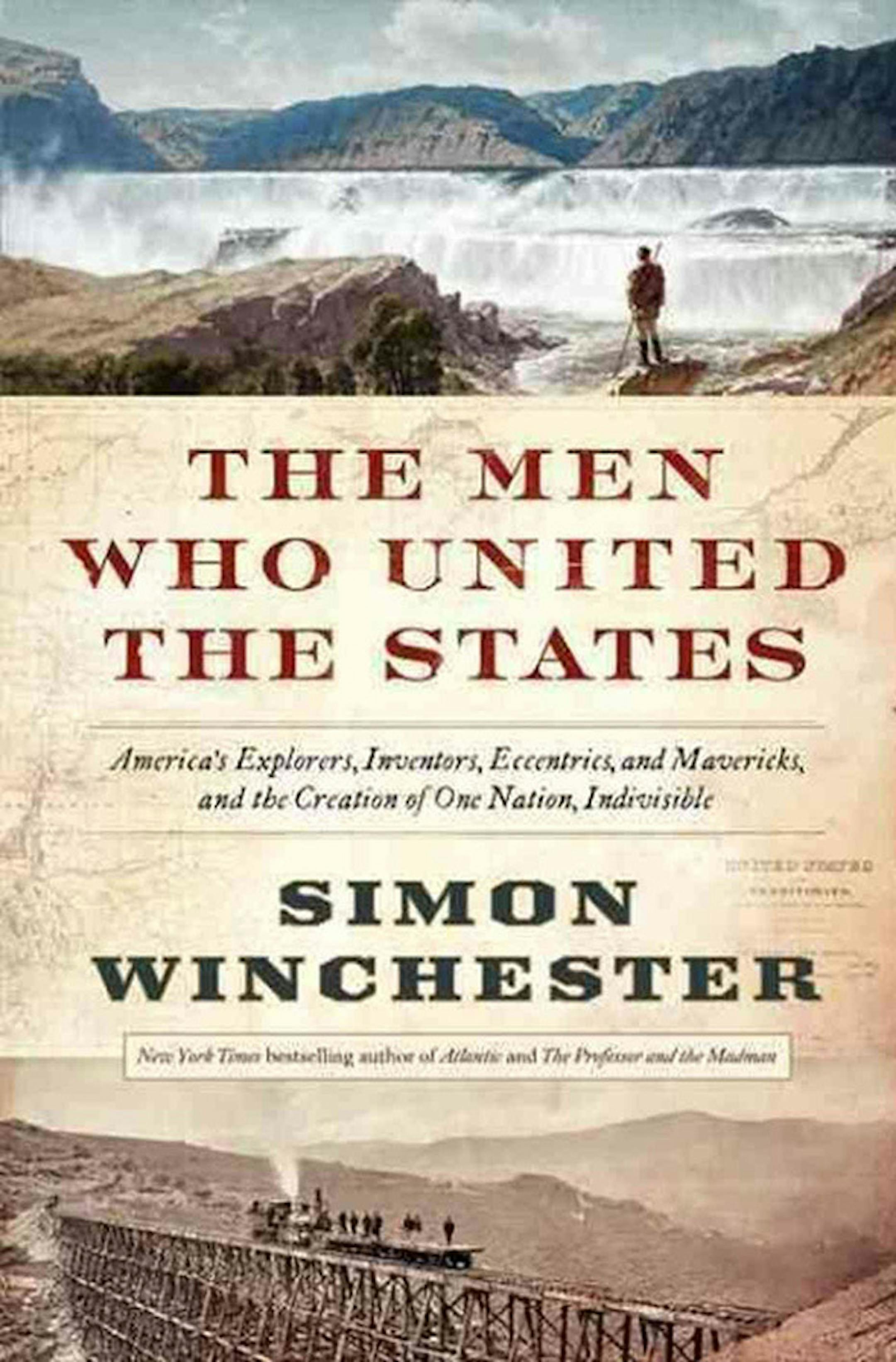
the men who united the states
By Simon Winchester, William Collins, 463 pages, $19
Simon Winchester is a literary impresario. Having written on the making of the Oxford English Dictionary and the 19th-century farmer's son who created the first real geological map, here is an author who wants to spin a yarn and to forge connections that have not been made before. Now, with "The Men Who United the States," Winchester uses stories to paint an unusual and personal portrait of the creation of a nation.
The organization of the book is intriguing. Winchester's wife is Japanese and he has spent a lot of time in Asia, where, as he says, "everything and everyone can be reduced to the barest essentials, the five so-called classical elements." The book is divided into five sections, each one dominated by wood, earth, water, fire or metal. Handily, this allows chronological movement, too, and "The Men Who United the States" begins with the great journey that, arguably, gave America a vision of its own size and scope: that of Meriwether Lewis and William Clark in the first years of the 19th century. What has this got to do with wood? Exploring territory for timber was one of the reasons for this historic expedition, which reached the Pacific Ocean in November 1805.
In the "earth" is John Wesley Powell's exploration of the Grand Canyon in the years after the Civil War; with "water" comes the creation of the Panama Canal; "fire" encompasses the building of both railways and roads, and "metal" is the wires — telegraph, telephone and finally vast Internet server farms — that connect Americans globally.
It is an unashamedly romantic sequence. Winchester, who was born in England, became a U.S. citizen in 2011; this book, he tells his readers, sprang from his love of his adopted homeland. So there is also mention of the people who inhabited the country before Europeans arrived.
the economist


