

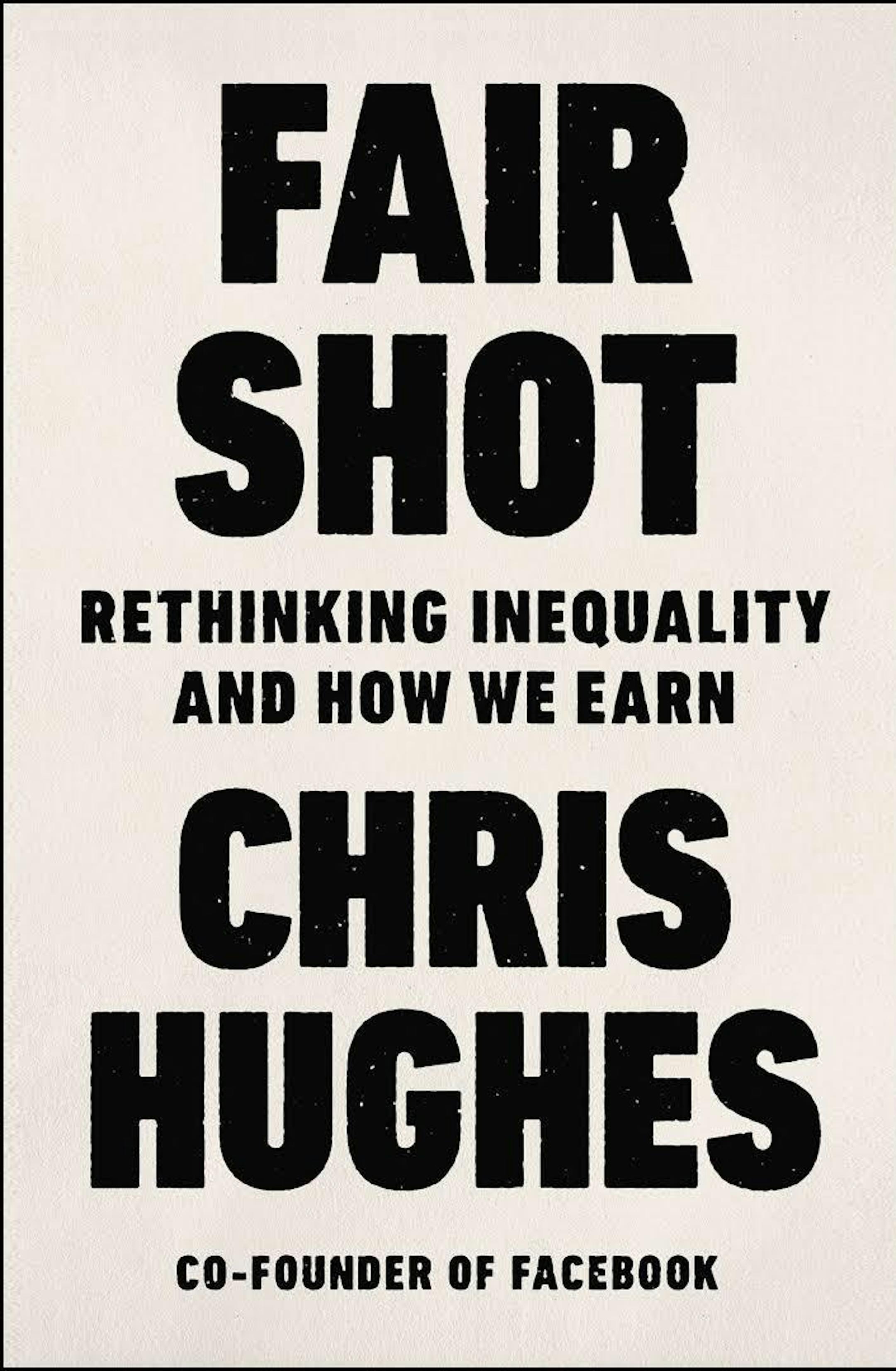
'Fair Shot: Rethinking Inequality and How We Earn'
Chris Hughes, St. Martin's Press, 224 pages, $19.99. There are strokes of outrageous luck and then there is the life of Chris Hughes. Having found his way to Harvard from a small town in North Carolina, he chose Mark Zuckerberg for a roommate in his second year at the university. Zuckerberg quickly enlisted Hughes and a few others to help in his social-networking side-project. Their ownership stakes in what became Facebook were soon worth incomprehensible sums of money. Such extraordinary good fortune is liable to change a person's outlook. Hughes became convinced that the world economy is fundamentally unfair — even after some economic failures later on convinced him of the virtue of measured idealism. His new book outlines a solution: a guaranteed minimum income, funded by increased taxation of the very rich. Though he makes an admirable case, the book is most interesting for the insight it provides into the mind of the author. Support for guaranteed incomes is something of a fad in Silicon Valley; Hughes embraces a relatively modest approach designed to address inequality now. "Fair Shot" is as much a memoir as a manifesto — an endearing effort by the author to understand the meaning of his extraordinary circumstances. Hughes was born to a traveling paper salesman and a math teacher. His parents' diligence and thrift enabled them to give him a middle-class childhood and the opportunity to move up. Yet this sort of ladder-climbing is increasingly difficult in the United States, he writes. Hard work alone is no longer a sure route to prosperity. Those blessed with high incomes also owe their success to luck.
ECONOMIST


