

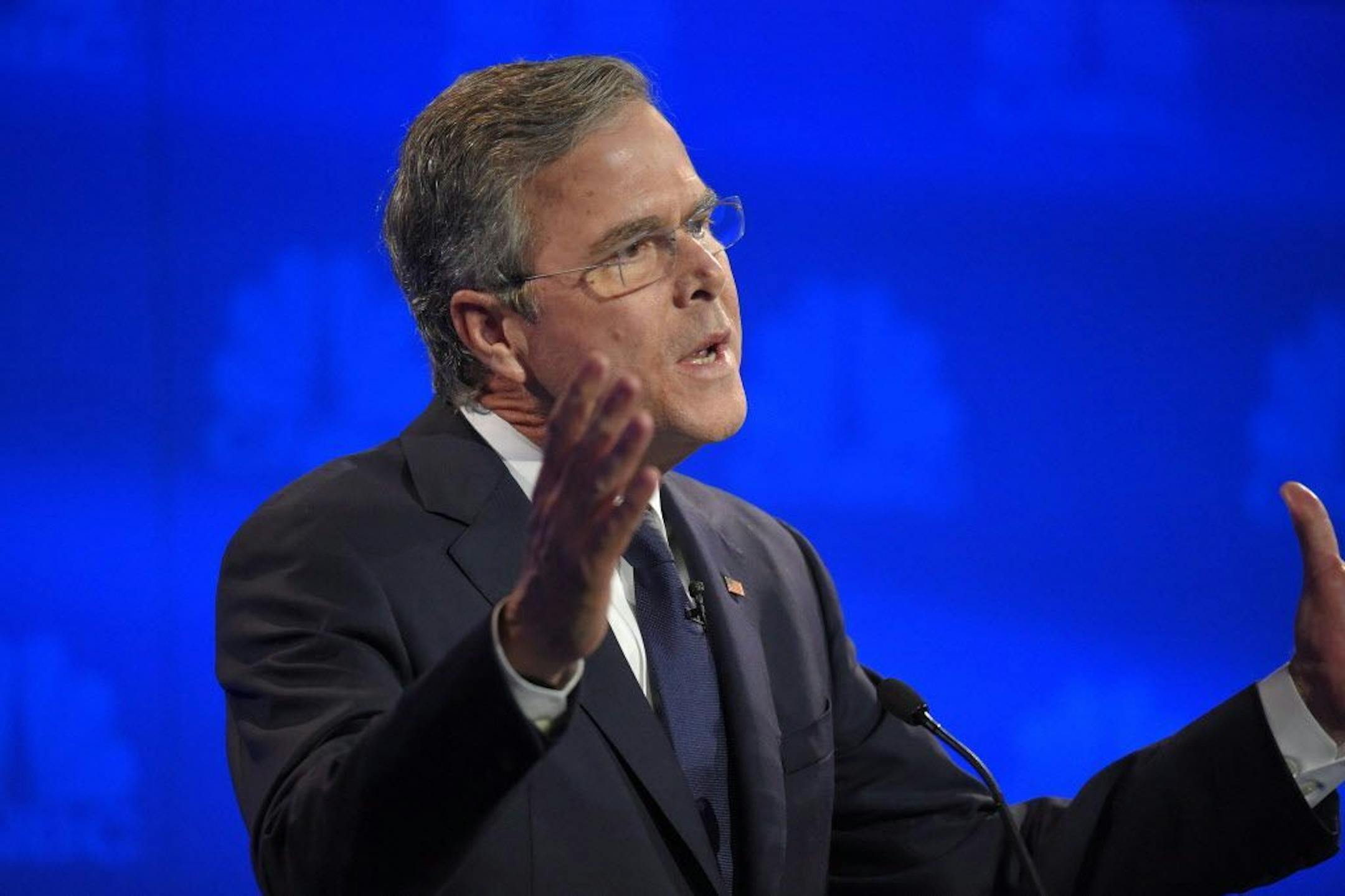
The political press — and presumably the donors and activists who consume it — has handed Jeb Bush his walking papers. Another poor-to-middling debate performance last night in Colorado is the proximate cause.
The debate left me unusually queasy, and I find the notion of Bush's departure from the field even more unnerving. I consider Bush pretty smart, pretty honest and pretty competent. You won't get me to defend his boneheaded and fully anticipated attack last night on Marco Rubio's Senate absenteeism, however. I have limits.
Bush's most telling exchange of the night was not, however, with Rubio. It was with moderator John Harwood: "Gov. Bush, in a debate like this four years ago, every Republican running for president pledged to oppose a budget deal containing any tax increase even if it had spending cuts ten times as large."
That 2011 pledge was prime evidence that the Republican Party had departed the realm of politics for religion, where doctrinal devotion trumps the crass realities of the material world. Bush, who wasn't a candidate at the time, had suggested that he would embrace such a preposterously bountiful political windfall in a hurry.
During the debate, however, when Harwood probed to see if Bush was still on solid ground, Bush demurred. He was unwilling to admit subscribing to a belief system — political compromise within a system specifically designed for it — that much of his party considers disqualifying. And let's be clear: The hypothetical is getting 10 times what you give up to your domestic political opponent. That's a good deal.
The devolution of one of the nation's two major political parties, and its sanction of nonsensical beliefs on taxes, science and other issues, is the most important political development of our era. Bush's candidacy originated as a conscious backlash to that. Before his campaign even began, he said a Republican would have to risk losing the primary to win the general. Bush was saying that his party had become so extreme that the policy positions required to please its base were toxic to a general electorate. He would have to risk the base's ire to have a shot.
Bush's burdens didn't stop there, of course. He is a quintessentially establishment figure at a moment when anti- establishment rage fuels his party. He is burdened by the presidency of his brother, whose fiscal failure and foreign disasters have made virtually identical conservative policies much more difficult to defend. And he has proved to be a sometimes awkward campaigner, seemingly out of sync with changing times.
Indeed, on the Republican stage, Bush appears as Dylan's Mr. Jones, an earnest square surrounded by tie-dyed merry pranksters. Yet it's not his beliefs that distinguish him from the crowd. He is socially conservative to a fault. And like his competitors, Bush proposes tax cuts that favor the wealthy and would produce trillions in additional debt even as he decries current debt levels.


