
BNSF cited for serious flaws in track before N.D. accident

The Federal Railroad Administration, in response to a request from a North Dakota senator, says its inspections frequently turned up defective track.

February 20, 2014 at 3:36PM
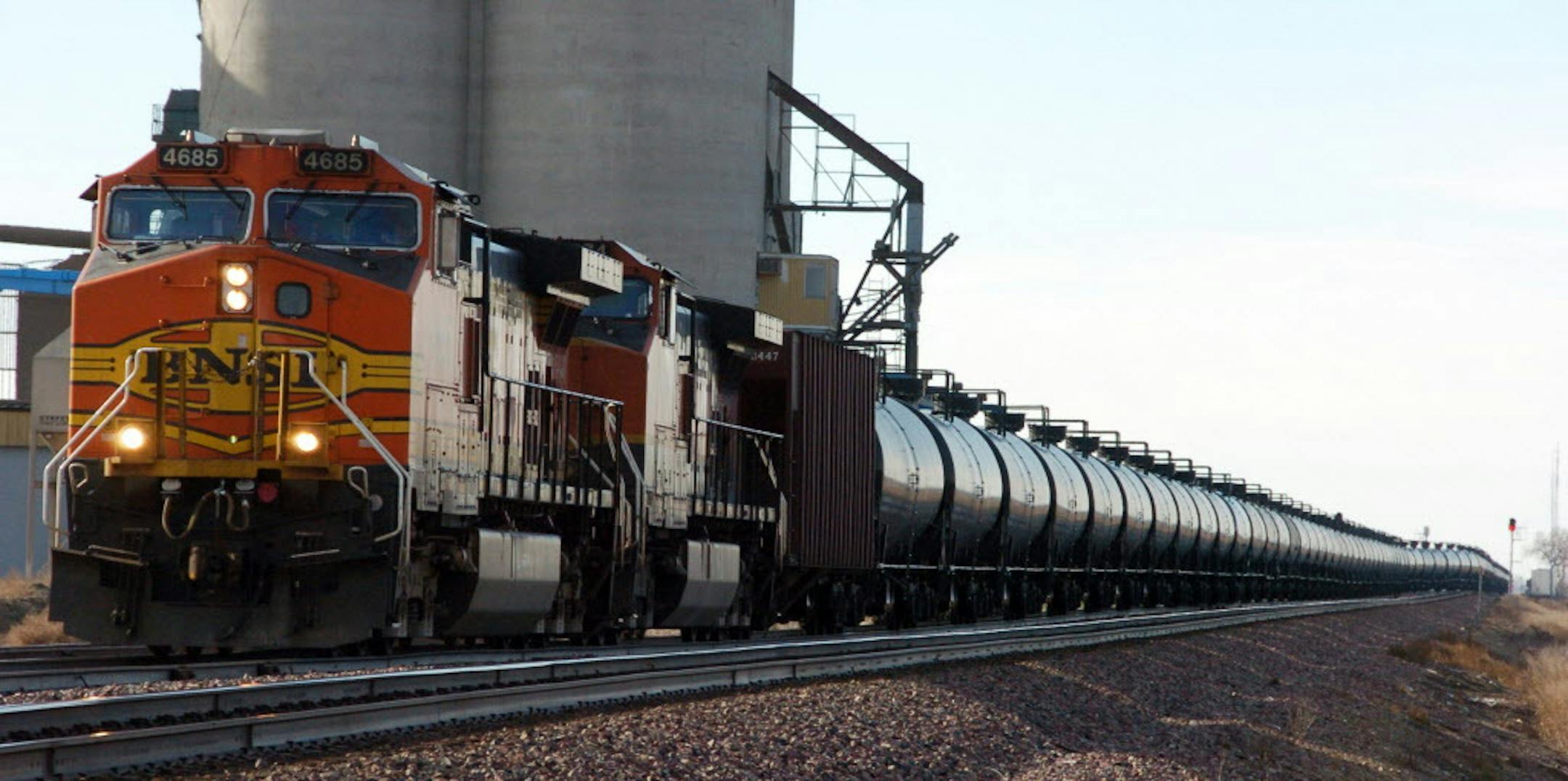
Nov. 6, 2013: A BNSF Railway train hauls crude oil near Wolf Point, Mont.
A BNSF Railway train hauled crude oil near Wolf Point, Mont. Potentially explosive shipments have increased 40-fold in recent years as crude production boomed. (Associated Press/The Minnesota Star Tribune)

Federal rail inspectors have cited BNSF Railway Co. in North Dakota for 721 track violations, finding problems serious enough to threaten fines in one out of every five inspections since 2006, according to federal data released Wednesday.

Federal Railroad Administrator Joseph Szabo said in a letter to a North Dakota senator that federal officials conducted 3,822 inspections during the period and found 13,141 defects, the vast majority of which were addressed without fines.

However, in 721 instances, or 19 percent of the inspections, officials determined that BNSF violated railroad regulations. That happens when a problem isn't fixed or is serious enough to warrant a violation right away. Szabo's letter, released by Sen. Heidi Heitkamp, D-N.D., didn't describe the violations, the track conditions that produced them or say how much BNSF paid in fines.

Heitkamp asked for the information after a BNSF oil train crashed a mile outside Casselton, N.D., on Dec. 30, producing explosions, a massive fire and temporary evacuation of much of the town, though no one was hurt. It was one of approximately 10 oil trains that depart daily from the Bakken oil fields, most of which run on BNSF tracks that lead into Minnesota.

In the letter, Szabo said the Federal Railroad Administration (FRA) has an ongoing investigation and safety assessment of the BNSF rail line in Cass County, where the accident occurred. He said four derailments have occurred on the line over nine years, two of which were track-related — a misalignment near Casselton in 2005 and a broken rail near Page, N.D., in 2008. The others, he said were equipment-related.

But Szabo's letter offered no comparison of BNSF's North Dakota problems to those of other railroads. FRA annual enforcement reports also don't offer comparable track-related violations, and an agency spokesman was unable to provide the information Wednesday. In 2013, BNSF was assessed $2.3 million in fines across the nation, according to the FRA's report.

BNSF, which responded to the letter and reporters' questions by e-mail Wednesday, said derailments on mainlines hit record lows last year, and that busy routes are inspected twice as frequently as the FRA requires. In North Dakota last year, the company said, it replaced 415,000 ties and 300 miles of rail and will make a record investment this year to maintain and expand capacity in the state.

BNSF spokeswoman Amy McBeth said defects detected by FRA and BNSF can include ties, rail anchors, the rock ballast around ties, switches, loose bolts and cracked bars. Many problems are immediately repaired or speed restrictions are imposed until repairs are made, she said. FRA audits over the past seven years found less than one defect per mile on BNSF's 2,300 miles of North Dakota track, she added.
Heitkamp said it's clear that the Casselton area, 20 miles west of Fargo, needs increased attention considering the number of derailments there.

"Folks who live near these tracks have been through a lot, and deserve to know that the rails are under close examination and that FRA is doing everything to make sure North Dakotans aren't at risk," she said in a statement.

The National Transportation Safety Board is investigating the Dec. 30 accident, but has not determined the cause. A broken axle was found near the crash, which happened after a westbound soybean train derailed on a parallel track. The oil train, which was headed for Minnesota, crashed into a grain car that had landed on the eastbound track.

Inspection vehicle

In July, the letter said, the FRA ran an automated track inspection vehicle from Dilworth, Minn., to Mandan, N.D., and discovered 11 problems over 202 miles. Another such inspection is planned later this year, the letter added.

Larry Mann, a rail safety attorney based in Washington, D.C., said in an interview that FRA's disclosure that it conducted just one automated inspection on the BNSF line in 2013, with one planned in 2014, illustrates the weakness in federal oversight.

"They should do it frequently," Mann said of the automated inspections, which examine whether tracks' distance apart, alignment and other parameters meet specifications. "That is what causes derailments."

Mann also said that violations carry such low penalties that they don't serve as deterrents.

Heitkamp and others in Congress and in the Minnesota Legislature have called for hearings on rail safety in light of recent oil train accidents.

Trains with 100 or more tank cars carry away about 70 percent of North Dakota's nearly 1 million barrels of daily crude oil production. Most oil trains go through Minnesota, with six a day, on average, passing through the Twin Cities, according to the Minnesota Department of Transportation.

David Shaffer • 612-673-7090 • Twitter: @ShafferStrib


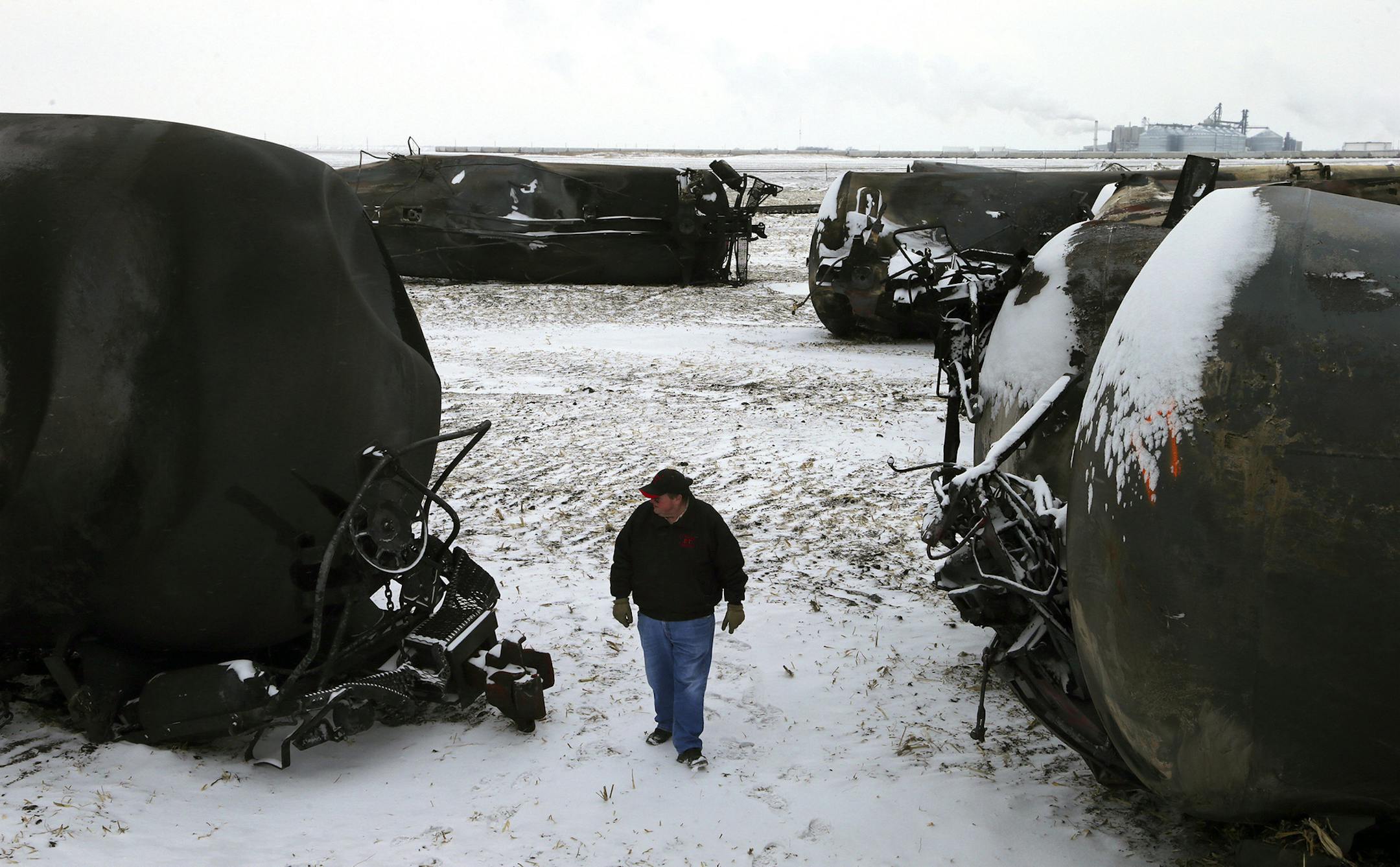
Ed McConnell, the mayor of Casselton, N.D., among wreckage from a recent oil-train explosion in Casselton, N.D., Jan. 16, 2014. A fiery rail accident last month in Casselton, N.D., which prompted residents to evacuate the town, has shattered people's confidence in the crude-oil convoys that rumble past seven times a day. (Jim Wilson/The New York Times) ORG XMIT: MIN2014021912571962
Mayor Ed McConnell of Casselton, N.D., walked amid the wreckage nearly three weeks after oil-train explosions and fires forced most of the city’s 2,400 residents to evacuate the town on New Year’s Eve. (The Minnesota Star Tribune)
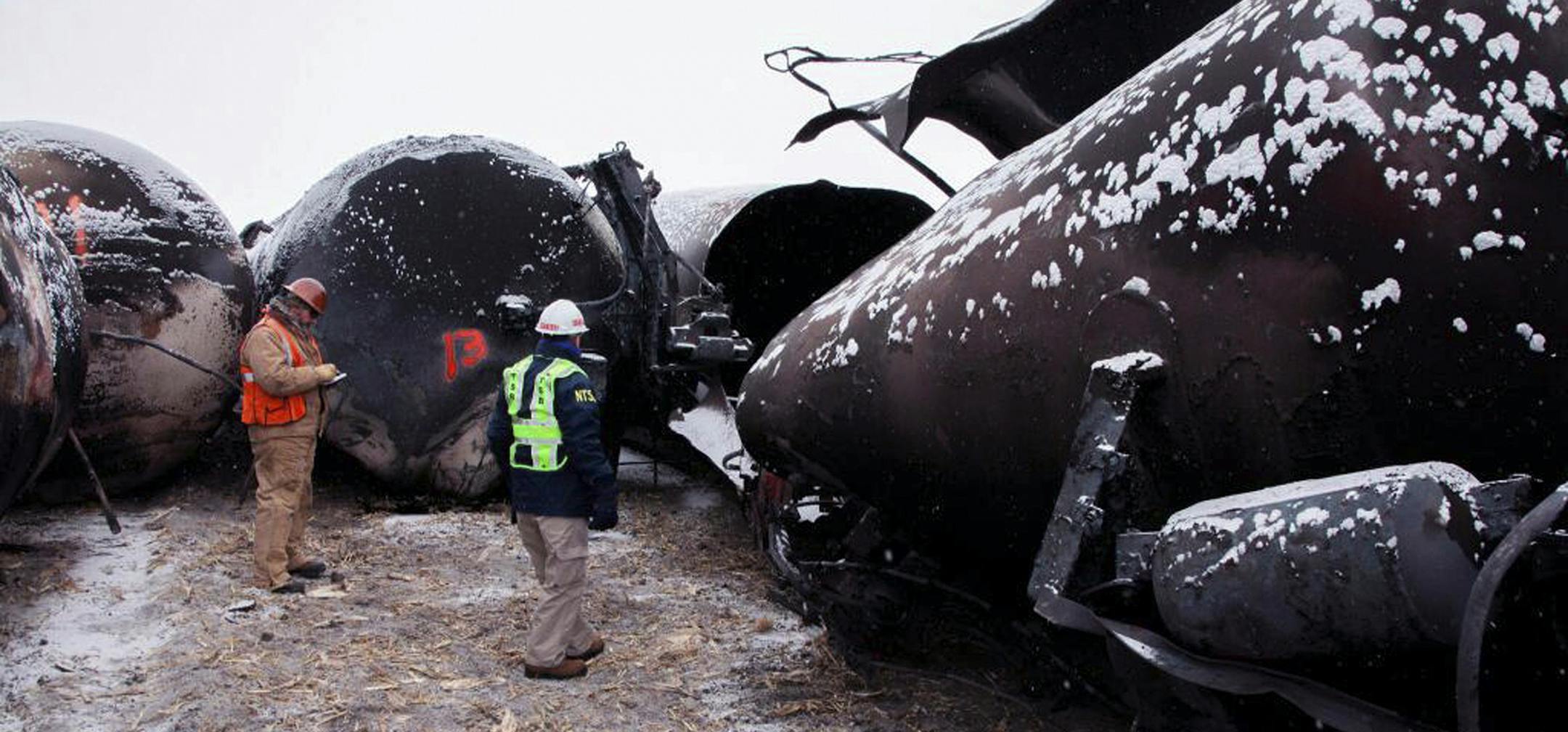
In a handout photo, Robert Sumwalt, right, of the National Transportation and Safety Board, investigates a rail accident in Casselton, N.D., Jan. 1, 2014. No one was hurt as a train carrying high-grade crude oil from the state's Bakken field struck a derailed grain train, but the incident, and previous accidents, have prompted North Dakota politicians to rally for stricter federal railroad safety regulations. (NTSB via The New York Times) -- FOR EDITORIAL USE ONLY. ORG XMIT: MIN2014021912580365
Robert Sumwalt, right, of the National Transportation Safety Board stood amid the wreckage two days after an oil train struck a derailed grain car a mile west of Casselton, N.D., on Dec. 30. (The Minnesota Star Tribune)
about the writer

about the writer

David Shaffer

Reporter

See Moreicon

More from Business

See More
card image
Jerry Holt/The Minnesota Star Tribune

President Donald Trump’s order starts the process of reclassifying cannabis alongside drugs with recognized medical uses, a change that could reshape taxes and enforcement in Minnesota.

card image
card image
