
Opinion | As my son turns 15, another reflection on growing up Black in Minnesota

A mother watches as her son attempts to figure out who he is becoming.

August 24, 2025 at 1:00PM
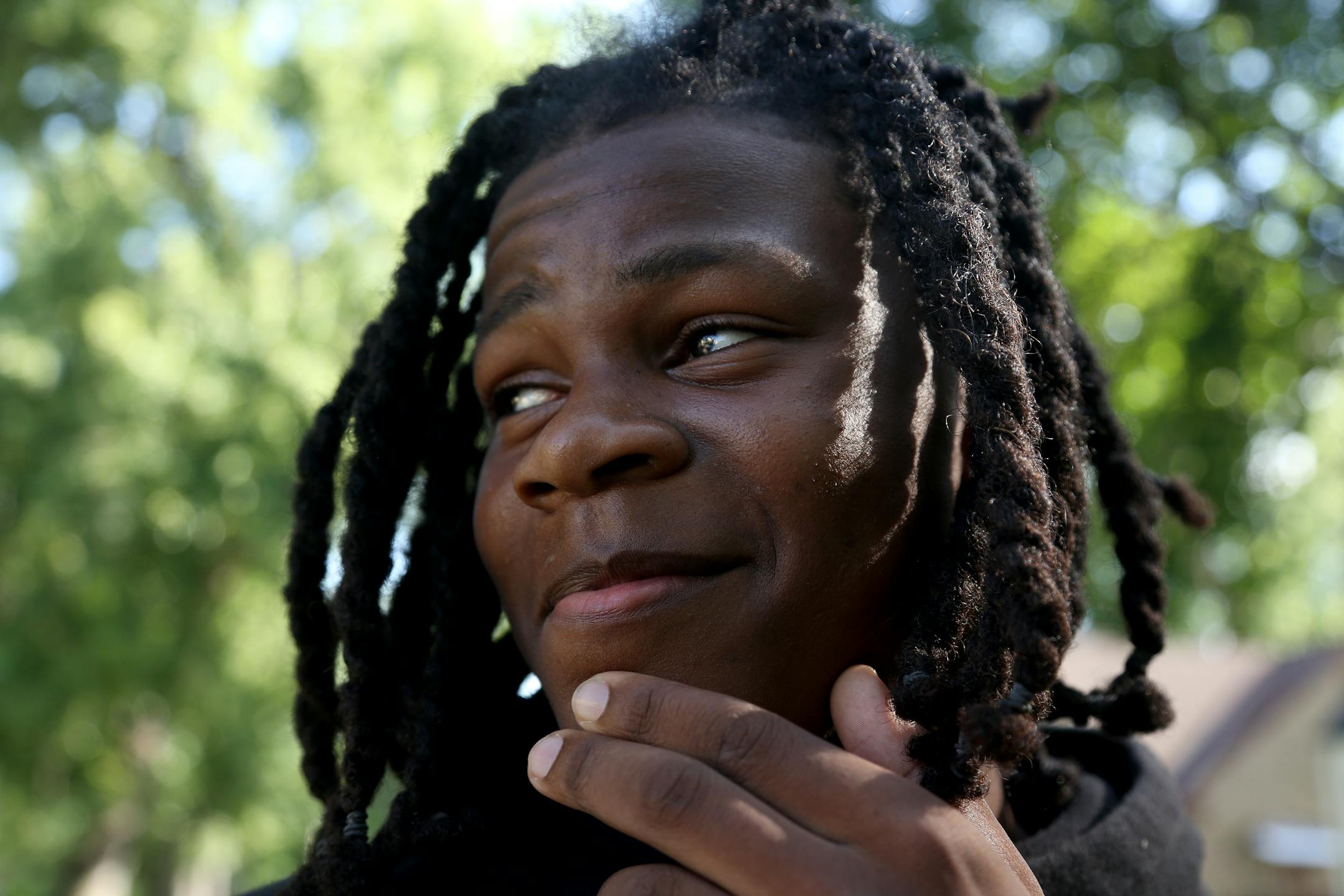
"Will is still my little boy," Kyndell Harkness writes. (Kyndell Harkness/The Minnesota Star Tribune)

Opinion editor’s note: Each five years, Kyndell Harkness, a former photojournalist for the Minnesota Star Tribune and current head of culture and community for the Star Tribune Company, has documented her experience of raising a Black son in Minnesota (see tinyurl.com/william-5 and tinyurl.com/william-10). It’s time for another check-in.

•••

Teenagers!

Will, no longer William, half asleep, lies in his adult-sized bed, with his hairy legs stretched over the edge. The surface is littered with controllers, charging cords and his cellphone. His hand reaches out to me — a hand that is so much bigger than mine now it’s hard for me to even recognize it, but I do. That outstretched hand has always meant one thing between us. Someone wants a hug.

Fifteen has happened to him — to me. This is the time that parents warn you about. “Your kid will hate you.” “They are so frustrating.” Now, frustration I have experienced, but teenager hate, tinged with casual disdain, can work for only some. When the world directs hate your way, that emotion for us is a luxury our brown skin can’t afford.

I feel fortunate to have Will. His expression of love is hardwired. Hugs as we part ways and statements of “I love you” freely offered on speaker phone with friends present are an open statement of a son’s love for his mother. Our love for each other is on display. I am eternally grateful.

Now believe me when I tell you that we’ve had our moments. We’ve had shouting, slammed doors, hang-ups and balled-up fists on both sides, because those reactions are sometime unavoidable. It’s a teenager’s disbelief in adult hard-earned logic that is frequently the source of the conflict, as well as a parent’s inability to see the cultural paradigm shift in front of us.

Now let me tell you about Will.

He’s 6 feet tall. Dark-skinned and dreaded. Powder blue Beats on his ears and Uggs on his feet. Like most teens, his neck remains practically parallel to the ground as he obsessively looks at his phone. His long legs seem to be thrown out in front of him in this laissez-faire stroll as if time stands still for him alone. He is a baller from head to toe.

As a visual journalist, I’m a watcher. I look at the uniform, the persona he wears into the world. This is not the uniform I would choose for him, but it’s not my choice. He is swimming in a sea of young people trying on who they think they are. He is no different. Whether feathered hair, dyed, shaved or dreaded, he and his freshman class have no idea who they are or who they are supposed to be. But they’re busy figuring it out.

This boy turning to man, my William to Will, has external forces as well as internal turmoil, and his Blackness is center stage.

Will’s inner struggle is real. This American boy, born of African parents, adopted by my former husband and me, has been raised in a mixed household. How he has been raised has different qualities. When 1 of 4 parents come from a Black experience, it seeds doubt. He’s wondering if those qualities are race-related.

What does it mean to be Black? The endless questions he raises are basic, yet profound.

What does it really mean to be Black, not just skin but soul? What do people with those qualities eat? Where do they go to church? What activities do they enjoy? What are family vacations like? How are their homes different? So many questions. So many pieces of content to measure and to try on.

Black identity for Will is tough in a place like Minnesota. Just finding the visible evidence of your existence can be hard to come by sometimes. To see yourself reflected in others. Remember, I’m a visual person. So is my son. To be blunt, the spectrum of Blackness here is limited. Period. There’s no right or wrong in that spectrum as others would have us believe, just difference. So, when you are looking for role models, wanting to try on different identities as teenagers do, what society leaves for him is very two-dimensional.

I have been my son’s cultural touchstone until now. But my relevance is waning. Friends and the internet are starting to outpace me. He finds comfort in the stereotypes that I ran away from. He wears his Black baller identity like a suit of armor he polishes every night. The language, the clothes, the mannerisms have been groomed and well cared for. But he’s changing into a young man, and I’m more anxious than ever. I still want the world to see the Will that I see.

As all mothers know, our children’s trying on of personas can be annoying. But as a Black mom with a Black son, I’m keenly aware that all personas are not created equally. Certain personas can invite misinterpretations and, in worst-case scenarios, can prove deadly.

Will shares just about everything with me. He gets so excited telling me when people think he’s older because that means he’ll soon be driving, and people will be forced to take him more seriously. I, on the other hand, can only think that as an older Black boy he will increasingly be unfairly judged a potential threat by some — a dangerous stereotype he has yet to grasp.

We argue, for instance, about him wearing a silken bonnet he sleeps in when he sometimes steps out in public. He says Black people do it all the time. He doesn’t understand my concern that the look may draw unwanted attention. He thinks I worry too much. My question to him is why you need to wear a bonnet outside as a show of Blackness.

We continually have these sorts of fights. He requests to do, eat, wear things that often fit stereotypes of Blackness. And I challenge him in his language: “Why you so thirsty?” I tell him that he is the culture and that there is no need to press so hard.

He hears me, but that is not his reality. He lives in a world where image is everything and cultivating the right one is high stakes. I attempt to explain to him that the world sees the “person” he projects; an infinite universe that goes unimaginably further than the classmates for whom he auditions.

As his mom, I’m compelled to tell him how his clothes and mannerisms can be perceived by strangers and how that could impact his life. I give him the information and let him decide. It feels dangerous. Young men are so invincible at this age and can only see so far. But I also believe that his choosing to wear certain clothes shouldn’t be a death sentence. He should be free to try these cultural bits and bobs on to see if they truly fit him. This is the age where they start to figure out who they are, and that trial and error is a part of real growth.

The summer of 2025 has been good for him so far. He’s finally healthy and getting his strength back after a season-ending basketball injury. He got promoted to manager at his biking job. He’s slowly becoming more independent, immediately paying what he owes, doing laundry, cooking and being responsible. He’s growing into that manly look he’s cultivating.

My hope for him is that his Blackness becomes a genuine extension of self, not merely a suit he puts on; that he continues to smile and hug me with the endless amount of love he has in his heart.

Will is still my little boy. Here’s hoping the world allows him to put his armor down when he chooses to. We all deserve a lighter load.

Kyndell Harkness is the head of culture and community at the Minnesota Star Tribune. She has also been a photojournalist and photo editor.

about the writer

about the writer

Kyndell Harkness

Assistant Managing Editor of Diversity/Community

Kyndell Harkness is the Star Tribune’s Assistant Managing Editor of Diversity/Community.

See Moreicon

More from Commentaries

See More
card image
Leila Navidi/The Minnesota Star Tribune

In government leadership, young people need to be ready to accept the torch, but previous generations can’t slow down their leg, or delay the pass.

card image
card image