

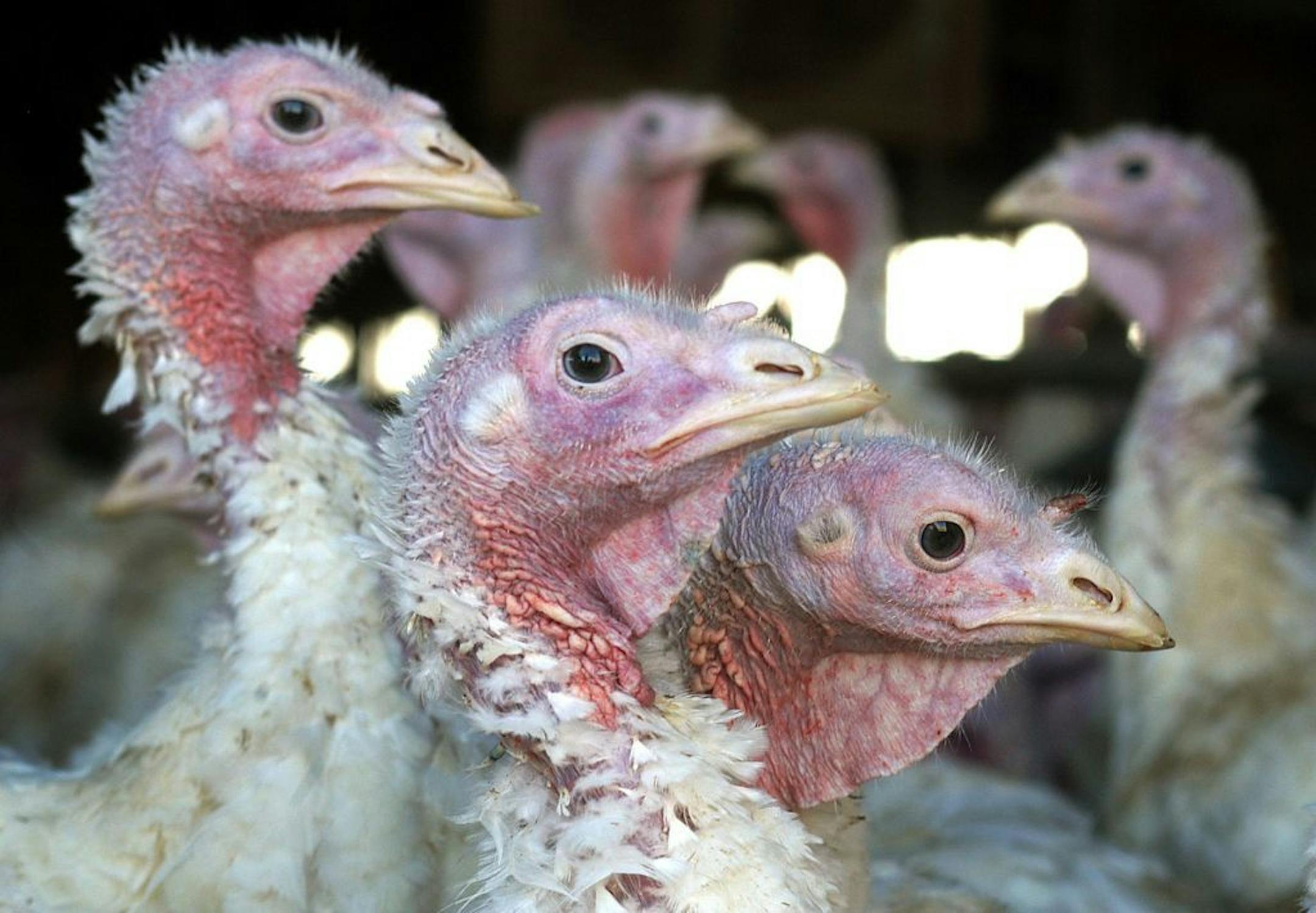
Minnesota has become the epicenter of a national bird flu outbreak, with the highly lethal virus hitting two more of the state's commercial turkey farms and perplexing animal health regulators with its rapid spread.
The bird flu has struck seven Minnesota farms, with regulators Monday announcing tainted flocks in the heart of turkey country, one each in Kandiyohi and Stearns counties. Three farms in Stearns County have been hit in the past 10 days. So far, 340,000 birds statewide have died or been killed out of precaution.
"This is getting to be disturbing," said Carol Cardona, a veterinary biosciences professor at the University of Minnesota.
The bird flu has been reported recently in eastern South Dakota, Arkansas and Missouri, and earlier this year in several western states. Though chicken flocks are susceptible to the H5N2 bird flu strain, it's particularly hard on turkeys, and Minnesota is the nation's largest turkey producer.
"Turkeys are exquisitely sensitive to it," Cardona said.
With the recent outbreaks, the state has called in an "incident management team" from the U.S. Department of Agriculture. About 30 USDA researchers started working in Minnesota this week on the turkey bug, joining about 20 state animal health workers, said Bill Hartmann, state veterinarian for the Minnesota Board of Animal Health.
The bird flu thrives in colder, damper weather, Hartmann said, so spring should help as temperatures rise.
While the H5N2 bird flu poses a low health risk to humans and isn't a food safety issue, it's a major threat to Minnesota's turkey industry, which churns out 46 million birds a year. The industry is boosting "biosecurity" measures: limiting farm access for people and machinery, and intensely cleaning both if they go into a barn.
![Turkeys on a Minnesota turkey farm. ] Richard.Sennott@startribune.com Richard Sennott/Star Tribune. Tuesday 04/03/12) ORG XMIT: MIN2015030616471836](https://arc.stimg.co/startribunemedia/DMJMTIG6SZNZU3PDANT7WS4EQE.jpg?&w=1080)



