

Opinion editor’s note: Star Tribune Opinion publishes a mix of national and local commentaries online and in print each day. To contribute, click here.
•••
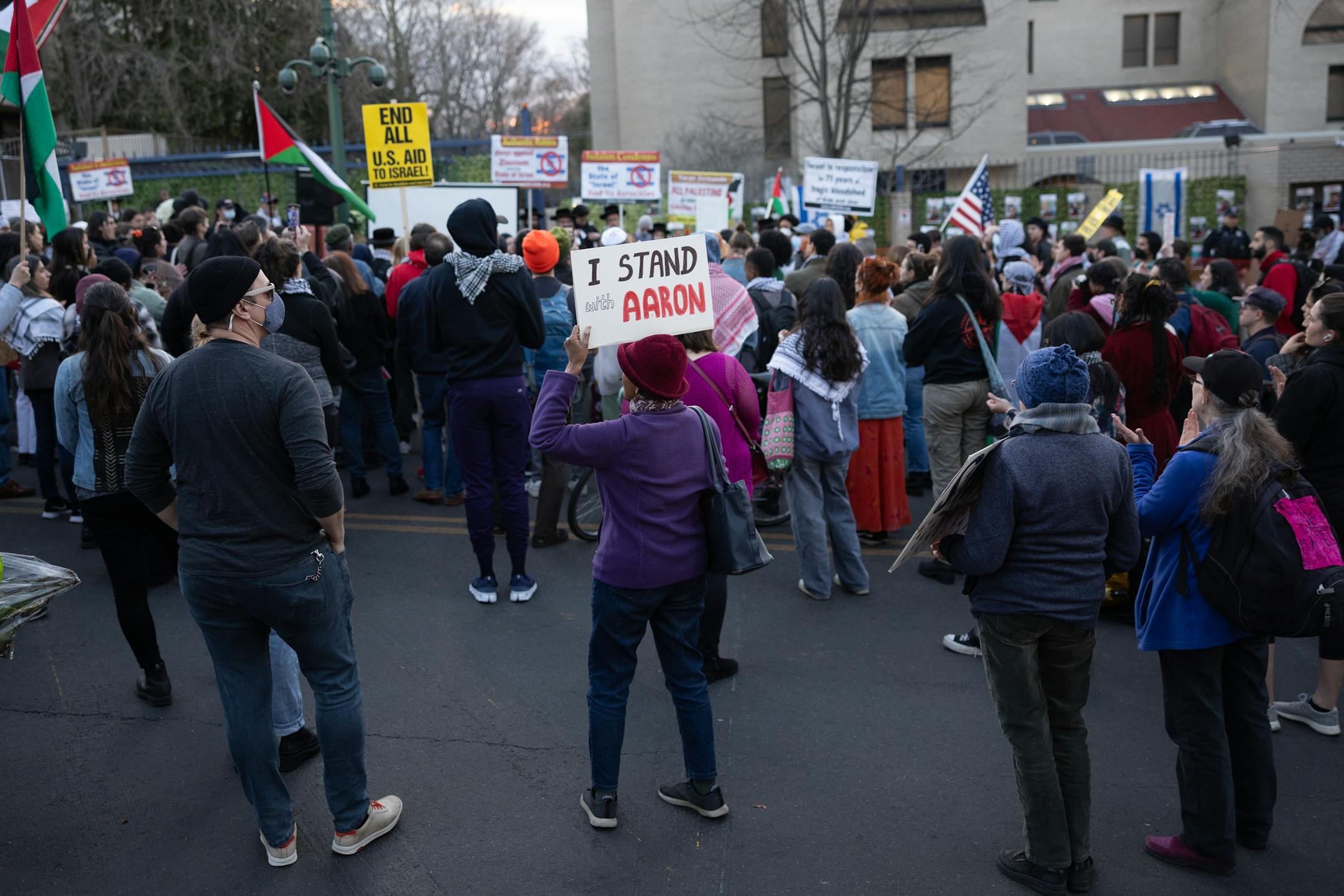
It’s harrowing to watch a human being set himself on fire, stand up as long as possible, then collapse into a heap. That’s what Aaron Bushnell, a young member of the U.S. Air Force, did last weekend, when he torched himself in front of the Israeli embassy in Washington, D.C., and later died. He was protesting what he had earlier called Israel’s “genocide” in the Gaza Strip. “Free Palestine,” he tried to yell out from the fireball, until it silenced him.
That conflict in the Middle East may also consume the re-election campaign of President Joe Biden. As this week’s primary in the swing state of Michigan showed, voters whom he needs for victory in November increasingly blame him for the Israeli bombing of Gaza that Bushnell was protesting, a campaign that Biden himself has called “indiscriminate.” These voters include Arab-Americans, but also African-Americans — more than 1,000 Black pastors are pressing Biden to force Israel into a ceasefire — as well as left-leaning and youngish people in general.
The risk for Biden is that these Americans stay home on election day, not that they defect to his likely opponent, Donald Trump. Meanwhile, though, Trump’s MAGA base is pounding Biden from the other side, as not supporting Israel and its prime minister, Benjamin Netanyahu, resolutely enough. In their telling, the cause for every problem in the Middle East, and indeed the whole world, is Biden’s alleged “weakness.”
Both sides are being unfair. Viewed dispassionately, Biden’s foreign policy in the Middle East since Hamas’s terrorist attack on Oct. 7, and even before, has been far from ideal but also far from weak. Overall, he has on balance been wise.
Biden didn’t create the conflicts in the region. The enmity between the U.S. and Iran dates back 45 years, that between Israelis and Palestinians 75 years or even longer, and others (like that between Sunnis and Shias) centuries. As senator and vice president Biden was admittedly part of the Washington “blob” that allowed these problems to fester. But as commander-in-chief of the world’s most powerful country, he has done his best to get America’s grand strategy right.
Before Oct. 7, Biden was trying to arrange an accord between Israel and Saudi Arabia, meant to pacify the region gradually and to hold Iran at bay. That was supposed to allow the U.S. to reduce its presence in the Middle East and redeploy its might to Asia and the Pacific, where America’s geopolitical interests are clearer.


