

Minnesota stands to benefit from the recently passed, bipartisan infrastructure bill in a way that simply would not have been possible without federal resources.
Despite all of its own investments in recent years, the state still has more than 5,000 roads and 600 bridges badly in need of repairs and updating. There will be money for transit systems, water sewer systems and the broadband access that parts of the state have lacked for too long.
How much? Try $4.5 billion for highways alone in the next five years. Another $300 million for bridges in the same time span, along with $800 million for public transportation, $680 million for water projects and $100 million for broadband. Those are real, substantial investments that will pay dividends for years to come.
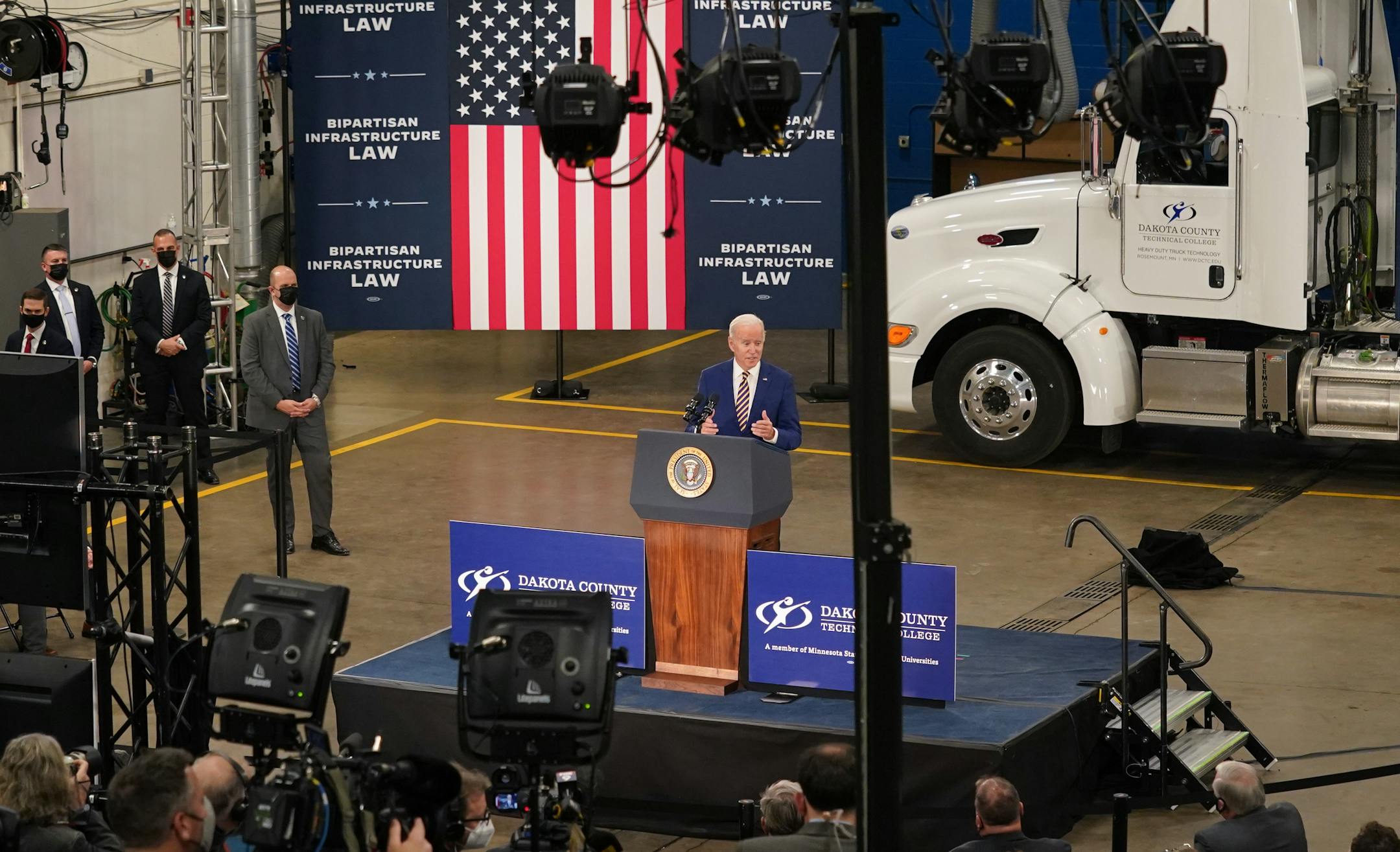
President Joe Biden visited Dakota County Technical College on Tuesday to highlight one of the largest investments in infrastructure in modern history, but also to send an urgent signal that more must be done. Both messages should be heeded.
This country has been coasting for decades on the investments made by earlier generations. Aging ports, rundown bridges, potholed roads and the lack of broadband all have hindered economic growth even in good times. Other countries, meanwhile, have been forging ahead. China in particular, Biden has said, has outpaced the U.S. for the better part of two decades on such investments.
"This has been the dream for years," Gov. Tim Walz told an editorial writer shortly before Biden's visit. "I ran [for governor] on the idea that we had to do something about aging infrastructure. But we did not have the resources necessary as a state. This speeds things up by decades.
"As someone who served on the transportation committee [in Congress], let me just say this is a really big deal. I supported the infrastructure package when [former President Donald] Trump proposed it, and I support it now. This is some of the best news we've had all the way around this year."
One of the reasons Biden chose Dakota County Technical College was to shine a light on one particular investment: training for skilled workers in trades. This is a component all too often overlooked but critical to the success of these projects. As some have put it, America also needs to invest in "human infrastructure."


