
Besieged by seaweed, Caribbean scrambles to make use of the stuff

Some entrepreneurs are turning it into animal feed, while others are adding it to construction material.

Reuters
October 2, 2021 at 1:00PM
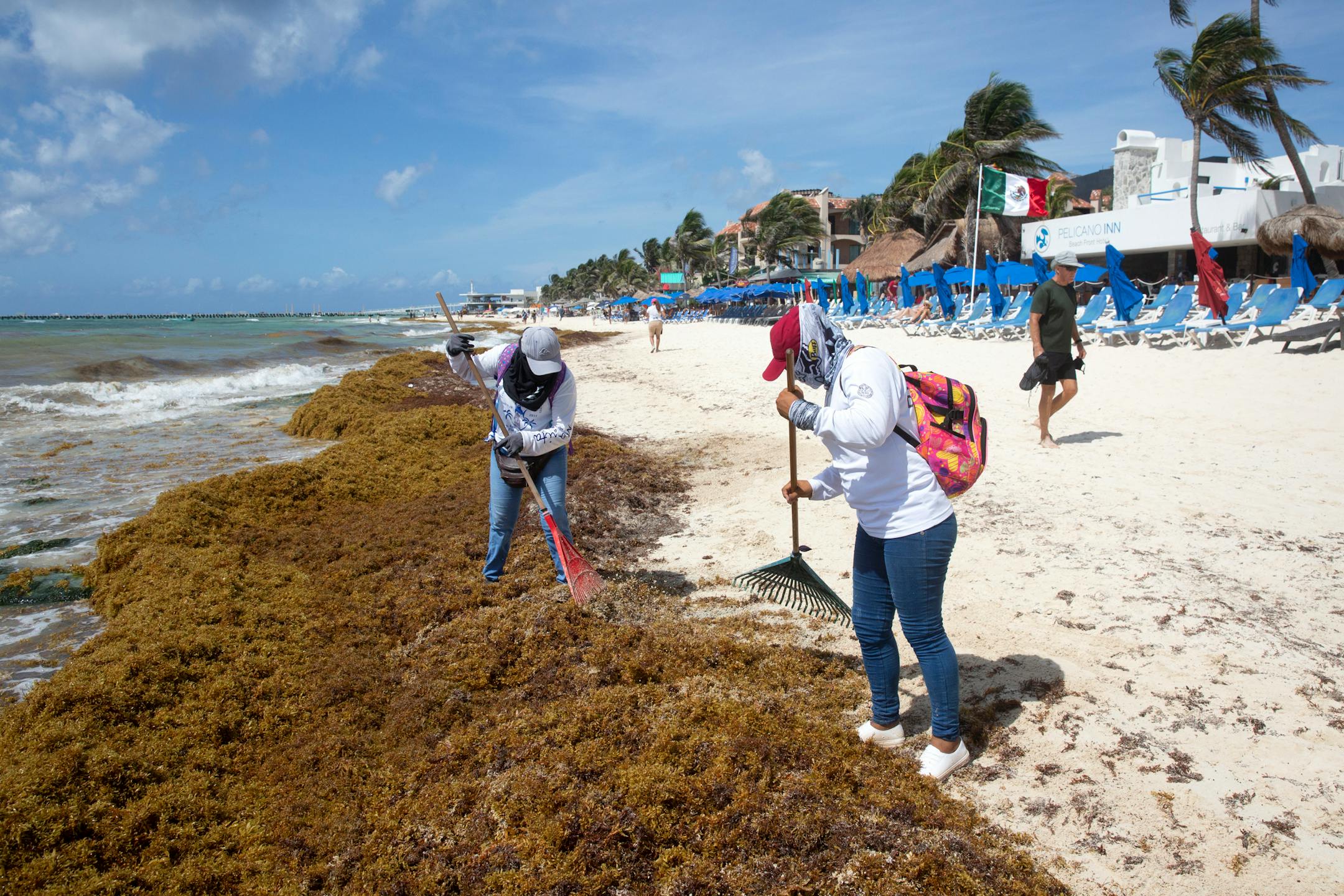
Workers remove Sargassum seaweed at a beach in Playa del Carmen, Quintana Roo state, Mexico on May 2, 2021. Sargassum—a brown seaweed that lives in the open ocean—has overwhelmed shorelines along the East Coast of the United States, Gulf of Mexico, and the Caribbean. Researchers say that the Sargassum outbreak started in 2011, but it has become worse over the years and could cause a serious environmental disaster. As the Sargassum is cleaned up on the shorelines, in a matter of days the shorelines are once again filled. When the Sargassum seaweed lands and starts to decompose, a toxic hydrogen sulfide gas is released, spreading an unpleasant odor and potentially causing adverse health effects. Apart from being an annoyance for tourists, Sargassum also affects oxygen levels in the water, brings contaminants and other microorganisms to the beach, changes the ecological balance of coral and causes beach erosion when its removed in such large quantities. There are several factors that could explain the proliferation of Sargassum in recent years. These include the rise of sea temperatures, the change of sea currents due to climate change and nutrients dumped into the ocean from farming and deforestation around the world. (Photo by Bénédicte Desrus/Sipa USA)(Sipa via AP Images)
Workers removed sargassum seaweed at a beach in Playa del Carmen, Quintana Roo state, Mexico, this summer. Sargassum—a brown seaweed that lives in the open ocean—has overwhelmed shorelines along the East Coast of the United States, Gulf of Mexico, and the Caribbean. (Sipa USA via AP/The Minnesota Star Tribune)

PUERTO MORELOS — As the sun rises in Mexico's Quintana Roo state, home to the white sandy beaches of Cancun and Tulum, Rear Admiral Alejandro Lopez Zenteno readies his sailors for another day of dragging rafts of brown seaweed to shore and out of view of cocktail-sipping tourists.

Zenteno heads the operation for the Mexican Navy, which coordinates with the state and local governments to protect an area where visitor trade was valued at more than $15 billion annually before the coronavirus pandemic hit, according to Quintana Roo's tourism secretariat.

When it washes ashore, the plant — known as sargassum — turns black and emits a sewage-like stench so powerful it has been known to make travelers ill. It attracts insects and turns the area's famed turquoise snorkeling waters a sickly brown.

And it just keeps coming. Since 2011, seaweed here and across the Caribbean has exploded for reasons scientists suspect is related to climate change but don't yet fully understand.

In Quintana Roo alone, Mexico's Navy since March has removed more than 37,000 tons of sargassum — more than the weight of three Eiffel Towers — from beaches and surrounding waters.

"We don't expect this to end anytime soon," Zenteno said onboard a seaweed-clearing ship known as a "sargacero," one of 12 deployed by the Navy.

Entrepreneurs across the region, meanwhile, are searching for ways to monetize the muck. They're experimenting with seaweed-based products including animal feed and construction material.

"Sargassum is seen as a nuisance," said Srinivasa Popuri, an environmental scientist in Barbados with the University of the West Indies. He views the Caribbean as "blessed" with a resource that grows naturally and requires no land or other inputs to flourish.

Popuri is working on extracting substances from seaweed that could have applications for the pharmaceutical, medical and food industries.

Whether such efforts prove viable remains to be seen. Commercializing seaweed can be challenging given the expense of collecting it.

One of the biggest potential uses lies in demand for so-called alginates, a biomaterial extracted from brown seaweed, which is a common ingredient in food thickeners, wound care and waterproofing agents for its gel-like properties.

The global market in 2020 was worth almost $610 million, a figure that's expected to grow to $755 million by 2027, according to consulting firm Global Market Insights.

Omar Vazquez, meanwhile, is building houses.

Vazquez, a nursery owner in the seaside town of Puerto Morelos near Cancun, for several years had used sargassum as a fertilizer. In 2018, he came up with the idea of turning it into a construction material. He said the resulting sargassum "bricks," baked in the sun, allow him to build a house 60% more cheaply than if he were to use traditional cement blocks.

Now dubbed "Señor Sargazo" by his neighbors, Vazquez said he has built and donated 10 such houses to local families in need. He hopes to turn his now-patented "Sargablock" material into a for-profit franchise.

"Everyone was complaining that sargassum was stinky, sargassum is a problem. What I did was find a solution for it," said Vazquez, 45, showing Reuters around "Casa Angelita," the first house he built with seaweed and which he named for his mother.

Still other efforts are waiting on scientific testing for safety. In Jamaica, entrepreneur Daveian Morrison is building a processing plant to scale up his experiments, including turning seaweed into charcoal for people to burn in lieu of firewood.

He said his recipe for animal feed made from the protein-rich plant proved a hit at a local goat farm, but it needs more testing to ensure the seaweed doesn't contain dangerous levels of arsenic or other harmful substances.

about the writer

about the writer

Cassandra Garrison

More from Agriculture

See More
card image
Renée Jones Schneider/The Minnesota Star Tribune

President Donald Trump unveiled an $11 billion bailout earlier this week. The aid package might not be enough to make up for farming losses.

card image
card image