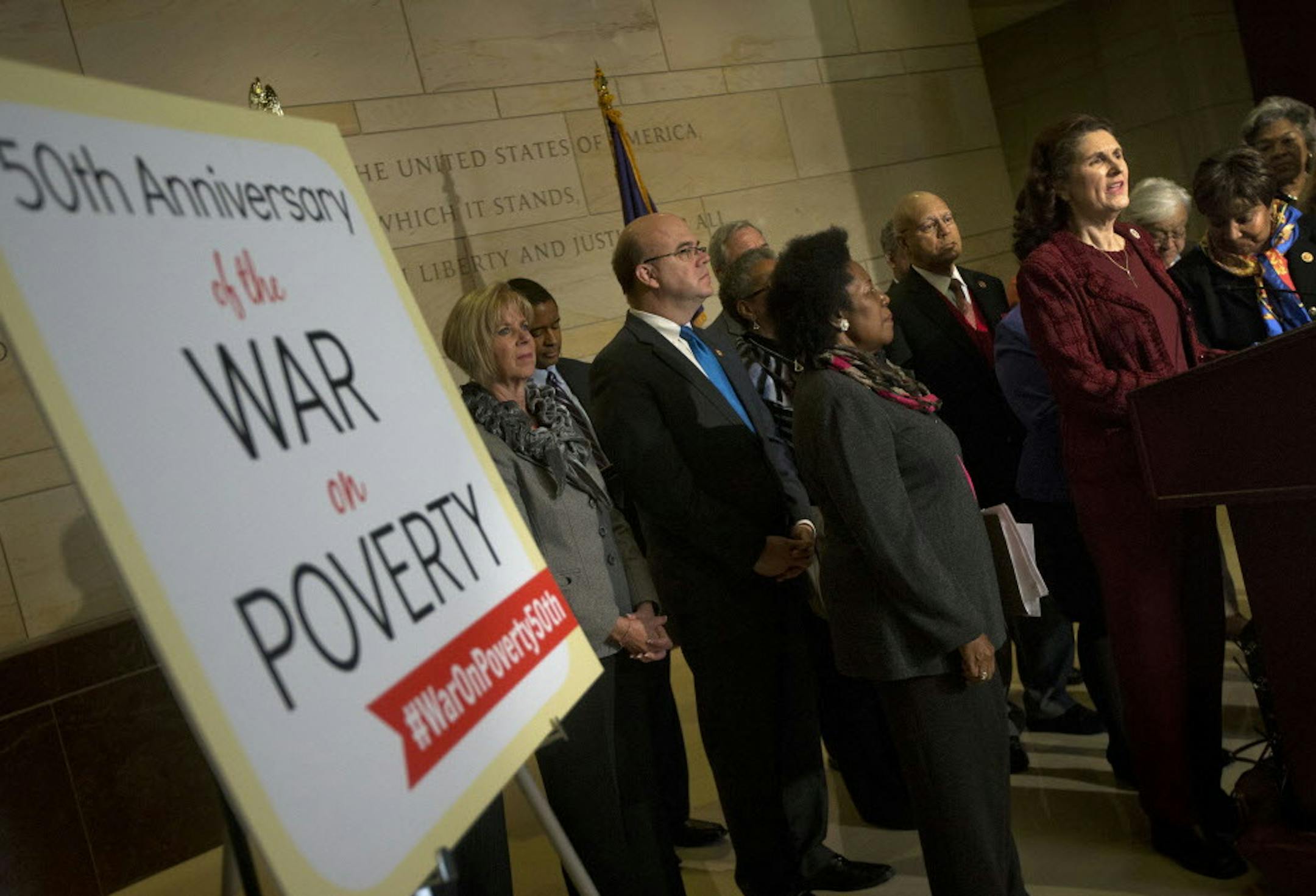
Fifty years after President Lyndon Johnson's "War on Poverty," the issue is still with us. Some say LBJ's programs didn't work. Others say they did work, but were abandoned. Today's debate is now supplemented by the emerging issue of income inequality. Citizens, both here and in other countries, yearn for a more generally prosperous world. However, our discussions are so partisan and devoid of sufficient reflection that neither political rhetoric nor advocated policies are likely to reduce poverty. Here are some facts we should consider.
Most economic studies indicate that the year 1978 initiated a long, gradual decline in real wages. The U.S. economy has created about 47 million additional jobs since, but it is not clear that our employment additions are aimed at providing opportunities for those who need it most.
Since 1978, we have 8 million more jobs in trade and transportation, 7 million more in education and health care, 3 million more in finance, 8 million more in leisure and hospitality, 6 million more in government, and about 15 million in other services. During the same time, we have 1.3 million fewer people in agriculture, a small gain in construction, and 7.3 million fewer people in manufacturing. Our hiring is out of balance.
Which of our expanding activities are aimed at reducing poverty? We have lots of casinos. Do casinos reduce poverty? We allow bridges to decay, but we are rapidly constructing lavish sports facilities at taxpayers expense. Do stadiums reduce poverty? We are just beginning to crawl out of the deepest financial crisis in several decades. Did the 3.2 million additional people in finance help to reduce poverty? The U.S. now has mushrooming video game and electronic gadget industries. Are these devices preparing people for meaningful participation in an increasingly competitive world economy?
Manufacturing has historically been particularly important to the reduction of poverty for two reasons. It has provided a large fraction of American jobs — more than 30 percent in the 1960s (now it is 8.8 percent). It has provided opportunities for young people to get a meaningful first job.
The reduction of poverty is made more difficult by the fact that poverty and job opportunities are in different places geographically. Industrial employment has been rapidly shrinking in core cities across the nation and with that decline, poverty has grown. Metropolitan counties with more than 100,000 manufacturing employees in 1998 lost 40 percent of them by 2011.
Poverty rates display the differences between core cities and healthier medium-sized towns. The poverty rates of people under the age of nineteen is about 31 percent in both Minneapolis and St. Paul. Cleveland's rate is 53 percent, St. Louis 43 percent and Youngstown, Ohio, is 63.5 percent. Meanwhile, St. Cloud, Fargo, Cedar Rapids, Iowa, and Appleton, Wis., all are 16 percent or below.
Too often, political rhetoric regarding poverty centers around possible changes in taxation — and maybe our antiquated tax code should be changed. Butif we really want to reduce poverty, we have to take more meaningful steps.