
As wireless price war continues, carriers warn of lower profits

Customers are shopping around to take advantage of increased competition.

Los Angeles Times
December 13, 2014 at 3:53AM
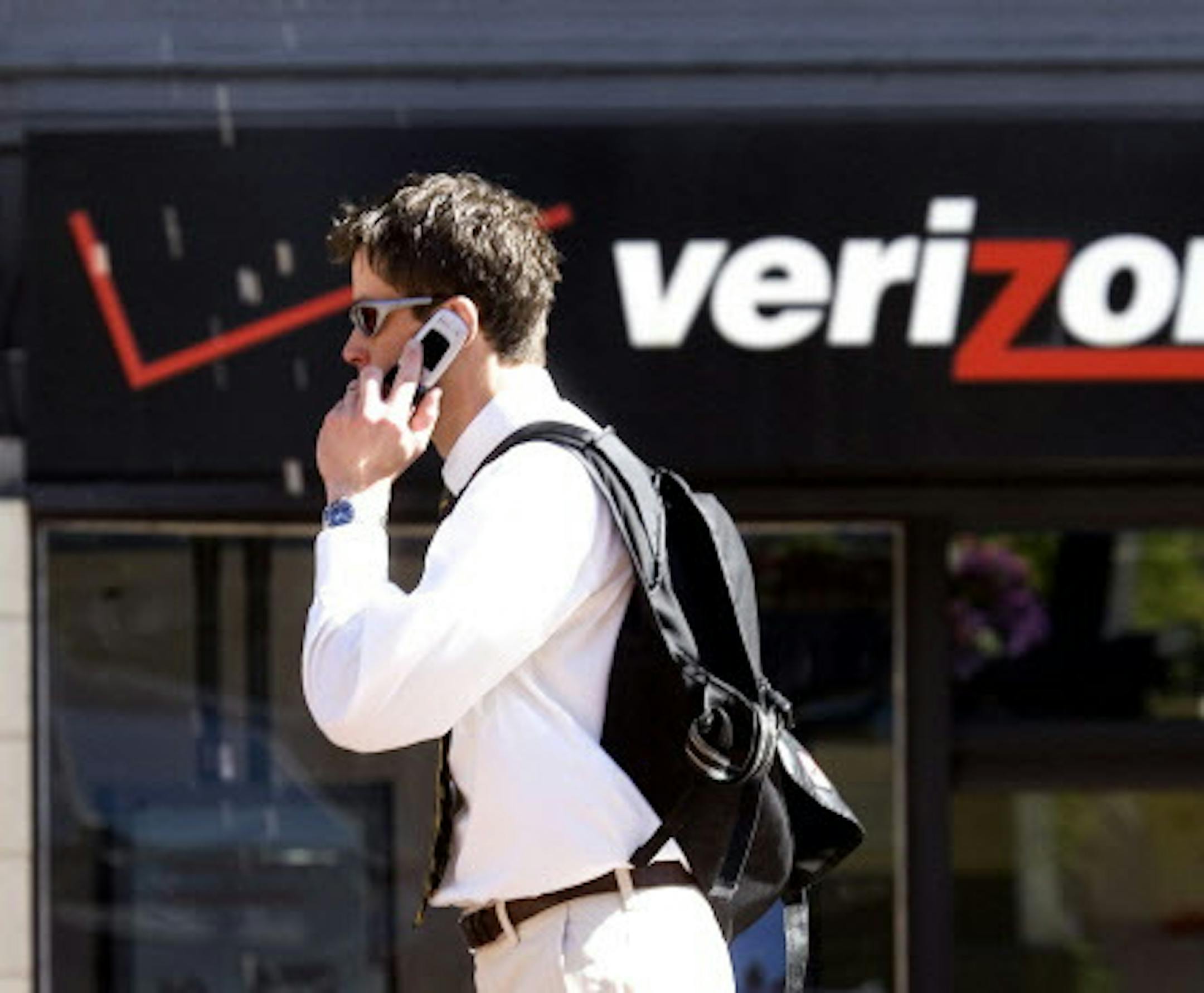
FILE - A Monday, July 28, 2008 photo from files showing Eric Roden speaking on his cell phone as he walks past a Verizon store in Portland, Ore., Britain's Vodafone PLC, one of the world's largest mobile phone companies, confirmed Thursday that it was in discussions with Verizon Communications to sell its operations in the United States. The British wireless provider is mulling its options for its 45 percent stake in the U.S.'s Verizon Wireless, of which Verizon Communications owns the other 55
Verizon Wireless warned last week that fourth-quarter profits probably would take a hit because it had to keep up with discount pricing. (The Minnesota Star Tribune)

Verizon Wireless once promised customers an unrivaled network with clear calls and fast downloads in exchange for expensive cellphone service.

But no longer. With network improvements industrywide, a price war is breaking out.

Verizon Wireless and AT&T Inc. warned separately last week that their fourth-quarter profits probably would take a hit because they had to keep up with discount pricing in an increasingly competitive market in the last year.

For the first time in recent years, industry analysts said, many customers have strong options. Verizon Wireless, the nation's largest carrier by customers, is feeling the heat because of revamped networks at Sprint Corp. and AT&T Inc. and an expanding list of unlimited packages at T-Mobile.

Though customers are still coming through Verizon's doors at a good pace, they're paying less because of such promotional offers as a $150 credit for every smartphone line switched to Verizon. It's a dynamic that "will put short-term pressure" on profit margins and earnings per share, Verizon said.

"The question now is, 'Is Verizon going to risk losing business or keep following the crowd?' " said telecommunications industry analyst Jeff Kagan. "We're watching the wireless industry transform itself because No. 1 right now is customers want to pay less for service."

The shift began about 20 months ago when T-Mobile began discarding two-year contracts, eliminating the subsidies of several hundred dollars for new phones and offering customers the ability to pay for devices in monthly installments.

The aggressive tactics continued into this year. T-Mobile sharply reduced the price of international plans and allowed music streaming that would not count against data usage.

On Tuesday, T-Mobile said it would reduce the price of a two-line plan with unlimited calling, texting and data to $100, from $140. Each additional line costs $40, meaning a family of four would save 50 percent compared with a comparable Verizon plan, according to T-Mobile.

The company also restored a previously offered deal of $100 for four lines with 10 gigabytes of data a month and unlimited calling and texting.

T-Mobile's so-called uncarrier effort has pushed it close to overtaking Sprint as the nation's third-biggest cellular service provider. Even though T-Mobile's service might be spotty in some areas, boisterous Chief Executive John Legere has won the marketing and pricing games, analyst Kagan said.

Both AT&T and Sprint have rolled out their own offers this year to keep pace.

AT&T CFO John Stephens warned Tuesday that AT&T would see an uptick in the percentage of customers leaving its network this quarter. Between the customer losses and the promotions to new ones, margins will be down, he said.

Apple thrives

Stephens also pointed to the latest iPhone as adding to the competition. In September, Apple Inc. launched the iPhone 6 on all four carriers for the first time. Despite the pressures, he said, profit margins for the entire year will be comparable or better than last year.

"In all this noise, in all these promotional offers and all this stuff going on, we're having one of our best years for churn," Stephens said at a UBS-hosted conference.

Customers are seeing through all the headlines and finding unacceptable details in the promotions, Stephens said. Having a broad and fast network coverage will be the ultimate thing that wins over customers, he said.

Verizon social media workers are making similar pleas. They've jumped into ­Twitter conversations to hold on to customers who post online about their desire to switch to deals with other carriers.

Sprint regional Vice President Kevin Kunkel said his company is counting on a combination of an improved network, especially in Southern California, and good pricing to attract customers. Last weekend, Sprint began offering to cut service charges in half for customers switching from AT&T and Verizon.

'Rumble with the big guys'

"We wanted to rumble with the big guys," Kunkel said. "It's the boldest statement we've made that Sprint is the best place to be in this super-competitive marketplace."

The deal has drawn scorn from customers annoyed that they have to buy new phones from Sprint to take advantage of the offer. And T-Mobile's Legere blasted Sprint for not making a similar deal available to existing customers.

"That makes my head spin, and it's exactly the kind of B.S. we're on a mission to end," Legere said.

Meanwhile, Sprint said it could offer 20 gigabytes, or double T-Mobile's new deal, for $100 on a four-line plan.

Analysts worried that the escalating price competition would hurt customers in the long run if it limits the investment that service providers can inject into network upgrades. The providers said that shouldn't be a problem for now, though costs for new signal space are exceeding expectations.

At the end of June, Verizon Wireless controlled 34.4 percent of the U.S. wireless market, followed by AT&T with 32.6 percent, Sprint with 14.7 percent and T-Mobile with 14.2 percent, according to equity research firm Oppenheimer & Co.

FILE - In this June 5, 2013, file photo, people use cellphones in downtown San Francisco. San Francisco's top prosecutor said Monday, Nov. 18, 2013, that Samsung Electronics, the world's largest mobile phone manufacturer, has proposed making a "kill switch" that would render stolen or lost phones inoperable a standard feature, but the nation's biggest carriers have rejected the idea. District Attorney George Gascon says AT&T, Verizon Wireless, US Cellular, Sprint and T-Mobile rebuffed Samsung's
The wireless price war has prompted analysts to warn that falling profits could hurt customers. (The Minnesota Star Tribune)
about the writer

about the writer

Paresh Dave

More from Business

See More
card image
Fairview Health Services

The school is changing an elective course while still working with the Eden Prairie-based health care giant after students raised concerns.

This transmission electron microscope image shows SARS-CoV-2, the virus that causes COVID-19, isolated from a patient in the U.S., emerging from the surface of cells cultured in the lab. (NIAID/TNS) ORG XMIT: 1659810
card image