

In October 2011, Ibrahim Al-Hajiby, a Yemeni student studying at Augsburg College, was far from home as his nation underwent its version of the Arab Spring.
But like many abroad during those heady days, he was still deeply involved.
Al-Hajiby used social media to spur Yemen's social revolution. And when he wasn't in front of a screen, Al-Hajiby was on the street. He took part in a 24-hour "Silence is a War Crime" demonstration. Asleep on the concrete steps of Augsburg's Christensen Center, he was awakened by a friend who informed him his countrywoman, Tawakkol Karman, was one of three women who had just been awarded the Nobel Peace Prize.
"I thought I was dreaming," said Al-Hajiby, who certainly wasn't silent in his celebration.
He also wasn't dreaming. The nightmarish rule of former President Ali Abdullah Saleh would eventually end, in part due to dissidents like Karman, of whom the Norwegian Nobel Committee said, "In the most trying circumstances, both before and during the 'Arab Spring,' Tawakkol Karman has played a leading part in the struggle for women's rights and for democracy and peace in Yemen."
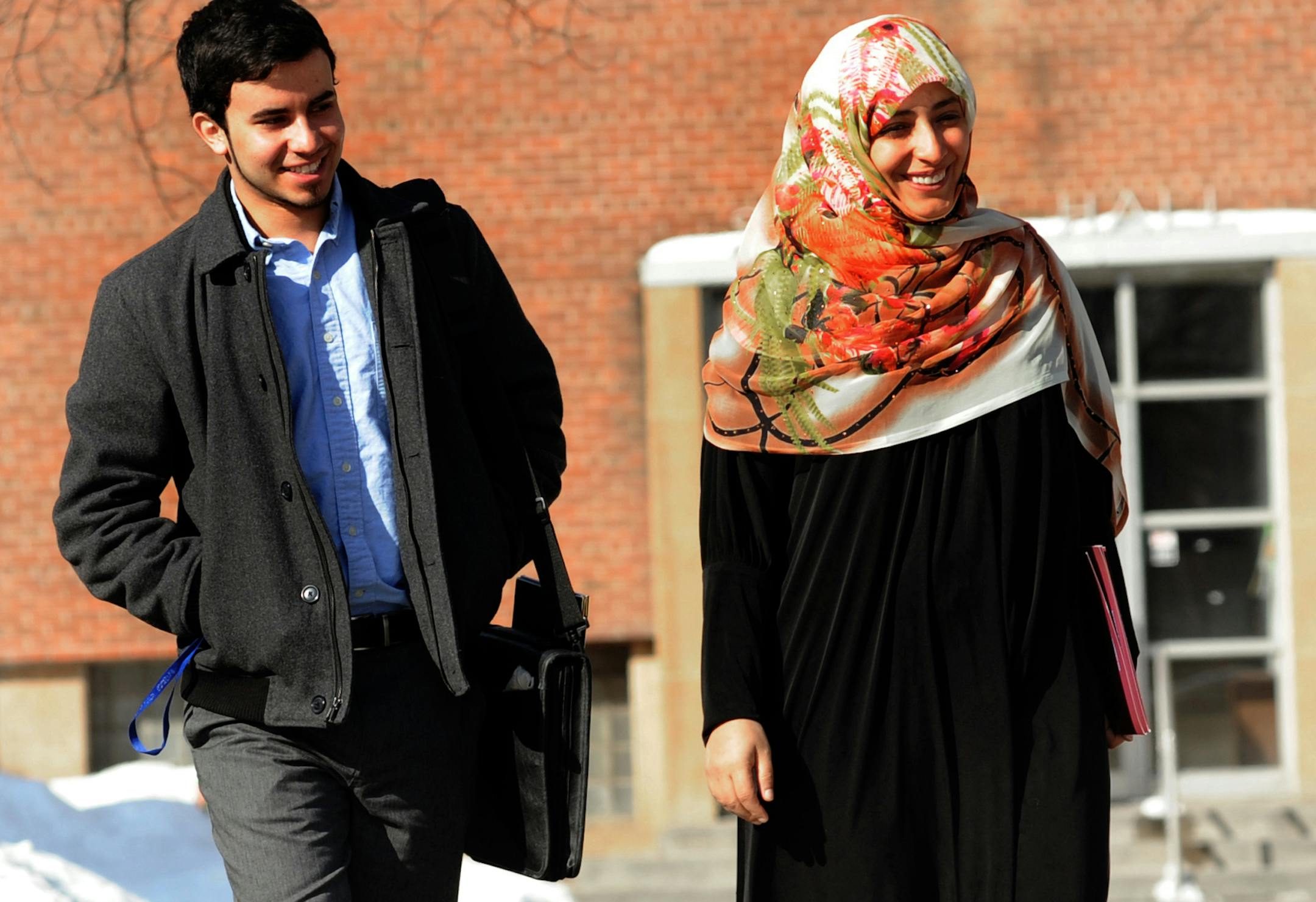
Back at the Christensen Center on Thursday, Al-Hajiby was vocal once again, but this time he was translating for Karman during an interview in advance of her keynote address at Sunday's Nobel Peace Prize Forum at Augsburg.
Being named a Nobel Laureate "brought a lot of meaning not only to Yemen, but to the whole Arab Spring and to all the nations that seek equality and freedom and dignity," said Karman, who added that the prize amplified her advocacy. "The Nobel Peace Prize didn't give me the leadership role in Yemen; it added value to make my voice very strong and to be more effective outside Yemen."
And voices outside Yemen, like Al-Hajiby's, were heard back home, Karman said. "The role of students, youth, outside Yemen — it was important and very strong, because they did great work in convincing the international community in their countries to support the revolution."


