
An overdue distress call for America's ports

Even without current stressors, our ports aren't efficient.

November 4, 2021 at 10:25PM
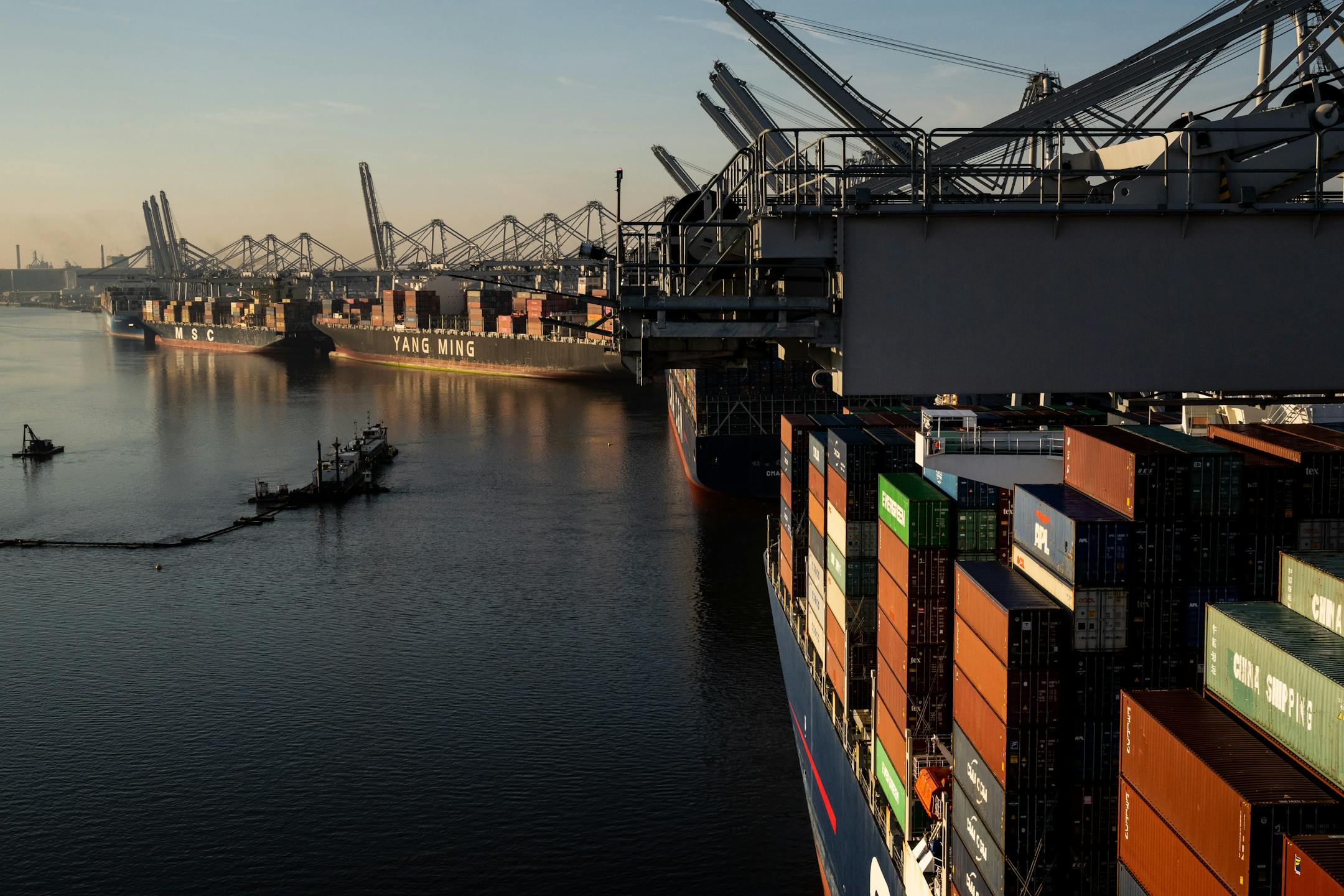
Ships loaded with containers at the Port of Savannah, which is running out of places to put a pileup of nearly 80,000 of them, in Savannah, Ga., Sept. 30. (ERIN SCHAFF, New York Times/The Minnesota Star Tribune)

The vivid news images we're seeing of dozens of container ships sitting in the Pacific Ocean outside the ports of Los Angeles and Long Beach, waiting to unload, shouldn't have come as a complete surprise. In global rankings, U.S. ports do very poorly.

The World Bank and IHS Markit published the Container Port Performance Index 2020 earlier this year (available with free registration at tinyurl.com/2pshtdye). It is the first effort to offer a systematic ranking of performance for 351 ports around the world. The report uses two methods to rank ports, one based on expert opinion and one based on data about unloading, but the results across these methods are similar. The report notes:

"The top ranked container ports in the CPPI 2020 are Yokohama port [Japan], in first place, followed by King Abdullah port [Saudi Arabia] in second place. … The top 50 ranked ports are dominated by ports in East Asia, with ports in the Middle East and North Africa region, such as King Abdullah port, Salalah in Oman, Khalifa port in Abu Dhabi, and Tanger Med as the notable exceptions. Algeciras is the highest ranked port in Europe … with Halifax the highest ranked port in North America."

The reader will notice that no U.S. ports are mentioned in the top 50, and the top-ranked North American port is located in Canada.

Here are rankings of some major U.S. ports according to the statistical measure of how long it takes ships to unload — adjusting for the size and type of ship — out of the 351 ports around the world. The main West Coast U.S. ports are Los Angeles (No. 328), Oakland (332), Long Beach (333), and Tacoma (335). The main U.S. East Coast ports are New York and New Jersey (89), Savannah (279), Port of Virginia (85), and Charleston (95). The main U.S. Gulf of Mexico port is Houston (266).

Inefficient ports matter. As the report was noting back in May, before supply chain woes had become headline news:

"Maritime transport is the backbone of globalized trade and the manufacturing supply chain, with more than four-fifths of global merchandise trade (by volume) carried by sea. The maritime sector offers the most economical, energy efficient, and reliable mode of transportation over long distances. …

"Unfortunately, ports and terminals, particularly for containers, can often be sources of shipment delays, supply chain disruption, additional costs, and reduced competitiveness. Poorly performing ports are characterized by limitations in spatial and operating efficiency, limitations in maritime and landside access, inadequate oversight, and poor coordination between the public agencies involved. … Instead of facilitating trade, the port increases the cost of imports and exports, reduces the competitiveness of its host country. …"

While much of the discussion of U.S. ports focuses on international trade, these issues affect within-U.S. trade as well. Substantial U.S. flows of goods could be shipped by water up and down the East Coast, the West Coast, or in and out of the Gulf of Mexico. But that potential ocean-based shipping is greatly hindered by costly and inefficient ports, so those goods travel overland by truck and rail instead.

The World Bank/IHS Markit report just offers a ranking — it doesn't seek underlying explanations for the poor performance of U.S. ports. I haven't made a deep study of this subject, but there are surely several main contributing factors.

First, in most recessions, consumption of services doesn't move much, while consumption of goods drops fairly sharply and then rebounds over time. But in the pandemic, U.S. consumption of services dropped substantially, and has recovered only slowly, while consumption of goods, after a brief drop, soared much higher. Americans consuming more goods means more ships arriving at U.S. ports.

Second, benefits of more efficient ports are spread across the logistics system, with lower costs for all the carriers hooked into ports and ultimately lower costs for producers and consumers. But if those who run the ports go through the time and trouble of updating its capacities and running it as efficiently as possible, they receive only a mild share of any benefits generated — and thus have only mild incentives to make such an effort.

Third, the Jones Act is a century-old law which requires that water transportation of cargo between U.S. ports is limited to ships that are U.S.-owned, U.S.-crewed, U.S.-registered, and U.S.-built. The goal of the law was to protect U.S. shipbuilders from foreign competition. The result has been that it costs far more to build ships in the U.S. than anywhere else, and ships that are U.S.-owned, -crewed and -registered have much higher shipping costs. In other words, it's not just in its ports where the efficiency of U.S. shipping has fallen far behind.

Fourth, the International Longshore and Warehouse Union is the famously militant union representing port workers on the West Coast. The union has done a fabulous job of negotiating high pay and benefits for its workers, and in that sense, I say more power to it. But the union has also been able to pass along these higher costs along the supply chain, while making it harder to update the efficiency of the low-ranking West Coast U.S. ports in particular.

Finally, accumulated disruptions from the pandemic make everything worse.

The poor performance of major U.S. ports has been imposing largely unseen costs on the U.S. economy for years. The visuals of container ships floating offshore merely make those costs apparent to the naked eye.

Timothy Taylor is managing editor of the Journal of Economic Perspectives, based at Macalester College. He blogs at conversableeconomist.wordpress.com.

about the writer

about the writer

Timothy Taylor

More from Commentaries

See More
card image
Alex Kormann/The Minnesota Star Tribune

Instructors taught us that the facts on the left side of the equation — the person with a gun, the escaping felon in a car, the person running into a home or away from the agents — did not always equate to an authorized use.

card image
card image