

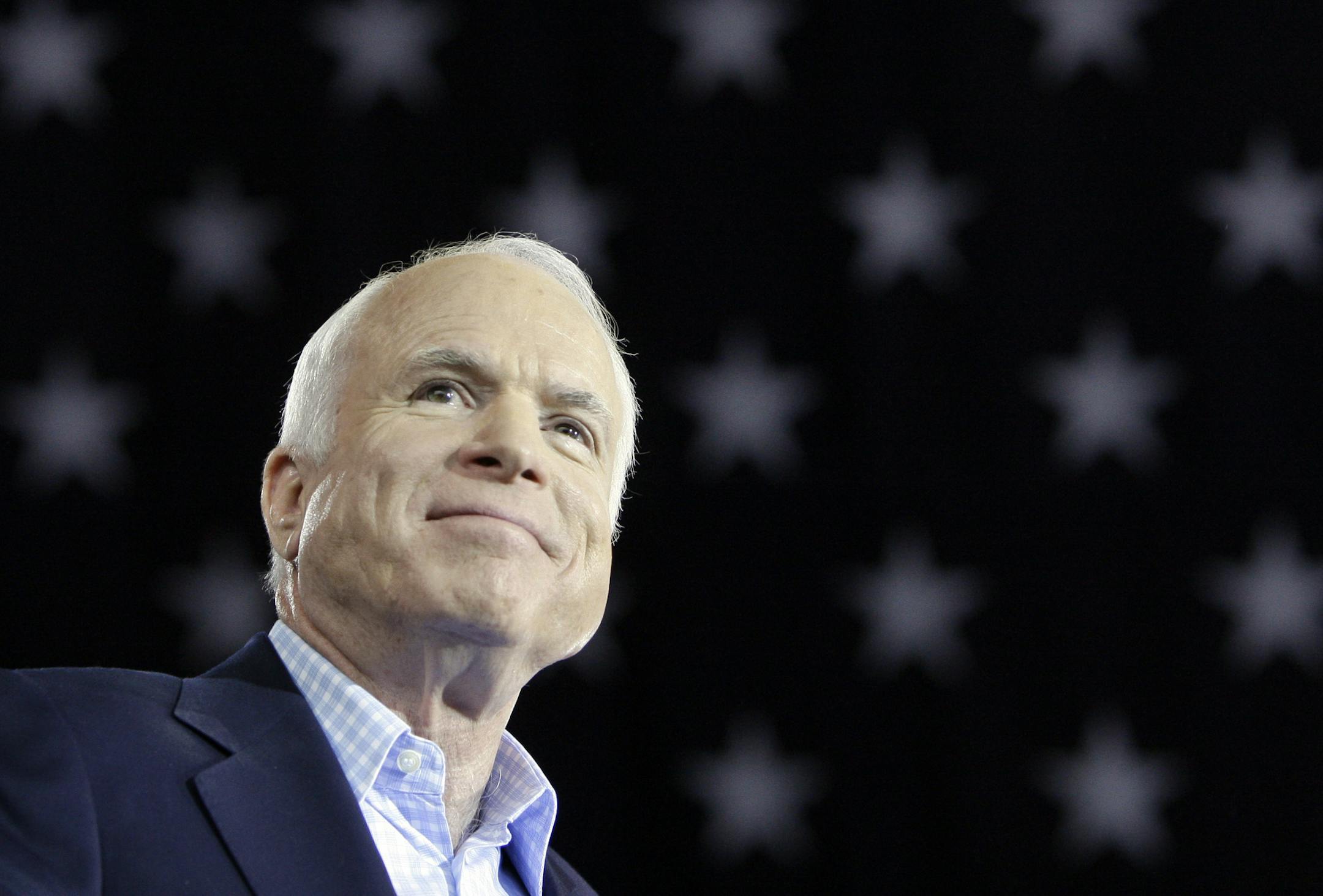
If there was ever a time and a place where the voice of John McCain was missing from Congress, this is it — at the intersection of an impeachment, an election and a constitutional crisis.
The late Arizona Republican was one of the few members famously ready and willing to stand on a political island if he thought it was the right thing to do. So it's easy to imagine him waiting in the well of the Senate to flash a thumbs-up or a thumbs-down on the fate of President Donald Trump, with cable pundits everywhere holding their breath until he did.
But more importantly, McCain was also the foremost expert and advocate in Congress for Ukraine, the country that served as the backdrop for the events that have led Trump to the doorstep of his own impeachment. Why is that important? Because there's no way that Rudy Giuliani could have marauded so freely in Ukraine or that Trump could have pulled the ambassador in Kiev with less than two hours notice or that the Office of Management and Budget and Mick Mulvaney could have withheld vital aid for Ukrainian troops as they did without the senator from Arizona making it known to the world. Loudly.
To understand how important McCain was in Ukraine before he died, you only need to know that there are multiple roads in the country named "John McCain Street," including one in Kiev (voted by its City Council). Another is in Krymske, a small town on the front lines of the war against Russia. Lacking the resources for a new street sign, Nolan Peterson from the Daily Signal described a day in Krymske in 2015 when Ukrainian troops taped a printed-out sheet of paper with McCain's picture on it to a power pole next to the road to make it official.
When McCain died in 2018, the editor of the Kiev Post described him as beloved in a country in search of champions and heroes: "When Ukraine faced some of its darkest and most dangerous times, it was often not the voice of a Ukrainian politician who lifted the spirits of the nation. It was the voice of U.S. Sen. John McCain."
A fierce advocate, McCain's commitment to Ukraine was equally well-known in the Senate, where he drafted legislation, pushed for funding and led CODELS to the country with more junior senators to focus their attention on the region. When Russia invaded Ukraine in 2014, McCain demanded sanctions to punish Moscow. He visited troops on the front lines. He led the push for money to strengthen its economy and eventually succeeded in authorizing funds to arm Ukrainian troops with lethal weapons to fight Russian President Vladimir Putin's army.
"I started working for him in April of 2004, and he called me in right away and said, 'We've got to plan a trip, a CODEL, this summer.' And he said we should go to Ukraine," Rich Fontaine, the CEO of the Center for a New American Security and a top foreign policy adviser to McCain, said a few weeks ago.
Fontaine described McCain's commitment to the country as partially driven by what he saw as America's responsibility to help fledgling democracies govern themselves. Even more important, he viewed Putin's Russia as an existential threat to Western democracy.


