

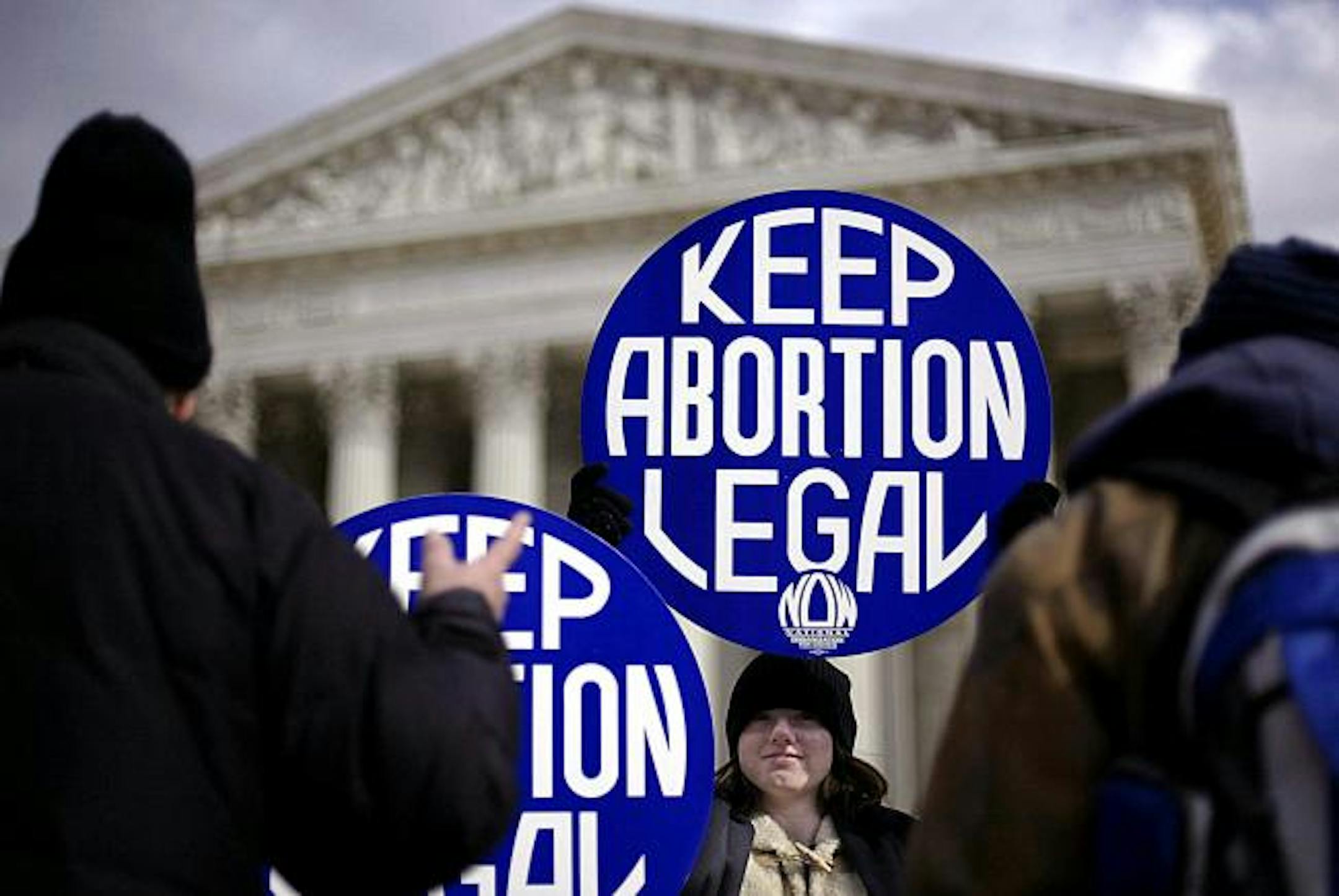
It was 40 years ago this month that the U.S. Supreme Court legalized abortion in the historic Roe vs. Wade decision. This landmark ruling affirmed that the constitutionally protected right to privacy includes every woman's ability to make her own personal medical decisions, without the interference of politicians.
Four decades later, a majority of Americans still agree with the high court: Personal health care decisions should be left up to a woman.
In poll after poll, the majority of Americans support access to safe and legal abortion in some or most cases. A Quinnipiac poll taken in February 2012 found that nearly two-thirds of American voters support Roe vs. Wade, with a mere 31 percent disagreeing with the historic court decision. In addition, a postelection poll from the Pew Research Center found that 64 percent of voters younger than 30 think abortion should be legal in all or most cases.
But interestingly, the way people identify with the issue has shifted over the years. No longer do labels like "prochoice" and "prolife" reflect the way people think about abortion. The fact is, generations of Americans -- across party lines -- understand that it's just not that simple.
Abortion is deeply personal, often complex, and not something that can be put squarely in a "pro" or "anti" box. Indeed, the number of Americans who support access to safe and legal abortion is consistently higher than those who identify as "prochoice." And many Americans self-identify as both "prochoice" and "prolife," or neither.
What unites people -- and what doesn't need a label -- is the shared belief that politicians should not interfere in a woman's personal decision about her pregnancy. And an underlying principle to such a complex decision is that none of us can understand a woman's specific situation. We don't walk in her shoes.
Undoubtedly, voters made it clear this year that they are opposed to policies that demean and dismiss women. In November's election, voters rejected some of the nation's most vocal and extreme opponents of safe and legal abortion. Yet, despite the outcome of the election, we continue to fight politicians who are intent on banning or chipping away at abortion access.
In state after state, legislators have put forward bills that seek to limit a woman's ability to make her own decisions about her pregnancy. In South Dakota, for example, politicians in Pierre have spent a significant amount of time making abortion extremely limited and heavily restricted in the state -- even though South Dakotans have twice decisively voted to protect access to abortion.


