
Investigation of Alex Pretti shooting would rely on evidence beyond videos, experts say

Video footage offers a limited view and a conclusion will require a thorough, credible investigation, use-of-force experts said.

The Minnesota Star Tribune
January 26, 2026 at 6:29PM
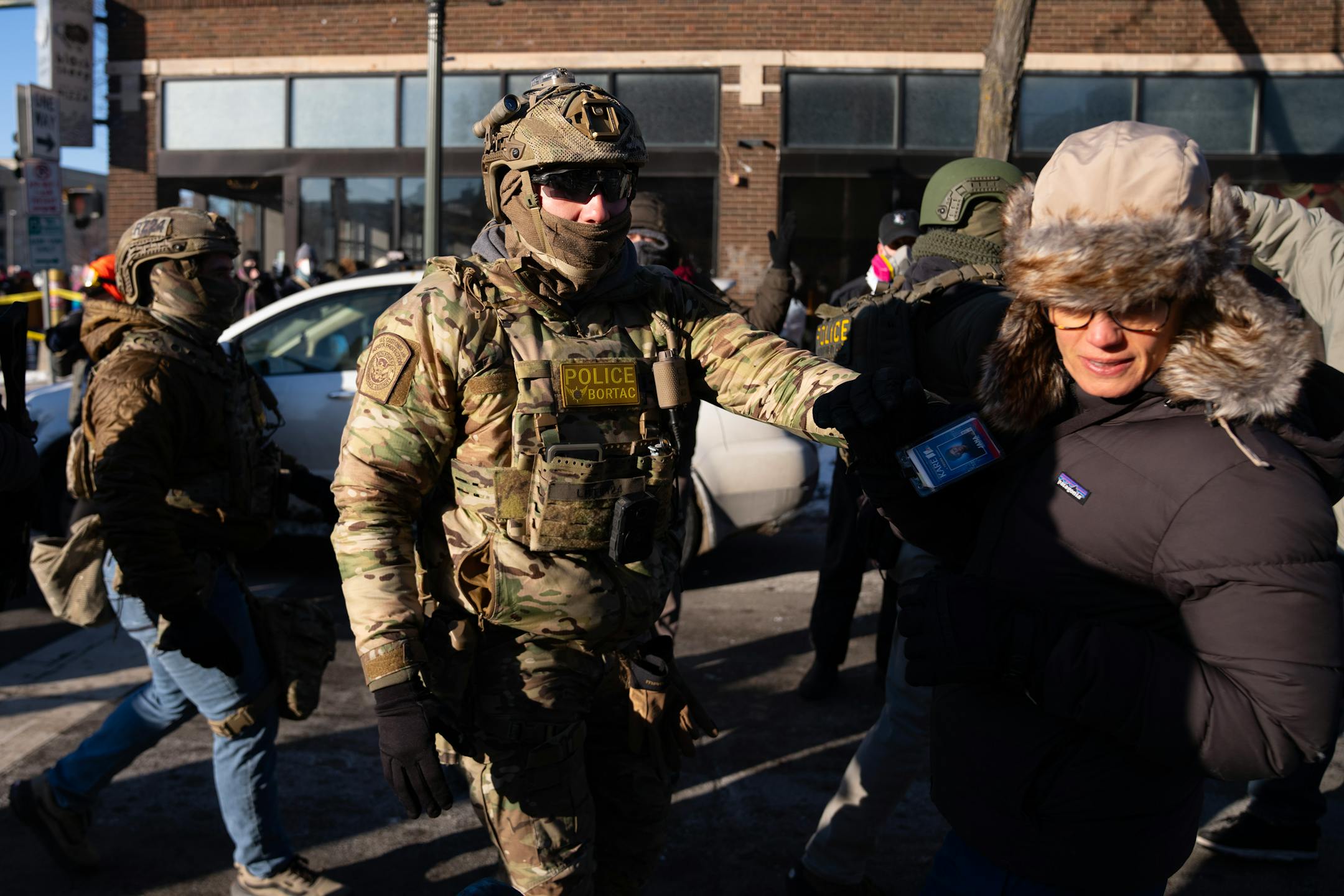
Federal agents push a woman with a KARE11 credential near the scene on Nicollet Avenue near W. 26th Street in Minneapolis on Jan. 24. Federal agents fatally shot Alex Pretti during an arrest in the morning of Jan. 24. (Alex Kormann/The Minnesota Star Tribune)

Several use-of-force experts who examined videos of the fatal shooting of Alex Pretti questioned the actions of federal agents leading up to the 37-year-old’s death on a south Minneapolis street.

But determining whether the fatal shooting of Pretti, who top officials in the federal government say was in possession of a firearm when he encountered immigration agents on Jan. 24, was justified cannot be accomplished through bystander cell phone footage alone.

Four use-of-force experts who spoke to the Minnesota Star Tribune said videos of the encounter did not definitively prove whether federal agents acted lawfully in shooting Pretti, and that it requires more investigation. That’s complicated by the growing fissure between Minnesota and federal officials over immigration enforcement in the state and their differing interpretations of what happened between Pretti and federal agents.

It is unclear whether a credible investigation is possible. Federal forces departed the scene after Pretti was killed, leaving an unsecured area where protesters descended and likely compromised evidence. Following Pretti’s death, investigators from the Minnesota Bureau of Criminal Apprehension (BCA) were physically blocked from accessing the shooting scene.

“I just wish everybody could be together and work on this and investigate it. Properly investigate it so that it gets done, and then let the public know what happened,” said Mylan Masson, a retired Minneapolis police officer and former director of police training programs.

“Let’s not hide anything,” she added.

The Department of Homeland Security (DHS) has said it would lead its own investigation into its officers’ use of force. Officials including DHS Secretary Kristi Noem labeled Pretti, an ICU nurse for the Minneapolis VA, as a domestic terrorist who approached officers while armed with the intent to inflict mass casualties, an assertion contradicted by videos and witnesses.

In addition to video footage from witnesses or body cameras, professional use-of-force experts who reconstruct police shootings rely on evidence preserved at a scene and statements from all the officers and other witnesses.

Federal authorities have been unwilling to partner with state and local law enforcement in the same manner as the fatal shooting of 37-year-old Renee Good in Minneapolis on Jan. 7. The Hennepin County Attorney’s Office and the BCA filed a lawsuit to preserve crime scene materials to be examined by local authorities. A judge granted the request.

‘A very ugly thing’

The shooting unfolded in a matter of seconds. Available videos from the scene provided no view of Pretti’s hands touching a firearm, including the Sig Sauer 9 mm pistol he was legally permitted to carry.

Federal law enforcement officers, such as those working on behalf of U.S. Border Patrol and Immigration and Customs Enforcement (ICE), are required to follow use-of-force standards that align with the civil rights provided under the Fourth Amendment to the U.S. Constitution, which prohibits unreasonable searches and seizures.

Legally justified use of force also draws on U.S. Supreme Court cases, including Graham v. Connor, which holds officers to an objectively reasonable belief standard, said Emanuel Kapelsohn, a use-of-force expert with 40 years’ experience who has testified on behalf of and against officers.

Police do not need to be correct about whether a person poses an actual threat, Kapelsohn said. An officer may use lethal force when an objectively reasonable threat to life or serious bodily harm is perceived — like a suspect pointing an unloaded firearm at a store clerk.

Kapelsohn said police shootings often draw strong reactions from people who are accustomed to seeing them only on TV or in movies.

“It’s understandable because it’s a very ugly thing to look at,” Kapelsohn said. “That doesn’t mean it might not be a necessary thing in some circumstances.”

Police tactics scrutinized

Some of the use-of-force experts who reviewed videos of the shooting were critical of the tactics employed by the federal agents, especially the first agent seen pushing two women and Pretti before the shooting.

“Their approach to policing is extremely violent, and unnecessarily so,” said John Gross, a law professor at the University of Wisconsin in Madison.

In the videos, the federal agent who shoves Pretti had aggressively pushed two other women. Pretti appears to put himself in front of one woman before being pepper-sprayed at close range. Two experts said spraying Pretti at close range goes against the recommended use of the chemical.

Masson, the retired Minneapolis officer, said effectively managing a crowd means asking people to step back, not becoming physical immediately.

“People are going to yell at you,” she said. “They’re going to blame your mother for everything. ... You don’t want to entice anything, and you don’t want to push anybody’s buttons.”

Police reform advocates have noticed a broader shift in action and tone in the past year as the most powerful law enforcement officials revive use-of-force tactics that have long been challenged, said Lauren Bonds, executive director of the National Police Accountability Project.

During the Obama administration and after the killing of George Floyd in 2020, Bonds said police departments across the country adopted more restrictive use-of-force policies and adapted new training techniques to promote safer encounters.

“We think that there’s a lot of different things that police need to be doing to de-escalate, use force more responsibly,” Bonds said. “But even the worst-trained police officers in this country aren’t doing stuff like this now. ... And I don’t say that lightly.”

The actions of federal agents during the massive Minnesota enforcement wave dubbed Operation Metro Surge are hurting citizens, Masson said. At this point, she said, even those who believed in its stated mission — to remove dangerous criminals — have lost faith.

“All they see is one woman getting murdered, another person shot, another person murdered,” she said.

“The trust is gone.”

about the writer

about the writer

Bill Lukitsch

Reporter

Bill Lukitsch is a business reporter for the Star Tribune.

See Moreicon