
After Minnesota shootings, Congress grapples with who should get extra security

The shootings prompted the U.S. Senate and House to hold briefings with lawmakers to discuss their safety.

The Minnesota Star Tribune
July 18, 2025 at 8:26PM
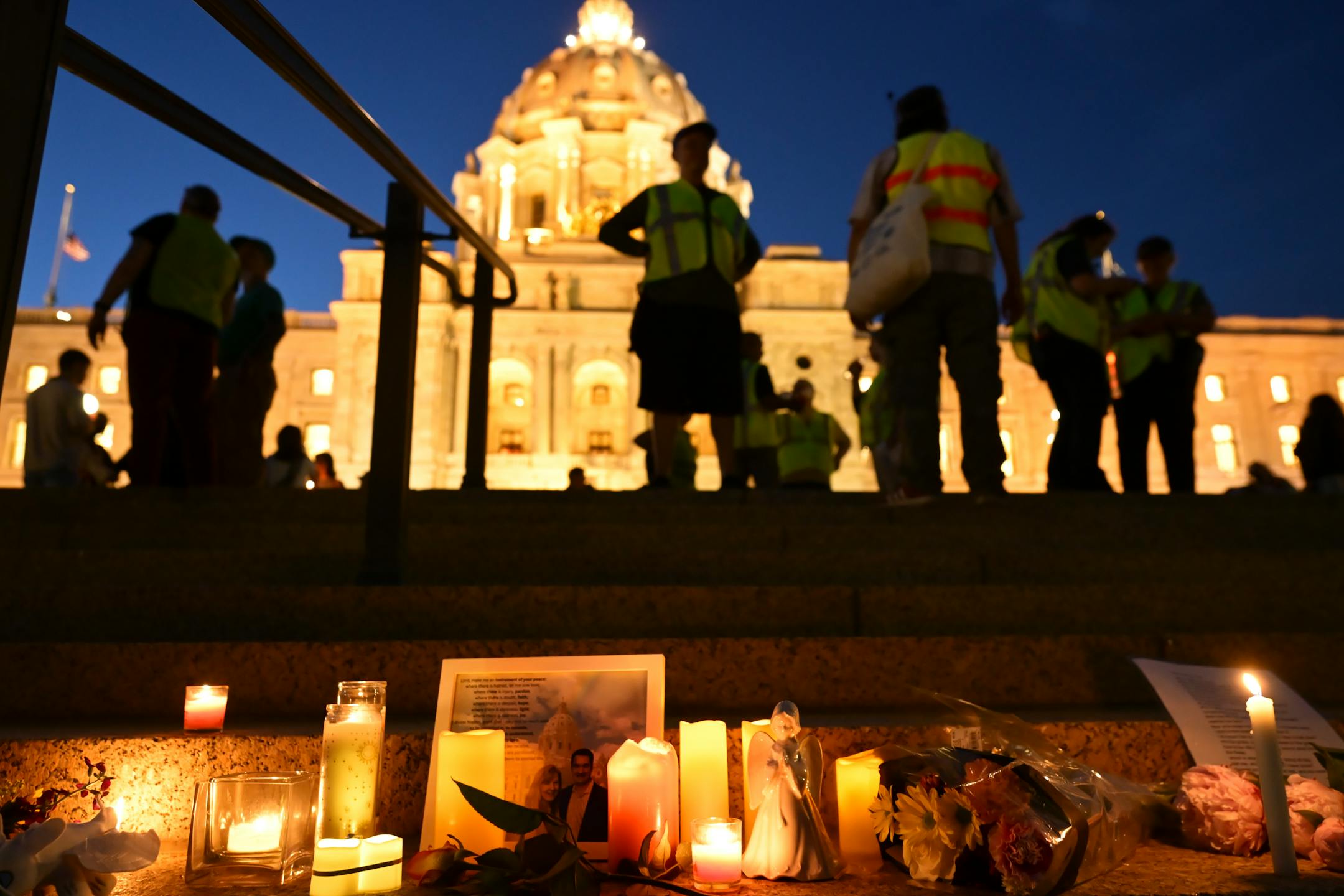
Candles, photos and flowers are left on June 18 at the Minnesota State Capitol during a candlelight vigil for Melissa and Mark Hortman, who were killed in what officials have called a targeted act of political violence.
Candles, photos and flowers are left during a candlelight vigil for Melissa and Mark Hortman, who were killed in what officials have called a targeted act of political violence, Wednesday, June 18, 2025, on the steps of the Minnesota State Capitol in St. Paul. (Aaron Lavinsky/The Minnesota Star Tribune)

Members of both parties in Congress are calling for more funding to keep them safe while they’re in Washington and in their districts in the wake of the Minnesota shootings that targeted lawmakers.

Congressional lawmakers are calling for more funding to ensure their safety in Washington and their home districts after a gunman attacked two Minnesota lawmakers last month.

The shootings, which killed DFL House Leader Melissa Hortman and her husband and injured state Sen. John Hoffman and his wife, renewed conversations at the federal level about security. But questions over how much money should be allocated — and decisions about who qualifies for extra protection — could present challenges as lawmakers try to figure out how to move forward.

The issue “becomes a question of cost,” said Rep. Ilhan Omar, who has faced death threats and been the victim of political attacks online. “I don’t know whether it is going to be possible or feasible to have around the clock security support for everyone.”

U.S. House members are able to pay for security from what’s known as the Members’ Representational Allowance (MRA). As of 2016, House members had access to as much as $1.8 million in MRA funding, spending over which they have significant discretion.

In the U.S. Senate, senators can access funds from the $2.5 million Senate residential security system program to help with related expenses.

Following the shootings, Democratic House Minority Leader Hakeem Jeffries and Rep. Joseph Morelle, the ranking member of the Committee on House Administration, which oversees MRA funding, called on Republican House Speaker Mike Johnson to “substantially increase” the MRA allowance “to support additional safety and security measures in every single office.”

It’s unclear if their calls will be heard. Johnson and Jeffries met in late June following the shooting to discuss members’ security and Johnson vowed to look at ways to go forward and implement changes.

Neither Johnson nor Rep. Tom Emmer, the No. 3 Republican in the U.S. House, could be reached for comment about whether they think security funding for House members should be increased.

When Omar has faced death threats in the past, she said Capitol police would provide around the clock security for her and her family and knows that option exists. But deciding who qualifies could be tricky.

“Oftentimes, there are a lot of us, some that don’t actually have any death threats, like for the case of my dear friends, Melissa, her husband and John and his wife, I don’t know if there were threats to their lives that was previously known to them by the psychotic assassin,” Omar said. “So, you have those kind of situations, and that’s always the fear.”

Omar and other Minnesota lawmakers think a larger discussion around security needs to happen, but she questions how far that conversation will go given the costs.

The shootings prompted the U.S. Senate and House to hold briefings with lawmakers about safety. The House is set to release a security report soon, with its scope expanded following the attacks.

Second District Rep. Angie Craig thinks lawmakers should get more money and flexibility for personal protection. Craig was attacked in an elevator at her apartment in 2023 and also received death threats afterward.

“It surprises people sometimes that members of Congress don’t get any security,” Craig said.

“A number of big city mayors get personal details, but yet members of Congress in such a slimly divided Congress, their personal safety is not protected,” Craig said. At times, she has had to pay for some additional security with campaign funds.

Craig also thinks there needs to be more of a push at the federal and state level to remove home addresses of lawmakers from the internet.

Sen. Amy Klobuchar, the former chair of the Senate Rules Committee, which oversees the Sergeant at Arms responsible for senators’ security, said it’s important that more resources are available for state and federal officials.

“I think we need more security in general for everyone, regardless of Democrat or Republican. We’ve seen attempts on people’s lives in state, and we’ve seen a murder in our state. We’ve seen attempts on President Trump’s life, as well as Speaker [Nancy] Pelosi’s husband,” Klobuchar said. “Tragically, we’re seeing a major increase in threats and violence.”

Reps. Pete Stauber and Kelly Morrison also think there will be larger discussion around security.

“The incident in Minnesota shocked the conscience, not only of Minnesota elected officials at all levels, but across the nation,” said Stauber, a Republican.

“I do think that we are probably looking at needing to increase funding and personnel to make sure that elected representatives feel safe and doing their job,” Morrison said.

Sen. Tina Smith said it may be too early to say exactly what more security will look like.

“This environment is changing rapidly, and so I do believe that additional things are going to need to be done, and what those are exactly, I think remains to be seen,” Smith said.

about the writer

about the writer

Sydney Kashiwagi

Washington Correspondent

Sydney Kashiwagi is a Washington Correspondent for the Star Tribune.

See Moreicon

More from News & Politics

See More
.
Tony Cenicola/The New York Times

A Ramsey County jury found Johnson & Johnson products exposed her to asbestos and caused her to develop mesothelioma.