
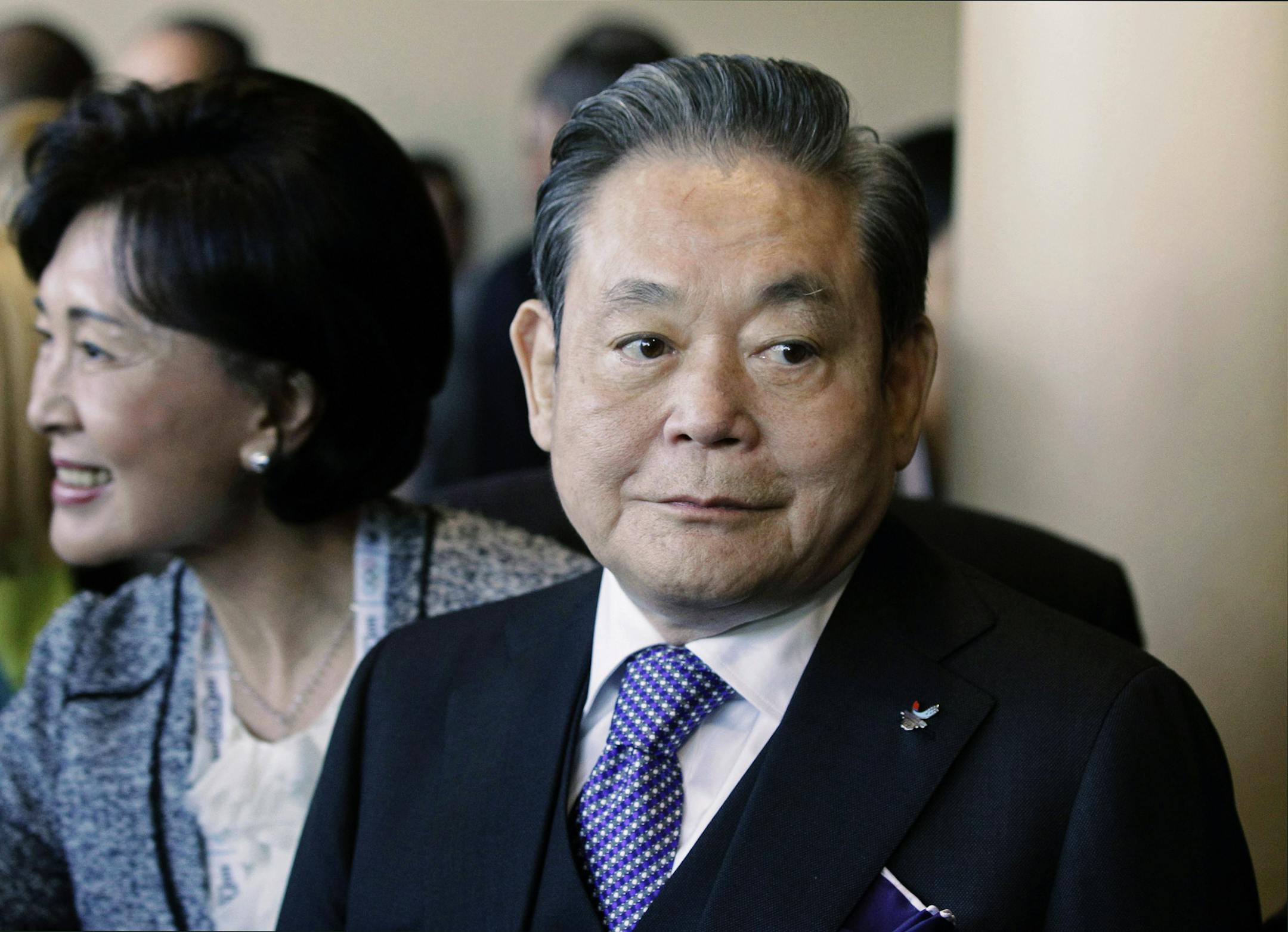
After death of Samsung chairman, investors bet on changes at top electronics maker

The shape of the world's leading maker of smartphones could change after the death of its longtime leader.

Reuters
October 26, 2020 at 8:01PM
FILE - In this July 6, 2011, file photo, Samsung Chairman Lee Kun-hee, right, greets people from the South Korean delegation in Durban, South Africa, for the 123rd International Olympic Committee (IOC) session that will decide the host city for the 2018 Olympics Winter Games. Lee, the ailing Samsung Electronics chairman who transformed the small television maker into a global giant of consumer electronics, has died, a Samsung statement said Sunday, Oct. 25, 2020. He was 78. (AP Photo/Schalk van
Samsung Chairman Lee Kun-hee, shown in a 2011 file photo, died Sunday after being incapaciated by a heart attack six years ago. (The Minnesota Star Tribune)

Shares in Samsung Electronics Co. and affiliates rose on Monday after the death a day earlier of Chairman Lee Kun-hee sparked hopes for stake sales, higher dividends and long-awaited restructuring, analysts said.

Investors are betting that the imperatives of maintaining Lee family control and paying inheritance tax — estimated at 10 trillion won ($8.9 billion) for listed stockholdings alone — will be the catalyst for change, although analysts are divided on what form that change will take.

Shares in Samsung C&T and Samsung Life Insurance closed up 13.5% at a two-month high and 3.8%, respectively, while shares in Samsung SDS also rose. Samsung Electronics — the jewel in the group's crown — finished 0.3% higher.

Son and heir apparent Jay Y. Lee has a 17.3% stake in Samsung C&T, the de facto holding firm, while the late Lee was the top shareholder of Samsung Life with 20.76% stake.

"The inheritance tax is outrageous, so family members might have no choice but to sell stakes in some noncore firms" such as Samsung Life, said NH Investment Securities analyst Kim Dong-yang.

"It may be likely for Samsung C&T to consider increasing dividends for the family to cover such a high inheritance tax," KB Securities analyst Jeong Dong-ik said.

Lee, 78, died on Sunday, six years after he was hospitalized due to heart attack in 2014. Since then, Samsung carried out a flurry of stake sales and restructuring to streamline the sprawling conglomerate and cement the junior Lee's control.

Investors have long anticipated a further shake-up in the event of Lee's death, hoping for gains from restructuring to strengthen de facto holding company Samsung C&T's control of Samsung Electronics, such as Samsung C&T buying an affiliate's stake in the tech giant.

"At this point, it is difficult to expect when Samsung Group will kick off with a restructuring process as Jay Y. Lee is still facing trials, making it difficult for the group's management to begin organizational changes," Jeong said.

Lee is in two trials for suspected accounting fraud and stock price manipulation, as well as for his role in a bribery scandal that triggered the impeachment of former South Korean President Park Geun-hye. The second trial resumed hearings on Monday.

Lee did not attend the trial on Monday, as Samsung executives joined other business and political leaders for the second day of funeral services for his father.

Samsung Electronics Vice Chairman Lee Jae-yong, a son of the late Samsung Electronics chairman Lee Kun-Hee, arrives at a funeral hall in Seoul, South Korea, Sunday, Oct. 25, 2020. Lee Kun-Hee, the ailing Samsung Electronics chairman who transformed the small television maker into a global giant of consumer electronics but whose leadership was also marred by corruption convictions, died on Sunday. He was 78. (Im Hun-jung/Yonhap via AP)
Samsung Electronics Vice Chairman Lee Jae-yong arrived at a funeral hall in Seoul on Sunday after the death of his father, Lee Kun-hee. (The Minnesota Star Tribune)
about the writers

about the writers

Joyce Lee

Hyunjoo Jin

More from Business

See More
card image

Fourth high-profile assault of hospital workers since last fall underscores challenge of managing patients in mental health crises.

card image
This transmission electron microscope image shows SARS-CoV-2, the virus that causes COVID-19, isolated from a patient in the U.S., emerging from the surface of cells cultured in the lab. (NIAID/TNS) ORG XMIT: 1659810