

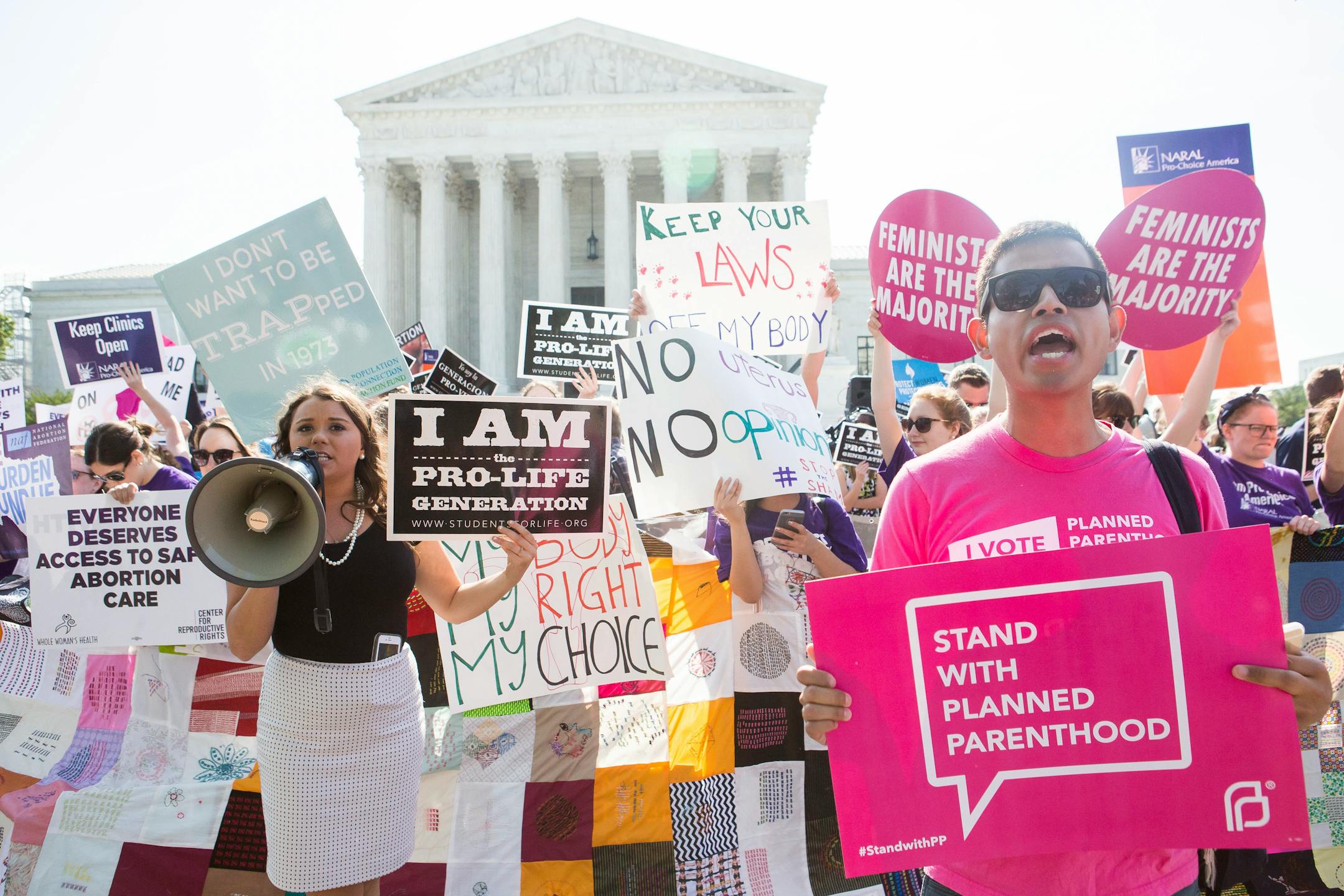
For the first time since 1992, the end of Roe v. Wade is a real possibility. Back then, the Supreme Court defied widespread expectations by sticking with the 1973 ruling's core holding that legislatures could not prohibit abortion. A lot of Republican politicians were relieved because they thought that a reversal by the court would have caused a political backlash. (They lost that year's election anyway.)
The circumstances are different now, as a Supreme Court with six Republican-appointed justices takes up a case about Mississippi's ban on abortion after 15 weeks. If the conservative justices think that Roe should go, they could hardly have found a more propitious time from the perspective of the pro-life movement.
The backlash theory is based on polls that find broad public support for Roe and opposition to overturning it. They also generally find opposition to a total ban on abortion.
But public opinion on abortion is complicated. Other polls find that most people also hold views that are incompatible with Roe, such as thinking that abortion should be allowed only in a few circumstances and not in the second trimester. A lot of people are ambivalent about abortion and not well versed in the particulars of Roe and the implications of overturning it. Many Americans — roughly two-thirds, by one estimate — are under the impression that overturning Roe would ban all abortion nationwide.
It wouldn't. If the court overturns Roe, its most likely ruling is that the Constitution lets legislatures set abortion policy. No justice has ever written an opinion urging the court to rule that abortion must be illegal.
If a pro-life Republican were president when Roe was overturned, it would be easier for supporters of abortion to capitalize on public worry that abortion policy was about to shift too far, too fast. But we instead have a Democratic president who is committed to legal abortion. If the court overturned Roe, President Joe Biden would urge Congress, also led by Democrats who favor legal abortion, to pass a law protecting it. That prominent pushback would make it harder to sustain the fiction that back-alley abortions were about to become commonplace.
Even better for pro-lifers, it's unlikely that Democrats could pass an abortion-protecting law. A bill to block states from restricting abortion would be subject to the filibuster. There are more than enough opponents of abortion in the Senate to sustain one. A lot of Democrats would be willing to end the filibuster to pass such a bill. But to succeed they would need the vote of Sen. Joe Manchin, the West Virginia Democrat who has said he favors keeping the filibuster and also calls himself pro-life.
We could expect many liberals to call for packing the Supreme Court with new justices who would reinstate Roe. But this gambit would have even less prospect of success. Democrats would have to expand their majority in the Senate and hold the House in the 2022 midterm elections, an accomplishment against the historical odds, to start to have a chance.


