

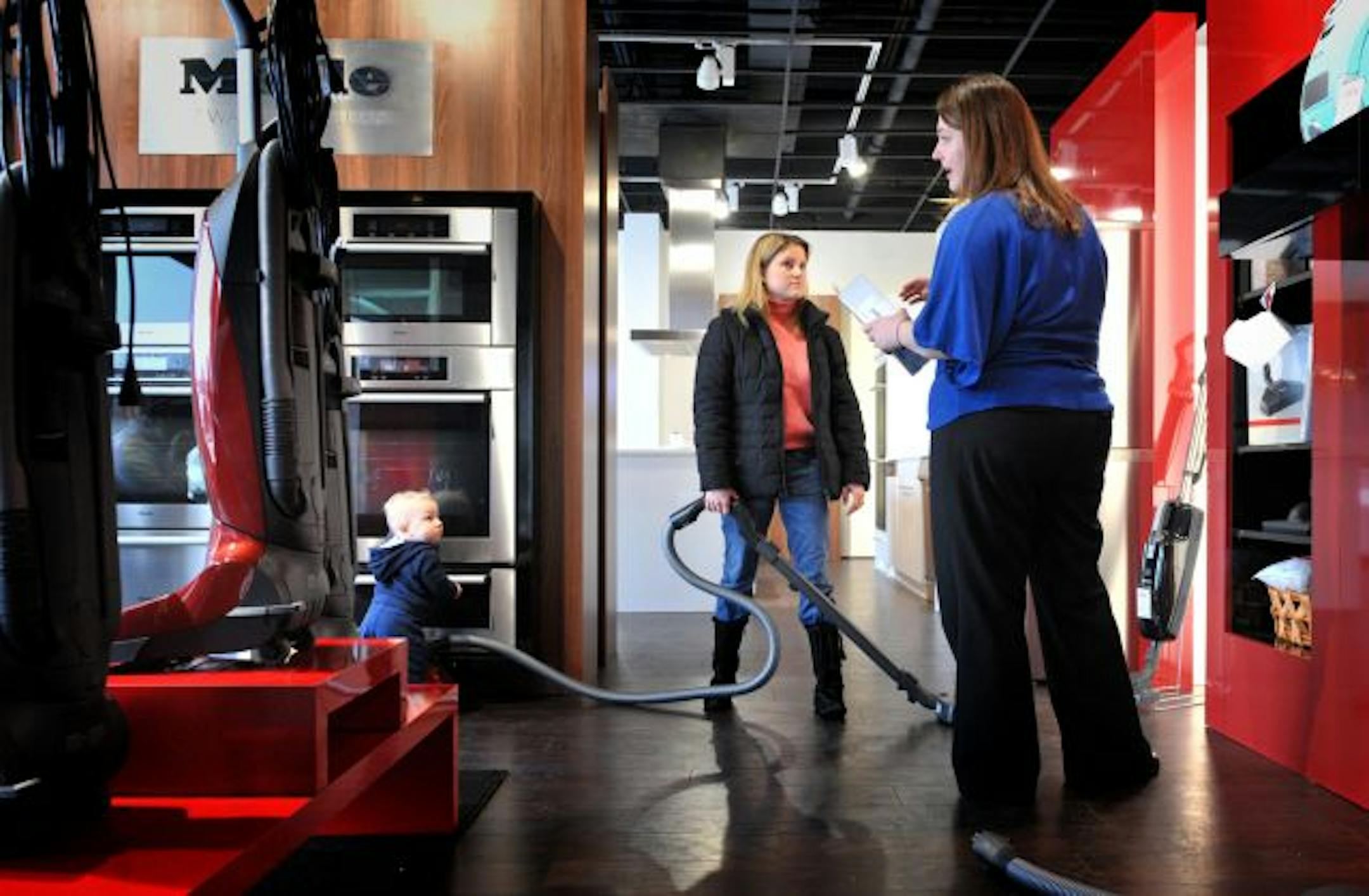
Chad and Kari Herrgott are on the front lines of the nation's tentative steps to get the economy humming again. With two young children (and two dogs), they're in their prime consuming years -- feeding and clothing a growing family, buying and furnishing homes, trading up to family-sized cars. Last week, after their vacuum cleaner sucked its last bit of dust, the Shakopee couple came looking for a replacement at the Warners' Stellian appliance store in Edina. The verdict: A slightly scuffed-up Miele floor model they bought for $250 less than the $699 price tag. "This is an extravagance for us," said Kari Herrgott, as 3-year-old Hailey vied for attention and Holton, 11 months, pounded the canister with a toddler's glee. "But with little ones on the floor, I'm vacuuming every other day. I want something that's going to work well and be durable." Young families like the Herrgotts have long provided the fuel for the nation's economy. But in previous downturns, the 78 million baby boomers were in charge. Now, boomers are getting older and holding fast to their cash.
The Herrgotts and their 49 million strong Generation X cohorts are both fewer in number and less affluent than boomers. Combine those basic demographic trends with a consumer who's settling into a more thrifty mindset, and the nation is primed for a slower and longer recovery this time around, economists say.
"Boomers aren't going to lead us out of this one," said Mandy Putnam, vice president and manager of Retail Forward's ShopperScape consumer surveys.
"The last two recessions hit boomers at life stages where they were younger and more able to recoup their losses," she said. "This one has hit them in their 401(k)s, their housing values -- all of what they thought was their accumulated wealth has taken a beating. So even affluent boomers have pulled back considerably more than their younger cohorts."
Minnesota's demographic landscape generally lines up with the national average. In the recession of the early 1980s, which also was deep and long, about 47 percent of the state's households were headed by people between the ages of 20 and 40. Now, about 37 percent are in that age bracket, a 10 percent drop.
"As a society and as a state, we're getting older," said state economist Tom Stinson. "The percentage of households in the 'big spending' years, compared to the save-for-retirement years, has changed. Other things being equal, we're going to see natural weaker spending growth, no matter what the economic conditions."
Shifting demographics also mean big challenges ahead for retailers, which have ridden the gravy train of easy growth for three decades, argues Doug Anderson, senior vice president of research and development with the Nielsen Co.
Traditionally, marketers haven't done a good job of reaching older and ethnic customers, Anderson said. But those "who assume that the baby boom will start to behave like the current older Americans, just because they reach the age of 65, do so at their own peril," he warned in a December report.



