

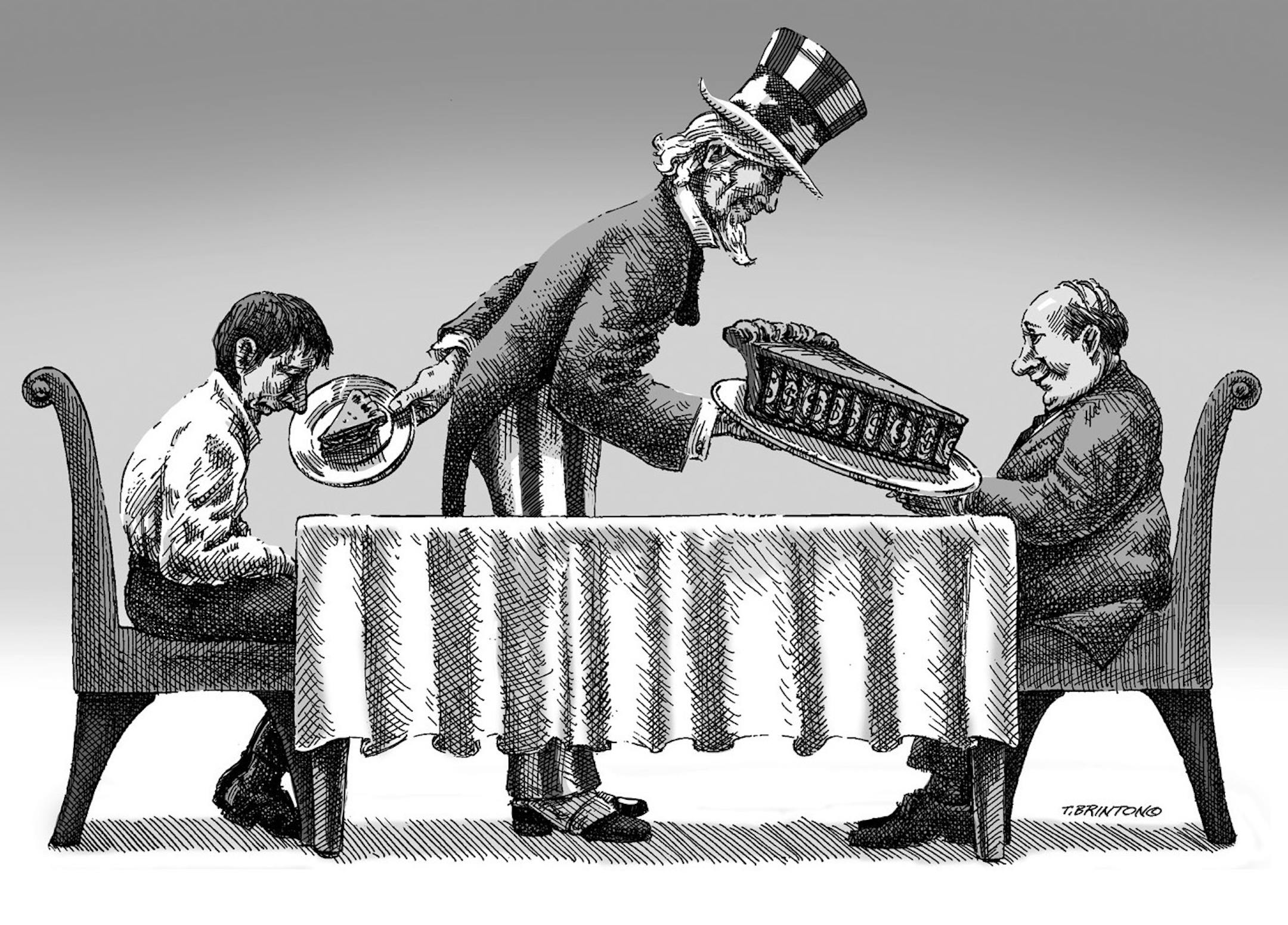
Big ideas can make a big difference. Lyndon Johnson's War on Poverty, declared 50 years ago this week, yielded Medicare and other safety-net programs that matter enormously in the lives of poor Americans. President Obama recently announced his own big idea: Inequality, he says, "challenges the very essence of who we are as a people."
The president's rhetoric thrills progressive Democrats. It folds poverty, lack of opportunity and the supposedly ill-gotten gains of the rich into a unified theory of economic injustice that aligns with the way progressives see the world. They also feel it's good political marketing. Which of these claims is more energizing: The poor stay poor as the rich get richer? Or the poor stay poor because the rich get richer?
Progressives are right that poverty, opportunity and fairness each deserve close attention, and conservatives are wrong in usually preferring to ignore all three. But Democrats are wrong to bundle the issues together.
For one thing, doing so is dubious economics. Much as it appeals to progressive minds, the idea that income inequality is the cause of poverty and social immobility isn't helpful.
Why would the surging incomes of the super rich — the trend that drives income inequality in the United States — suppress incomes at the bottom? If hedge-fund managers and superstar basketball players were paid less, Wal-Mart Stores would pay its shelf-fillers more and the children of poor single mothers would be more likely to go to college? The logic isn't obvious.
I don't deny that there might be subtle connections. Maybe fast-rising incomes at the top shift political power in ways that militate against anti-poverty or pro-opportunity policies. That strikes me as unlikely, but it's possible. Plenty of other channels have been posited — but none proven. What seems to carry the most weight with progressives is the notion that incomes are somehow fixed in the aggregate, implying that the rich cannot thrive except at somebody else's expense — and that's a fallacy.
Progressives lately have been charmed by what's called the Great Gatsby curve, which suggests a statistical relationship between income inequality and a lack of social mobility. Alan Krueger, chairman of the White House Council of Economic Advisers, drew attention in 2012 to findings by Miles Corak of the University of Ottawa: Countries with higher income inequality tend to have lower social mobility. That's interesting, but as progressives have pointed out in other contexts, correlation is not causation. More recently, the correlation has begun to look suspect, in any case.
Here's the point: It doesn't matter. The case for improving social mobility in the United States is compelling in its own right. It needs no support from a unified theory of injustice.


