

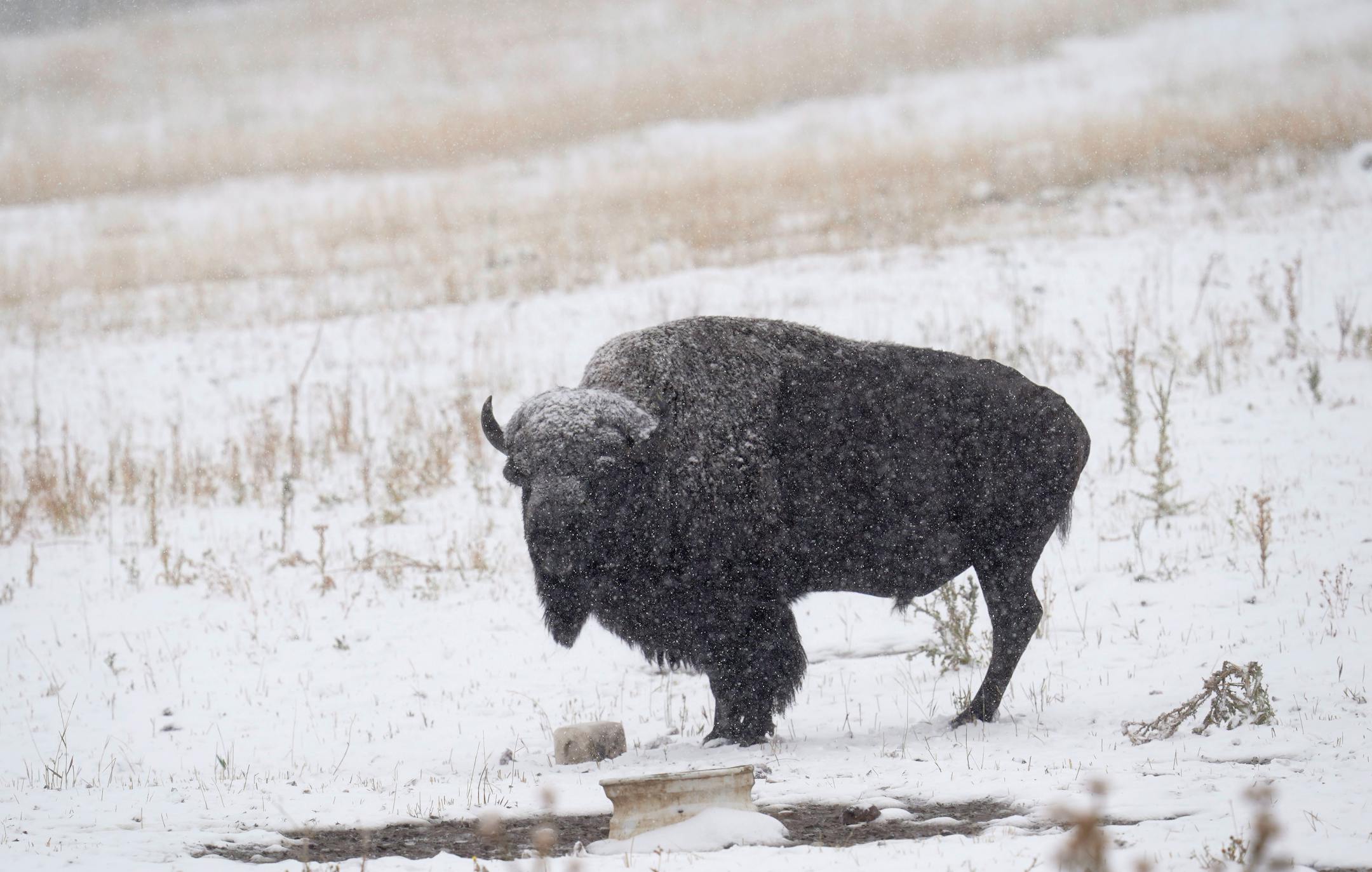
When blizzards are blowing and snow swirls into monster drifts, Minnesota’s bison herds barely miss a beat.
Extra thick skin and famously warm winter coats protect these once free-roaming goliaths of the Great Plains from fierce winds and temperatures down to minus 40 degrees. The finer undercoat insulates while the coarser outer fur repels water. Snow will often pile up on their fur without melting, much like the roof of a well-insulated house.
“One of my favorite adaptations of the bison is the hump,” said Alex Watson, regional naturalist for the Minnesota Department of Natural Resources. “It’s almost all muscle. It powers their head, and they can use their head like a shovel to dig out snow and ice.”
Long vertebrae jut vertically from the bison’s upper spine into the hump to give it support and strength as they swing their heads.
As North America’s largest land mammal, male bison can weigh 2,000 pounds and stand 6 feet tall. Females weigh about 1,000 pounds and can be up to 5 feet tall. Bison may lose about 20% of their body weight in the winter as it takes more work to find food beneath the snow.
In addition to the extra warmth, their winter coats serve another role in dispersing native prairie seeds, Watson said. Tens of thousands of seeds can stick to or get tangled in their curly fur until they’re shaken off or shed in the spring, enabling them to take root.
Minnesota’s Bison Conservation Herd can be seen with its thick winter coats at the Minnesota Zoo, Dakota County’s Spring Lake Park Reserve, Olmsted County’s Oxbow Park and Zollman Zoo, Blue Mounds State Park in Luverne and Minneopa State Park in Mankato.
Blue Mounds’ 80 to 90 bison may be visible from an observation deck with a spotting scope or along the Western Loop Trail bordering their 530-acre prairie. Minneopa’s herd of 30 to 40 animals can be viewed along a drive through their 325-acre enclosure or from trails around the perimeter.


![Frosted Birch trees reach for the sky on a bitter cold morning in December. ] Minnesota -State of Wonders, Arrowhead in Winter BRIAN PETERSON • brian.peterson@startribune.com
Grand Marais, MN 2/14/2014](https://arc.stimg.co/startribunemedia/6ZXHG4LKYMULX4MFGGBDRWW2GE.jpg?&w=252&ar=3:2&fit=crop)