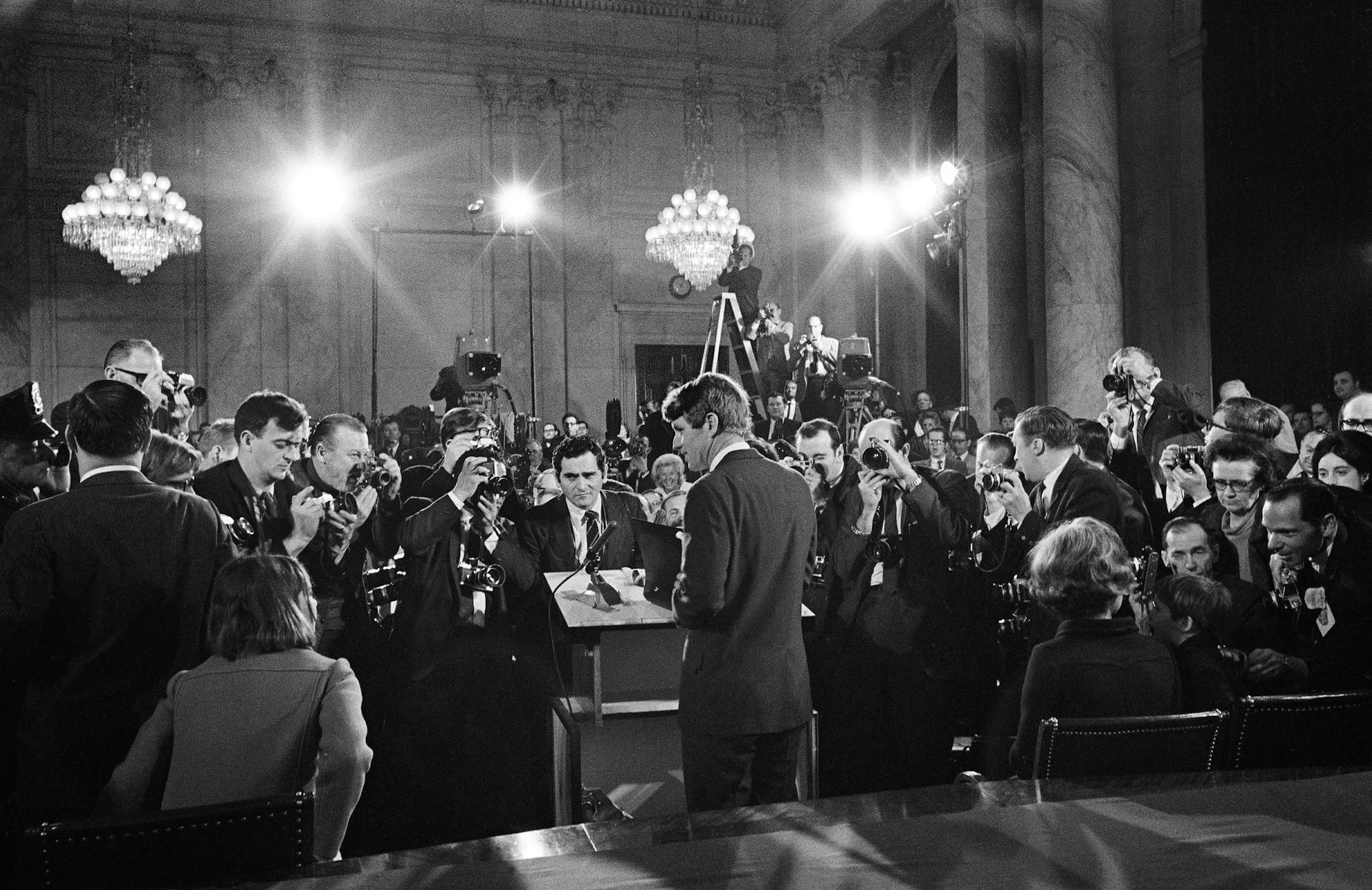
On the morning of March 16, 1968, CBS pre-empted its regularly scheduled television programming for breaking news. Then-New York Sen. Robert Francis Kennedy was prepared to announce his candidacy for the presidency.
As the audience waited for the senator to arrive in the Senate Caucus Room on Capitol Hill, venerable newsman Roger Mudd, who anchored CBS' coverage for the occasion, set the scene of Kennedy's decision with these ominous words:
"The senator is doing so in the face of almost solid opposition from the Democratic Party professionals. Only three state [Democratic] chairmen — New York, Oregon and Tennessee — have come out in favor of Mr. Kennedy's candidacy."
From that point on, RFK's presidential campaign to re-create the glamour of Kennedy Camelot at the White House lasted only 80 days.
Kennedy later lost the Oregon primary in an upset to Minnesota Sen. Eugene McCarthy, the antiwar, Bernie Sanders-like candidate of his time. Then, after Kennedy barely won the make-or-break California primary on Tuesday, June 4, he was shot mere minutes after his victory speech at the Ambassador Hotel in Los Angeles. He died at Good Samaritan Hospital on June 6, at 1:44 a.m. Pacific time. He would have turned 43 on Nov. 20, 1968.
RFK was murdered five years after his older brother, President John F. Kennedy, was assassinated on Nov. 22, 1963, in Dallas. The Rev. Martin Luther King Jr. had been assassinated two months earlier than RFK, almost to the day.
At the time of RFK's death, his chief competition was the entrenched Vice President Hubert Humphrey. He led the Democratic race with 561 delegates, Kennedy had 393 and McCarthy 258. (The incumbent, the pro-Vietnam War Lyndon Johnson, ultimately decided not to seek re-election because of the antiwar sentiment sweeping the nation, which fomented into ugly riots at the Democratic National Convention in Chicago during August 1968 and splintered the party itself.)
Now we ask: "What if?"