
Jessie Diggins’ bruised ribs are ‘one of the most painful injuries you can get’

After winning a bronze medal on Thursday, Afton’s Jessie Diggins will be back in action at the 2026 Winter Olympics on Saturday in the 4x7.5km relay.

February 13, 2026 at 7:20PM
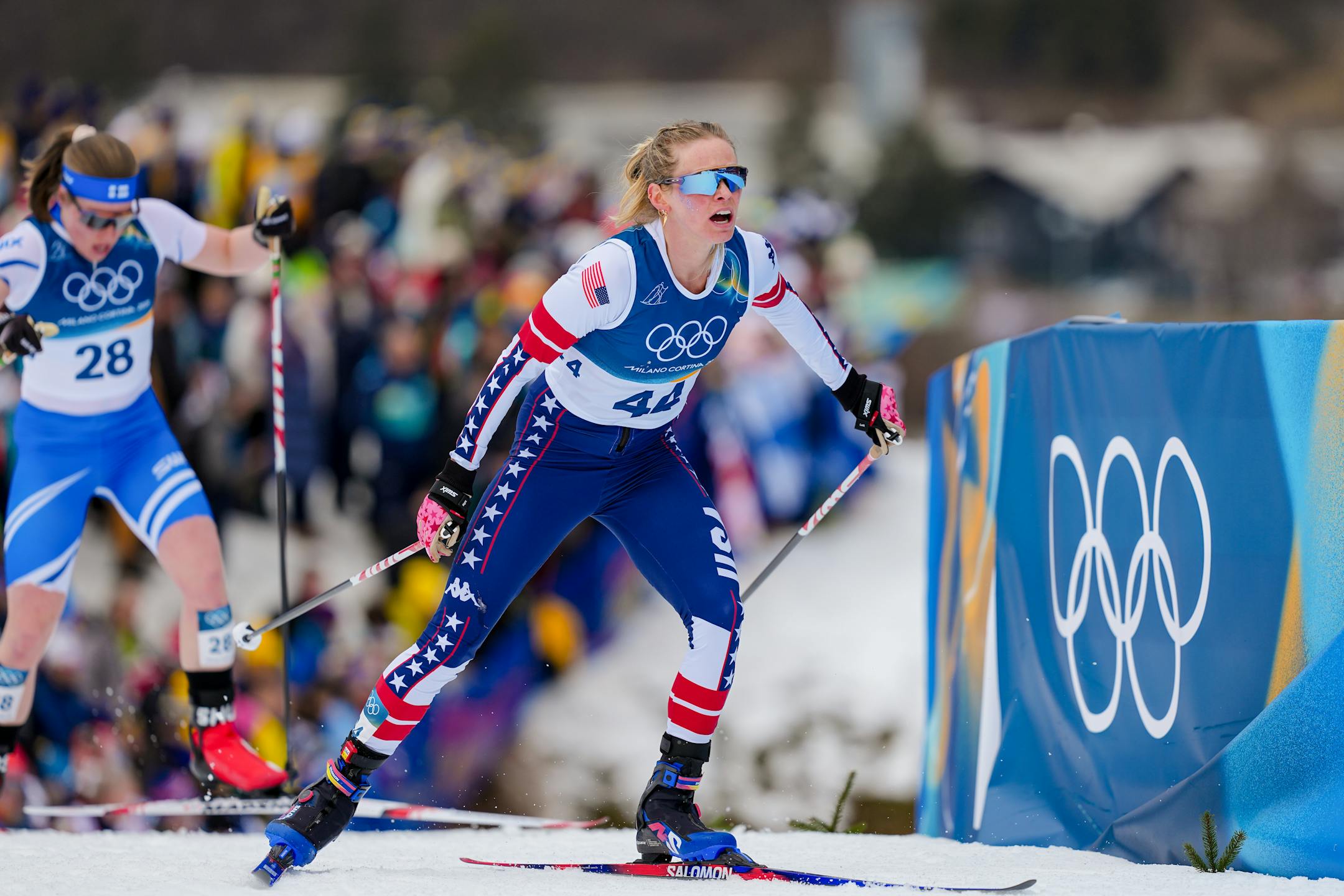
Jessie Diggins of Afton competes near the end of the women's 10km cross-country race at the Olympics in Tesero, Italy, on Feb. 12. (Matthias Schrader/The Associated Press)

Jessie Diggins was hunched over, mouth gaping, arms pumping, as she raced against the clock down the stretch of the women’s 10-kilometer freestyle race on Thursday, Feb. 12, at the 2026 Winter Olympics in Tesero, Italy.

When the Afton native crossed the finish line, she collapsed to the ground, cried out in pain and grabbed her right side, where viewers at home and spectators in the stands knew she had bruised ribs from a crash in a race on Saturday. Her American teammate Hailey Swirbul rushed to her side.

Those images, that video, of Diggins in agony after pushing her body to the limit to earn a bronze medal may end up being among the most indelible from the Milan Cortina Games.

A doctor back in Minnesota, who has raced in cross-country ski events, marveled at her performance. Bruised ribs in general involve muscle or soft tissue damage that causes swelling that presses up against the rib cage.

While distinct from broken ribs, when the bones themselves partially or completely break, bruises can cause just as much pain, said Dr. Michael Knutson, an emergency physician who practices at Methodist Hospital in St. Louis Park and the Urgency Room in Golden Valley.

“You have to breathe, so every time you breathe you are irritating the injury,” he said. “And then you go to something like skiing, which is one of the most aerobic activities a human can do, and you’re doing a lot of breathing. You’re also double poling and transmitting a lot of force from your poles through your body. So, every time you are doing that, that’s going to be pulling on that injury as well.”

Knutson is training to race next month in the famed 93-kilometer Vasaloppet in Sweden. He is rehabbing a calf injury in preparation. When he first heard of Diggins’ injury, he said he was worried as a fan because “it’s probably one of the most painful injuries you can get, even when just doing normal activities.”

“Knowing Jessie Diggins,” he said, “if anyone could do it, it would be her.”

ADVERTISEMENT

Diggins said she had an ultrasound that showed no break on her right side, and she worked with a physical therapist to get ready for Thursday’s race.

“It’s bruised and then there’s probably a strain of muscles in between,” Diggins said. “It’s just been hard to sleep because I feel like I’m waking up because things are clicking. And it’s just really disconcerting. But at the same time, we know racing can’t make it worse.”

On Instagram on Friday, Diggins wrote that the 10km was “maybe the most pain I’ve ever worked through in a race.” She added that she was in tears 24 hours before it from the physical and mental pain.

View post on Instagram
 

“You can block out the pain to some degree while you’re racing, but when you finish, it all comes flooding in,” she said Thursday after the race. ”I knew that was going to happen, but I was only going to let that in once I’d crossed the finishing line.”

Once she did, she said, “It took a minute because I felt like I couldn’t breathe.”

With Diggins still on the ground, others skiers were crossing the finish line, including the only one who mattered: Astrid Oeyre Slind of Norway. Diggins was in bronze-medal position when she finished, and Slind was in striking distance of her time. But the Norwegian ended up 3.3 seconds slower, securing Diggins her fourth career Olympic medal.

Diggins said she did not know until about 15 minutes later that she had won the bronze. She still held on to advice from her coach at Stillwater High School, Kris Hansen: “Before you look at the results, you decide how you think you skied. Don’t let the results define your sense of self worth and your sense of pride in what you did or didn’t do.”

“When I was laying there trying not to die after the race, I was really proud of just doing everything that I could in every moment and feeling like I put everything I had out into the snow,” Diggins said.

View post on X

Diggins, 34, is scheduled to race three more times in her fourth and final Olympics before retiring at the end of the season: the 4x7.5km relay on Feb. 14, the team sprint on Feb. 18 and the 50km on Feb. 22. She said she was “really excited” about the team events in particular.

“I really want to pull it together and get this done with my teammates and for my teammates,” she added.

about the writers

about the writers

Naila-Jean Meyers

Deputy Sports Editor

Naila-Jean Meyers is the deputy sports editor at the Minnesota Star Tribune. She previously worked at the New York Times, St. Louis Post-Dispatch and Sporting News.

See Moreicon

Jeremy Olson

Reporter

Jeremy Olson is a Pulitzer Prize-winning reporter covering health care for the Star Tribune. Trained in investigative and computer-assisted reporting, Olson has covered politics, social services, and family issues.

See Moreicon

More from Olympics

See More
card image
Ashley Landis/The Associated Press

The men’s free skate at the Milan Cortina Games is underway Friday as are the quarterfinals of the women’s hockey tournament.

card image