Phil Esten’s steady leadership takes St. Thomas to new heights

December 21, 2025
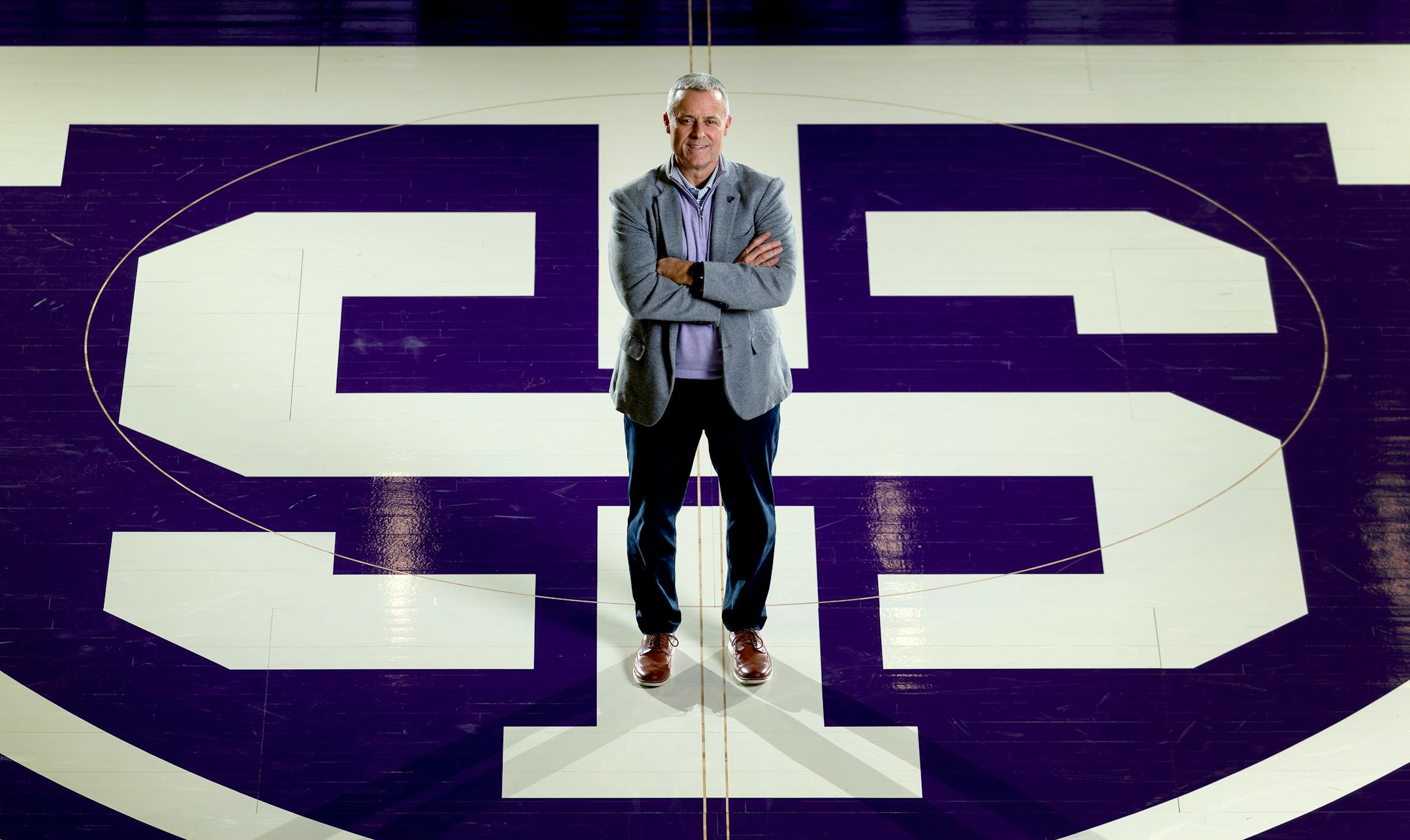
Phil Esten, Vice President, Director of Athletics of University of St. Thomas photographed Dec. 8 at Lee & Penny Anderson Arena in St. Paul. (Carlos Gonzalez/The Minnesota Star Tribune)

The Minnesota Star Tribune Sportsperson of the Year led the Tommies to Division I with an intelligent and creative vision.

The Minnesota Star Tribune

The Gophers opened their new on-campus football stadium on a mid-September evening in 2009. As an administrator in the athletic department, Phil Esten had served as point person for all facets of the stadium’s construction.

Esten drove home that night thinking less about the game’s final score or the pomp and circumstance surrounding the venue’s opening, and more about the legacy created for generations to come.

“I remember thinking, ‘That was a lot. I’m not sure I can do something like that again,’ ” Esten recalled, pausing a beat. “Here we are.”

He chuckled at the irony.

A decade and a half later, Esten is sitting courtside at the Lee & Penny Anderson Arena, the $183 million facility and crown jewel symbol of St. Thomas’ unprecedented leap into Division I athletics.

Historically, the NCAA’s reclassifying process from Division III to Division I mandated a 12-year window. St. Thomas did it in four years, becoming the first institution to make the jump directly without a stop in between.

That expedited passage required leadership that is equal parts ambitious, patient, nimble and creative. The Tommies leaned on the stewardship of an athletic director who once played catcher on their baseball team and washed dishes and served sandwiches as a student worker in the campus cafeteria.

Esten’s steady hand in guiding St. Thomas athletics into a new era has made him the Minnesota Star Tribune’s 2025 Sportsperson of the Year.

ADVERTISEMENT

“I really think he was the perfect person at the perfect time at the perfect school,” longtime men’s basketball coach Johnny Tauer said. “I don’t think I can overstate how powerful his leadership has been throughout this whole process.”

At right, Dr. Phil Esten, Vice President, Director of Athletics of University of St. Thomas is photographed Dec. 8 at Lee & Penny Anderson Arena in St. Paul. Construction on the $183 million facility began in 2024, just three years after St. Thomas began its unprecedented move from Division III to Division I. (Photos by Carlos Gonzalez (right) and Renée Jones Schneider, The Minnesota Star Tribune)

Since moving to Division I in 2021, the athletic department has nearly tripled its donor base and netted more than $160 million in fundraising. That figure includes a $75 million gift from Lee and Penny Anderson for the construction of the dual-purpose basketball and hockey arena. At the time, their donation represented the ninth-largest gift in college athletics history.

St. Thomas teams are eligible to compete in D-I postseason tournaments for the first time this school year after Esten and Summit League leaders successfully petitioned the NCAA to change the provisional waiting period for reclassification, reducing it by one year.

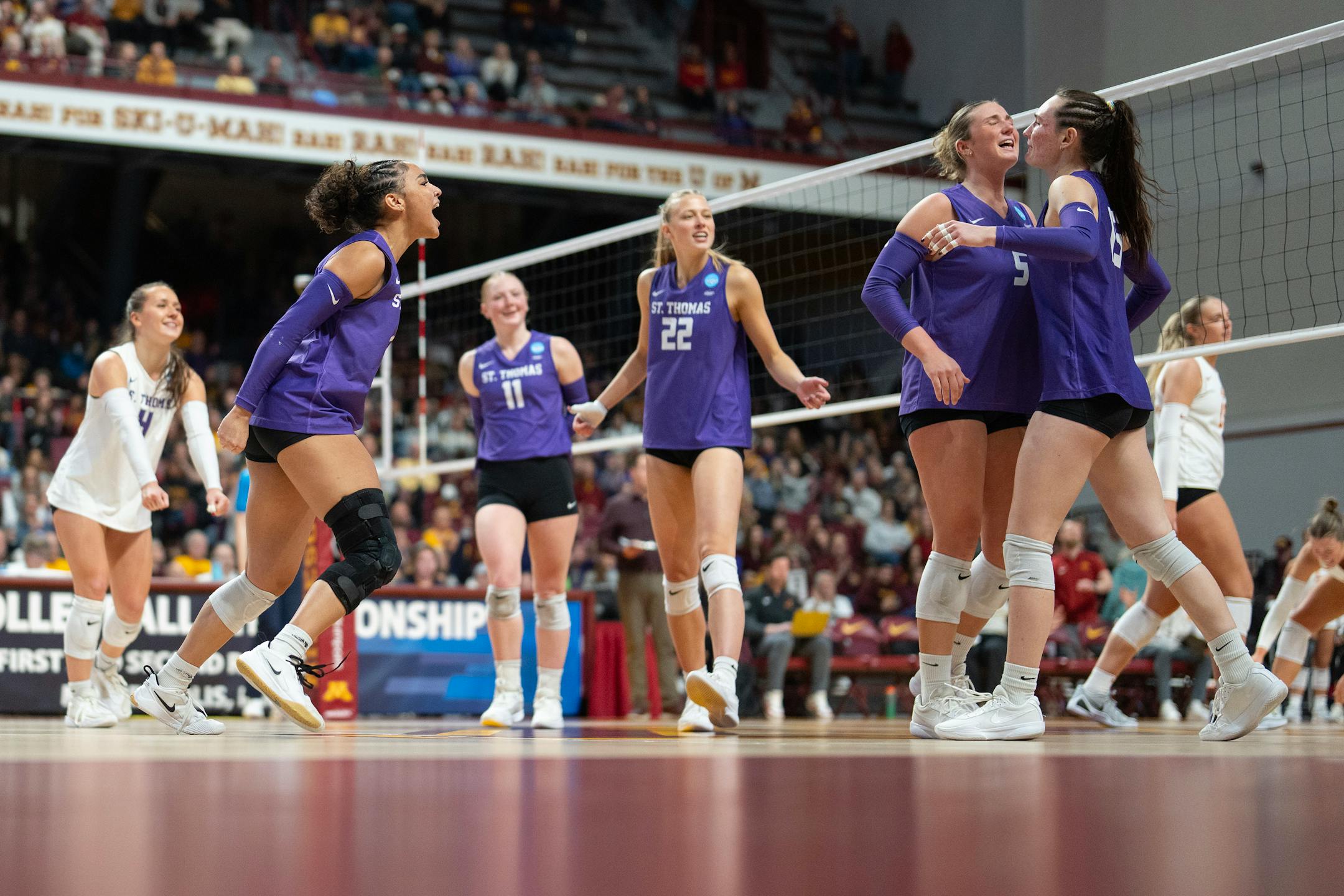
The Tommies volleyball team earned an inaugural trip to the NCAA tournament, losing to No. 23 Iowa State in five sets in the first round Dec. 5. The men’s basketball team was picked to win the Summit League in its preseason poll.

The transition has created ripple effects outside of competition. In each of the past four years, 25% or more of donors to the athletic department have been first-time donors to the university. That equates to athletics attracting more than 1,000 new donors to the school.

St. Thomas players celebrate after winning a point against Iowa State during the first round of the NCAA Division I women's volleyball tournament. (Alex Kormann/The Minnesota Star Tribune)

University President Rob Vischer describes visibility in higher education as “oxygen” and noted the move to D-I has helped expand the school’s name recognition nationally, attract students and engage alumni who might not have otherwise invested emotionally or financially.

Vischer credits Esten’s background as a St. Thomas student and experience in major college athletics as essential components in navigating this new adventure.

“He knows the big picture and where the path can go and how to do it in a world-class way,” Vischer said.

Esten, 53, nearly chose a different path both as a student and professional.

A native of La Crosse, Wis., he originally committed to play baseball for the Badgers, but then the school dropped its program. He pivoted to St. Thomas and played there until graduating in 1995. He worked in the dining hall to help pay tuition.

His career in athletic administration included stops at Ohio State, Minnesota, Cal and Penn State. Esten was a finalist for several Division I AD openings before former St. Thomas President Julie Sullivan called to pitch a homecoming for him, wife Dani and their three children.

Esten thanked Sullivan, but decided to stay at Penn State with the goal of becoming a Division I athletic director. Sullivan called again a few weeks later and explained the growing discontent within the MIAC aimed at St. Thomas.

Esten took the job with no guarantees about the school’s athletic future.

Phil Esten, top, teaches a Foundations of Sports Management course at St. Thomas. He said teaching keeps him relevant and connected with what young people care about. Esten has guided the new-look Tommies athletic department to fresh heights at the Division I level with coaches like Rico Blasi, left, and Johnny Tauer. “I really think he was the perfect person at the perfect time at the perfect school,” said Tauer, the longtime men’s basketball coach. (Photos by Carlos Gonzalez (top), Brian Peterson (left) and Alex Kormann (right), The Minnesota Star Tribune)

“It was clear at the time that there wasn’t a path directly from Division III to Division I,” Esten said. “If that was something we wanted to do, we were going to have to figure out a plan that nobody had ever endeavored before.”

He arrived in January 2019 and learned within days that St. Thomas’ future in the MIAC was tenuous. A few months later, the conference formally asked the school to find a new home. St. Thomas considered options in all divisions before deciding to pursue permission from the NCAA to jump directly to Division I.

That choice brought messy complications. Most of the sports programs joined the Summit League. Football moved to the Pioneer League, while men’s and women’s hockey became members of the CCHA and WCHA, respectively. Esten also finalized an awkward divorce from the MIAC after 99 years.

“He was juggling five different conferences for two years,” said Pat Ryan, former chair of the school’s board of trustees. “It is just crazy. But he immediately surrounded himself with people that were very capable and started putting the pieces together.”

The puzzle was complicated. Esten’s message to his department was direct and concise. Don’t cut corners. Focus on building culture. Look at the process through a long lens.

The athletic department had grown into a powerhouse Division III program. Suddenly, the Tommies were facing teams with scholarship athletes. They went from big fish to small fish overnight.

“I’ve seen time and time again that culture pulls success and not the other way around,” Esten said. “It was important to me that our coaches felt permission to make decisions that might ultimately lead to a loss or two but was there to build culture long term.”

Comforting words, but coaches don’t take losing well. Their careers hinge on their record.

Tauer is a national championship coach who maintained a premier program in Division III, winning 81% of his games in 10 seasons.

His team went 10-20 its first Division I season, which included a 12-game losing streak.

Tauer, who graduated from St. Thomas the same year as Esten, spent a lot of time talking to his boss after losses.

“Phil might have been my pseudo therapist,” Tauer said, laughing. “He would oftentimes talk me down when I was really frustrated or down about the outcomes.”

Esten’s message never wavered. He stressed patience and perspective, though the competitor inside him didn’t enjoy losing either.

“My wife would say all the time, ‘It’s not losing, it’s learning,’” he said.

Tauer noted that, metaphorically, he was never asked to run a four-minute mile. As scholarship numbers increased incrementally on rosters, Tommies programs became more competitive.

Tauer’s team won 19 games its second season in Division I, then 20, then 24.

The football team won the non-scholarship Pioneer League championship in its second season. The baseball team has won back-to-back Summit League regular-season titles. The softball team won the conference championship this past season, making St. Thomas the first school in Summit League history to win the conference softball and baseball titles in the same year.

Both men’s basketball and men’s hockey advanced to their respective league championship games last season.

That success has fueled an increase in brand exposure and fan engagement. The Tommies’ social media following has increased by more than 130% since their transition to Division I.

A surge in season ticket accounts — 140% growth in men’s basketball, 190% in men’s hockey in the past year — coincided with the opening of the Lee & Penny Anderson Arena.

The four-year provisional window that prevented the Tommies from participating in postseason tournaments might have felt like an eternity, but Esten found some positives.

“None of our coaches were accustomed to losing,” he said. “Long term, we can’t lose regularly. We keep score for a reason. But when the stakes aren’t necessarily, ‘Win and go to the tournament,’ it does make it easier to lean into culture.”

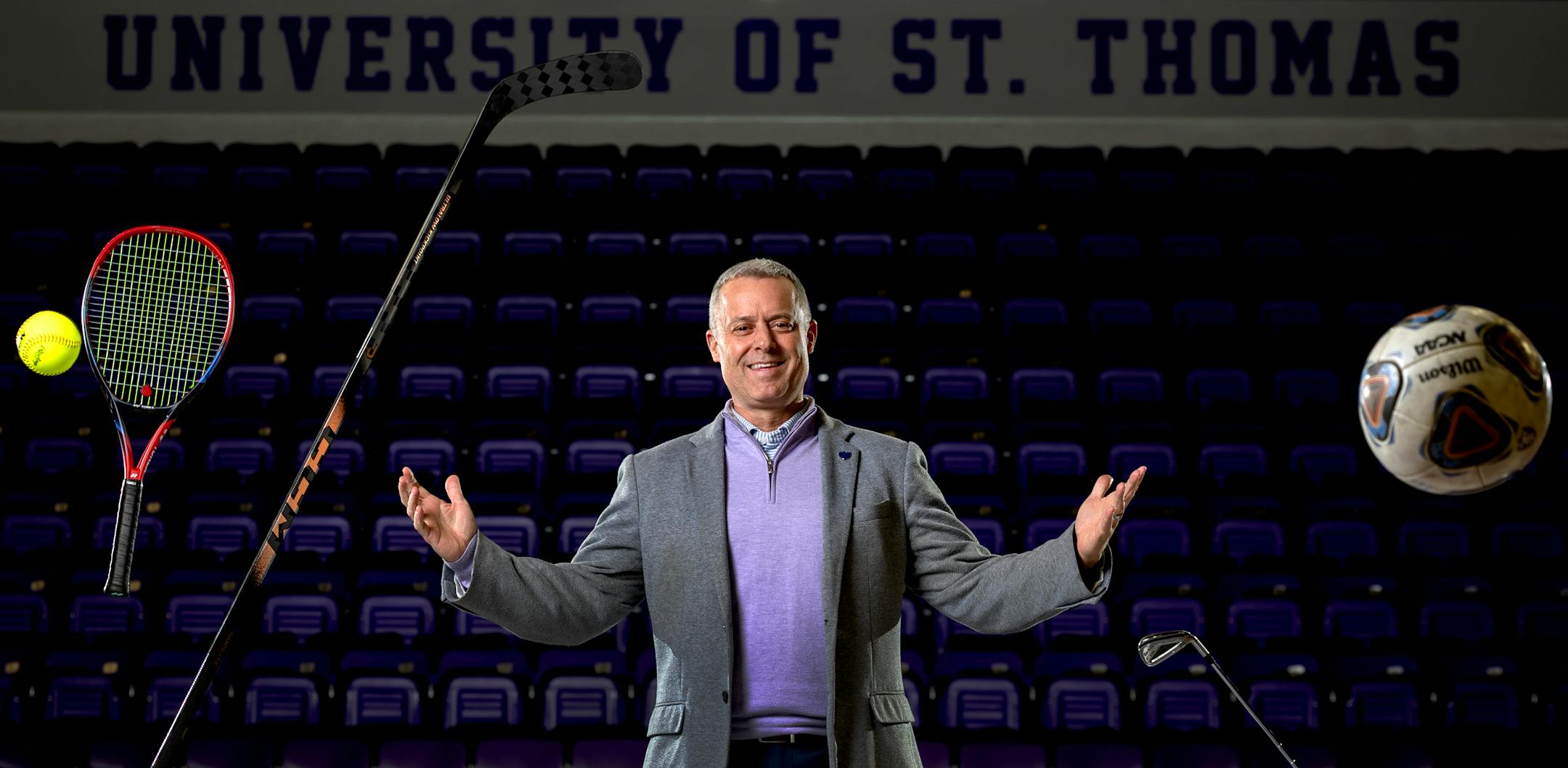
Under Phil Esten's guidance as Vice President, Director of Athletics of University of St. Thomas the Tommies grew into a powerhouse Division III program. The school now competes at the Division I level. (Carlos Gonzalez/The Minnesota Star Tribune)

The athletic department’s infrastructure changed alongside what was taking place with its sports programs. Esten inherited 33 full-time employees. That number now stands at 115.

Enhancements were necessary in a multitude of areas, including fundraising, oversight, marketing and athlete support.

“Phil’s pitch to us was to be part of something that nobody has ever done before,” said Ben Fraser, a senior administrator who joined the staff in 2020 to oversee development and fundraising, “and to put your mark on an institution and really build something from the ground up.”

Colleagues describe Esten’s leadership style as intelligent, no-nonsense and even-tempered. He uses the term “comprehensive excellence” frequently when outlining expectations.

“He’s led with grace but also tenacity as well,” said Jodee Kozlak, current chair of the board of trustees. “It’s kind of a nuanced approach. But he put amazing guardrails in place.”

Though newbies to D-I, the Tommies made the leap with eyes open. Winning matters to the bottom line. Fundraising is paramount. Investing in facility upgrades commensurate with Division I standards was non-negotiable.

Vischer noted that increased visibility benefits the entire university — “A rising tide lifts all boats,” he said — but it also requires appropriate perspective.

“We’re not trying to be Ohio State,” Vischer said. “We’re trying to be St. Thomas.”

What this version looks like in, say, five years, 10 years or 30 years is to be determined. But just as he did back in 2009 after watching the Gophers football stadium come to fruition, Esten has thought a lot about the legacy tied to his current endeavor. Not his own legacy, but the university’s.

“That’s something that plays on repeat in the back of your mind as you go through this,” he said.

Something else does, too. The feeling of: what’s next? Esten said he’s always been steered professionally by that mentality. Start a project, finish it and move on to the next.

“What’s next, what’s next, what’s next?” he said of the internal motivation to keep growing. “We’ve done that for the last five or six years. What’s next is, now let’s take advantage of all the things that we’ve done.”

How Sportsperson of the Year is chosen

Candidates are nominated by the Minnesota Star Tribune sports department. A selection committee of staff members debates the nominees and votes on the final choice.

about the writer

about the writer

Chip Scoggins

Columnist

Chip Scoggins is a sports columnist and enterprise writer for the Minnesota Star Tribune. He has worked at the Minnesota Star Tribune since 2000 and previously covered the Vikings, Gophers football, Wild, Wolves and high school sports.

See Moreicon

More from Colleges

See More
card image
Carlos Gonzalez/The Minnesota Star Tribune

The Minnesota Star Tribune Sportsperson of the Year led the Tommies to Division I with an intelligent and creative vision.

card image
card image