
Reusse: An appreciation for the underappreciated Twins great Jim Perry

Jim Perry took the Twins to new heights as a pitcher, and never shook off an appearance. “I was always available to pitch,” he said.

Columnist Icon
The Minnesota Star Tribune
August 16, 2025 at 10:56PM
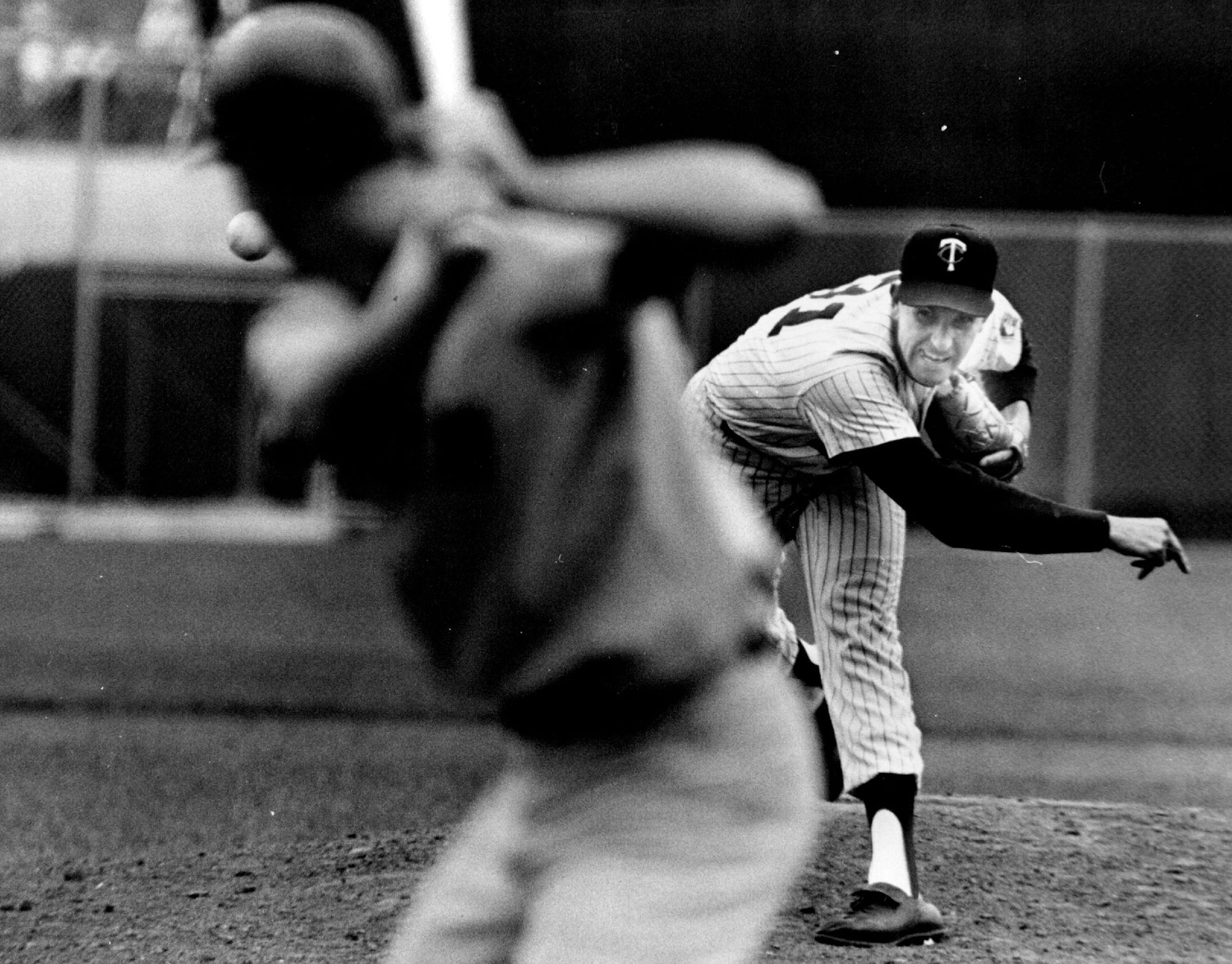
Jim Perry grimaces with effort as he fires a fastball past Boston's Carl Yastrzemski on August 8, 1965. (John Croft/The Minnesota Star Tribune)

Jim Kaat would have been the first winner of the Cy Young Award for the Twins in 1966, other than for the fact it was the final season in which the Baseball Writers Association of America voted for only the best pitcher to cover both major leagues.

There were also only first-place votes and that lefthander with the Los Angeles Dodgers, Sandy Koufax, had developed a habit of getting all 20 of those votes.

Kaat had been the losing pitcher when Koufax beat the Twins, 2-0, in the seventh game of the 1965 World Series. And a year later, Kaat knew that his magnificent season — 25-13, 2.75 ERA, 304⅔ innings — would again cause him to suffer a shutout loss to Koufax in Cy Young voting.

The Twins’ lefthander did get an excellent consolation prize: the Sporting News’ American League Pitcher of the Year, back when that weekly newspaper still was “Baseball’s Bible.”

Kaat was among four Twins at Target Field on Saturday night to take a bow in this 60th anniversary for our first World Series. Also here was the pitcher that did win that first Cy Young for the Twins: Jim Perry in 1970, 24-12, 3.04 ERA, 278⅔ innings in 40 starts.

Forty. And none as a designated opener.

“Where’s the Cy Young Award now?’’ Perry was asked Saturday morning.

Now 89, Gentleman Jim smiled and said: “It’s at the college, where visitors can see it.’’

ADVERTISEMENT

The college would be Campbell University in Bules Creek, N.C., two hours west of the Perrys’ hometown of Williamston in eastern North Carolina. Jim attended Campbell when it was a junior college in the 1950s. The Fighting Camels’ ballpark is Jim Perry Stadium.

“Camels’’ also figured in the upbringing of Jim and Gaylord Perry, a historic pair of pitching brothers, as young men. Their parents, Evan and Ruby, made a living off farming roughly 50 acres of tobacco.

“Summer, we’d work in the field for a few hours, and then we’d go to town and play ball.’’ Jim said. “We won the state tournament in high school. I was two years ahead of Gaylord. I would pitch a game and Gaylord would play third. Then, he’d pitch and I would play third. We had nine shutouts in a row one season.”

Think of this for a moment.

On Saturday night, there were four members of the 1965 American League champions on the field before the game with Detroit:

Jim Perry, started life on a small tobacco farm in North Carolina; Tony Oliva, started life on a small tobacco farm near Pinar del Rio, Cuba; Jim Kaat, raised in the small, all-Dutch town of Zeeland, Mich.; and Dick Stigman, the lefthanded fast-baller from Nimrod, Minn. (current population: 82).

And what do all these winning Twins have in common? Never went to a showcase or swung a $350 metallic bat.

And now — back to breakfast with Jim Perry, sought out on this rare return visit because I’ve decided he is probably the most underappreciated Twins’ great in the minds of newer generations of team followers.

Perry signed with Cleveland in 1956 and was sent to the bottom-rung of pro ball: Class D in North Platte, Neb. Three springs later, the Indians had him ticketed for Class AA, but manager Joe Gordon and his pitching coach Mel Harder wanted him in the big leagues.

“I was 23 when I broke in and 39 when I finished in the majors,” Perry said. “You know how many times I was on the disabled list? None.

“A big reason for that — I would run. Almost every day. I ran to keep the body in shape, keep the legs in shape. Strong legs, strong arm."

We liked Jack Kralick in those early Twins’ days — one reason being the lefthander pitched the Twins’ first no-hitter against the Kansas City A’s on Aug. 26, 1962. So, as fans, we weren’t all that happy when the Twins traded Kralick to Cleveland for Perry on May 2, 1963.

Owner/GM Calvin Griffith out-foxed the fans on that one, as he had a tendency to do before payroll became a more vital issue in MLB.

Perry pitched here through the 1972 season — nearly 10 full seasons. He had 128 of his career 215 wins for the Twins. He was a full-time starter, or a reliever and, for sure, the greatest spot starter in Twins history:

Meaning he could come in as a reliever twice in four days, and then make a start when an injury or a doubleheader piled up.

“I was always available to pitch,” he said.

He paused, shook his head and said: “You know when I should have pitched — one of those two games in Fenway Park at the end of ‘67, when we needed one win to go to the World Series? I pitched well there. That ‘Wall’ didn’t bother me.

“You know who was mad about it? Harmon [Killebrew]. He came up to me and said, “Jim, if you had pitched, we’d be going back to the World Series.”

The Perrys stayed in Minnesota even after he was traded before the 1973 season. Pro golfer Chris (he had a PGA Tour win) and his two sisters graduated from high school in Edina. Jim and Daphne moved to Sioux Falls for business, then back home to North Carolina in 2004.

They have gotten back for the 50th and now 60th reunions for the ‘65 AL champions. And, dang, if manager Cal Ermer had pitched Perry on that last weekend in Fenway, Jim and Daphne might have had another appointment here in two years.

about the writer

about the writer

Patrick Reusse

Columnist

Patrick Reusse is a sports columnist who writes three columns per week.

See Moreicon

More from Twins

See More
card image
Mike Janes

Winokur, a 6-foot-6 shortstop and center fielder, hit .226 with 17 homers, 68 RBI and 26 stolen bases in high Class A this year.

card image
card image