

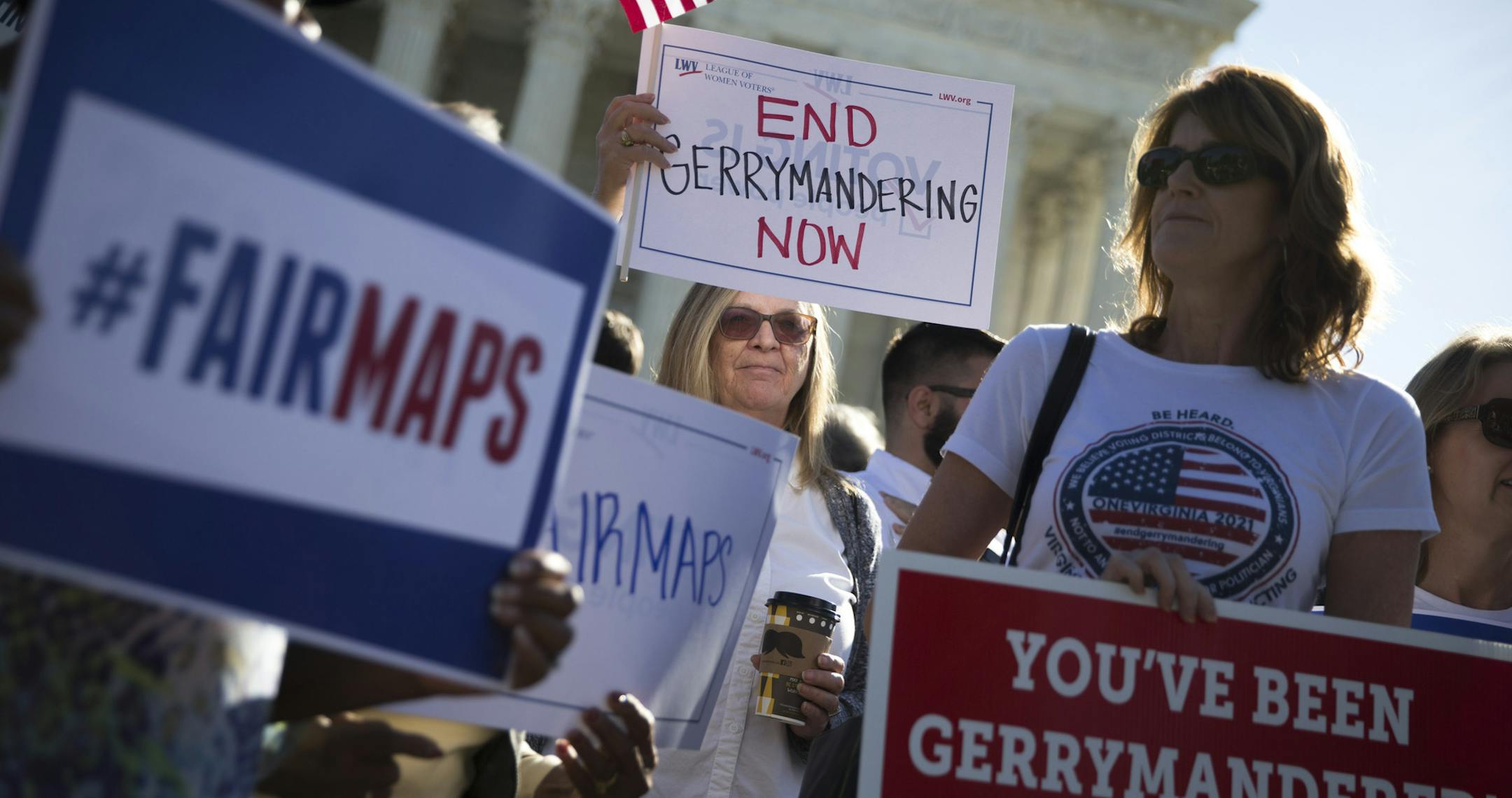
Virginia Democrats achieved something they have been dreaming about for some time — control of the Legislature and governor's office ("Democrats' Southern victories could affect redistricting," StarTribune.com, Nov. 18). Now they can pursue their policy agenda, including creating a fair process for redistricting that will let voters choose their representatives instead of the representatives drawing maps that allow them to choose their voters. It's called gerrymandering and is a corrupt way of deciding elections. Now, though, Democrats in Virginia may be backing away from the plan to create an independent, transparent process.
In Minnesota there is a chance that Democrats could control the Legislature and governor's office in 2021 when the next redistricting process occurs, after the 2020 census. Some Democratic legislators have worked very hard and even drawn up in the House and Senate legislation that would create a fair, voter-focused, transparent process for our state. It would be a huge mistake if the Legislature were to succumb to the political forces we have come to recognize in government at the state and national levels and not enact reform. We need better. We need our legislators to recognize the urgent need for real leadership to restore the faith of citizens in government.
Our democracy is under threat from many angles. We need legislators who will meet that threat and strengthen the infrastructure of democracy by creating a truly fair, transparent and voter-driven process for drawing legislative and congressional district lines. Real democracy demands fair maps.
Gary Fifield, St. Paul
HEALTH CARE
This Band-Aid doesn't fix the issue with a free-market approach
The recent commentary on health costs ("A good first step by Trump," Nov. 25) is full of contradictions. The authors, from the Economist magazine, seem certain that classic, "free market" principles will fix health care. But they list a number of complications and conclude that "health care is not a normal market." Indeed.
One complication is the dream of making medical choices into something like a restaurant menu. How many restaurants have thousands of selections? That is the number of Current Procedural Terminology codes promulgated by the American Medical Association to describe actions your doctor may take. Trump's transparency program would publish prices for 300 of them. Will a drop in the bucket really change the whole bucket? And how often does a procedure involve just one simple thing? And have you tried reading the descriptions of medical procedures? Good luck understanding that menu.
The Economist authors offer yet another reason why their "free market" ideal will not work. Not only has choice of hospital been limited by consolidation, but most of us are essentially excluded from hospitals and other providers that we might have chosen from our mythical menu. That is because commercial health insurers have divided up our "market" into walled gardens called health care networks. Our current system for financing health care specifically prevents us going to the provider of our choice.
The essay might best be seen as a failed defense against the increasingly obvious solution to these problems: universal health care based on single-payer financing.
Joel Clemmer, St. Paul
HOUSING
That solution is not quite it
U.S. Rep. Ilhan Omar's monumental affordable housing bill rightly calls attention to the federal government's failure to fund its housing programs according to rising need ("Rep. Omar proposes $1 trillion for housing," Nov. 22). She underscores the fact that housing investment is an investment into the health and well-being of Americans. But Omar shouldn't assume that every state needs the thousands of new units she has proposed. For instance, while the vacancy rate is low in Minnesota, the state housing agency reports that at current levels of production, the amount of rental housing will soon be in line with demand. What is needed is housing assistance so low-income renters can afford the rent. In this state and much of the country, communities would be better served if states had the option to use as rental assistance the new housing resources proposed by Omar.

