

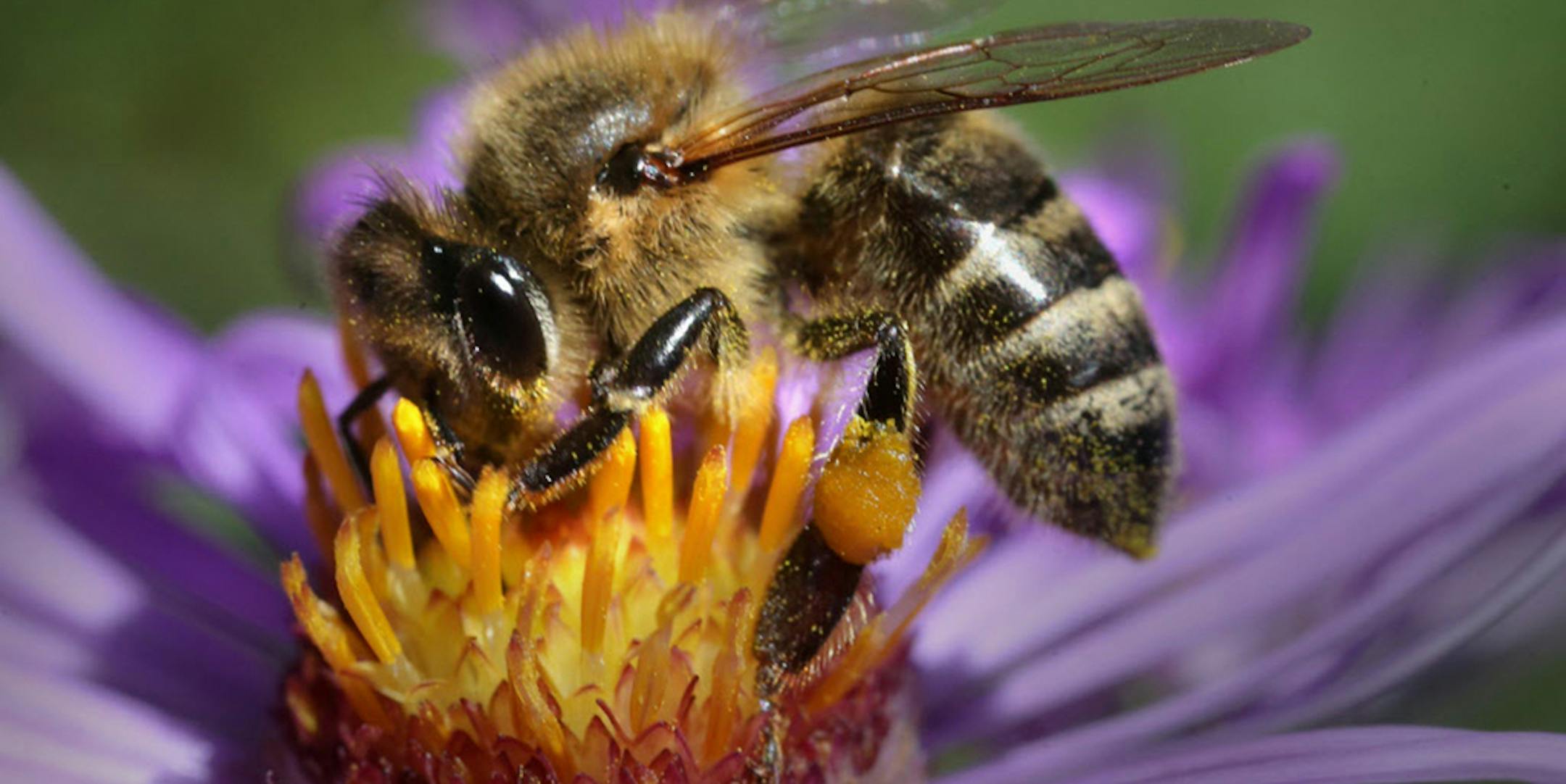
My name is Elliot, and I am in fifth grade. I am going to tell you about why we are learning about bees. Bees are important because one-third of the things we eat are pollinated by bees. A few of the things that we like the most that are pollinated by bees include: almonds, corn, apples.
One way to save bees is to not use pesticides. Pesticides can kill us, so why would we think they would not hurt bees as well? Monoculture is another way bees can be at risk. Monoculture is when there is one type of crop and bees are released together to pollinate it. But bees should be fed many types of pollen. It is a lose-lose if the bees die, because we don't get a lot of the food that we need!
Please consider helping bees by planting bee-friendly flowers, by not using pesticides and even making farms that only have bees and many types of crops. It will save us and bees! I want my city to become the first registered Bee City in the state of Minnesota. Please help us!
Elliot Thompson, Maple Grove
WOMEN IN POWER
If you truly care about women, you're in the wrong political party
It would be easier to empathize with former Republican state Senate Majority Leader Amy Koch's unfair treatment ("Few know the public shame of private scandal," Opinion Exchange, Oct. 31) if her deeply conservative behavior as a senator were not so hypocritical to her personal life. She and the party she represents have demonstrated that they are much more interested in corporate rights than the rights of the LGBTQ community, voter rights, social equality, climate justice or women's rights.
According to a recent poll by LeanIn.org, less than a third of Republican voters say they are "very ready" for a woman to be president. More than 70% of Democratic voters are in this category. I suggest she look at membership in the alternative party, if she is truly interested in women being allowed to rise on their merits, no different than men.
Mark Andersen, Wayzata
BOY SCOUTS
Don't let the past tar the future
Here we go again with the relentless negative press about the Boy Scouts of America, which is raising rates to pay for sex-abuse lawsuits ("Boy Scouts to boost annual youth fees by over 80%," Nov. 1). Yes, it's true that some of the leaders abused kids in the '60s, '70s and '80s, as in schools, churches, sports, theater, etc. What you never hear about is what the BSA has done to prevent this from happening since at least 1989.
As a former Scout and current leader, I can attest that the BSA has one of the most comprehensive and effective youth protection programs in existence. All adult leaders are required to take youth-protection training every two years and no adult is allowed to be alone with a Scout unless it is their child. Also, each unit does yearly education for all Scouts and parents on issues such as sexual abuse, cyberbullying, etc. These are difficult and uncomfortable topics to discuss, but the BSA tackles them head-on. I applaud the BSA's commitment to youth safety and wholeheartedly recommend the program to appropriate-aged youths, regardless of gender, ethnicity, religious beliefs or sexual orientation. All are welcome!
Jeff Hickstein, St. Louis Park
LEAD POISONING
Most exposure comes from homes
If you really want to help families avoid lead exposure for their children ("Get serious about this poison," Readers Write, Nov. 1), I suggest you read a report the Minnesota Pollution Control Agency published in 1987 titled, "Soil Lead Report to the Minnesota State Legislature." It was a joint effort by the Minnesota Pollution Control Agency and the Minnesota Health Department. It was driven by legislation in 1985 directing both agencies to determine if there was a lead issue in the state and if so to recommend corrective actions. I was one of the principle authors for the MPCA and Dr. Mark Schmitt did most of the statistical analysis. We concluded that lead-based paint was by far the largest factor in causing lead toxicity in children. Home interiors were the greatest factor, with lead-contaminated soil around the base of houses painted with lead-based paint next.

