

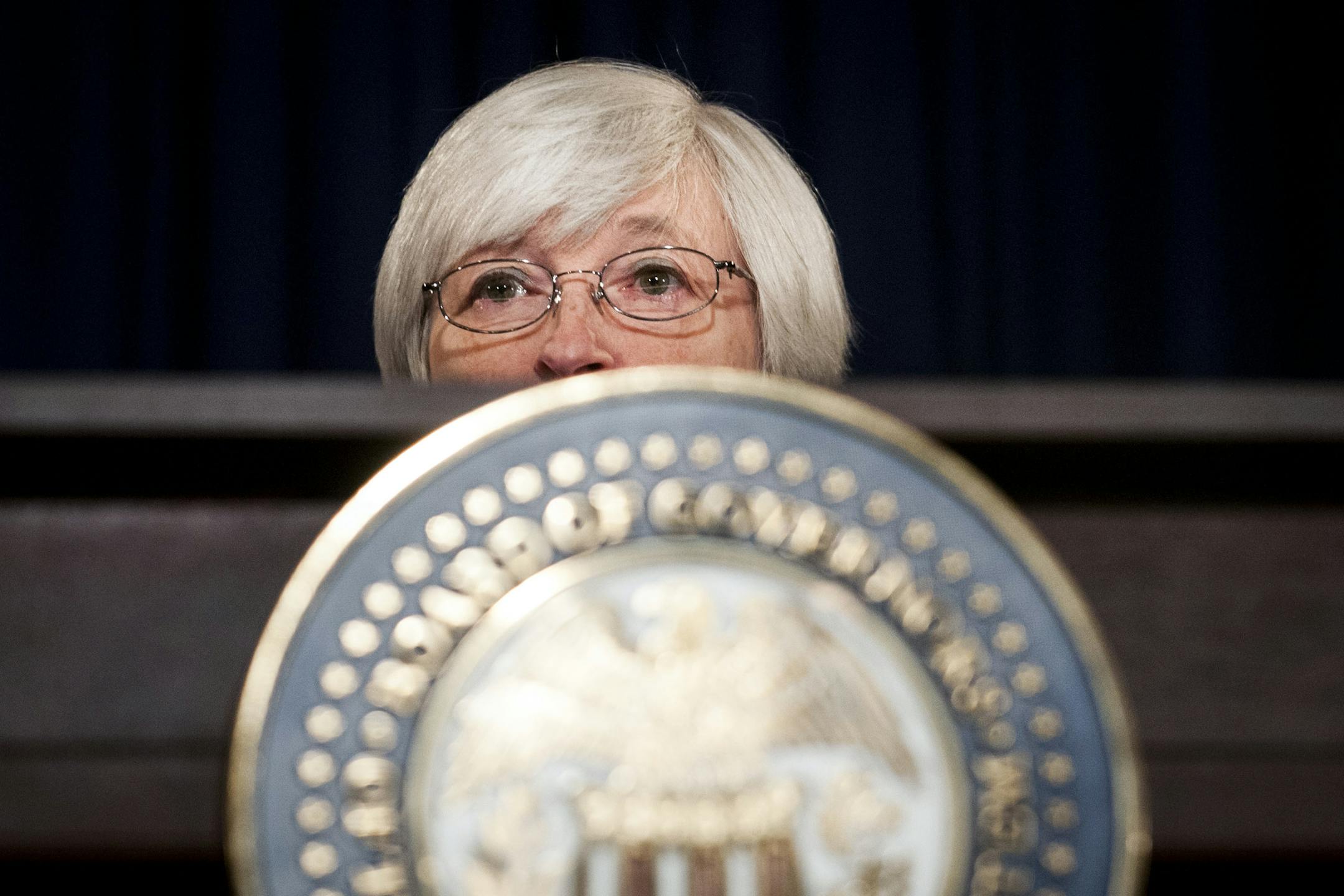
Don't blame Janet Yellen for what she said. Blame her for what she's doing.
Last week, Yellen had her first news conference since becoming chairwoman of the Federal Reserve. She said, in answering a question, that the Fed would probably raise interest rates "around six months" after its quantitative-easing program ends. The remark is being called a "gaffe" that caused stocks to fall. The Standard & Poor's 500 Index fell 1 percent in the seconds after she made the comment.
Some of Yellen's critics fault her for being too forthright and specific. The Fed often gets knocked for being unclear, they say, but opacity has its virtues. This critique seems off the mark. If the Fed really does intend to tighten monetary policy six months after QE ends — or roughly next spring, if present trends continue — the market will have to adjust to that event soon enough. In that case, specificity would be no sin.
But Yellen's other remarks at the news conference suggest that the Fed doesn't desire to be ruled by the calendar. Economic conditions will guide its decisions. It expects those conditions to justify tightening early next year, but it isn't committed to tightening if conditions develop in some unexpected way.
To the extent Yellen's remarks were problematic, then, it was not because they made the Fed more transparent but because they made it less so. They may have been misleading about the central bank's intentions, making it seem as though the Fed were more eager to tighten money than it is.
The Fed's communications strategy is important, and not just because it can produce short-term swings in the stock market. Fed policies work in part — many economists would say in large part — through their effect on market expectations. So when the Fed leads the market to think that it's going to tighten monetary policy in the future, it tightens money in the present. A Fed that doesn't want tighter money but misleads people into thinking that it does is accidentally tightening it.
In this case, though, the muddled communications aren't a gaffe. They reflect a muddled policy. The markets are obsessed with every syllable Yellen utters because they're so unsure about what the Fed is going to do. Its behavior is difficult to predict. It has acted in an ad hoc way for the past several years and has never bound itself to any rule.
The Fed has not said, for example, that it would take undershooting its 2 percent inflation target as seriously as overshooting it. It has not said, to take another example, that it would seek to keep spending throughout the economy growing at a 4.5 percent rate each year. Either rule would make the Fed's behavior under various circumstances predictable and make it easy to see whether it had succeeded or failed in hitting its target.


