
Wrist wrap nudges you to mind your health

The bracelet syncs with an iPhone app to track your everyday habits.

November 28, 2011 at 6:34PM
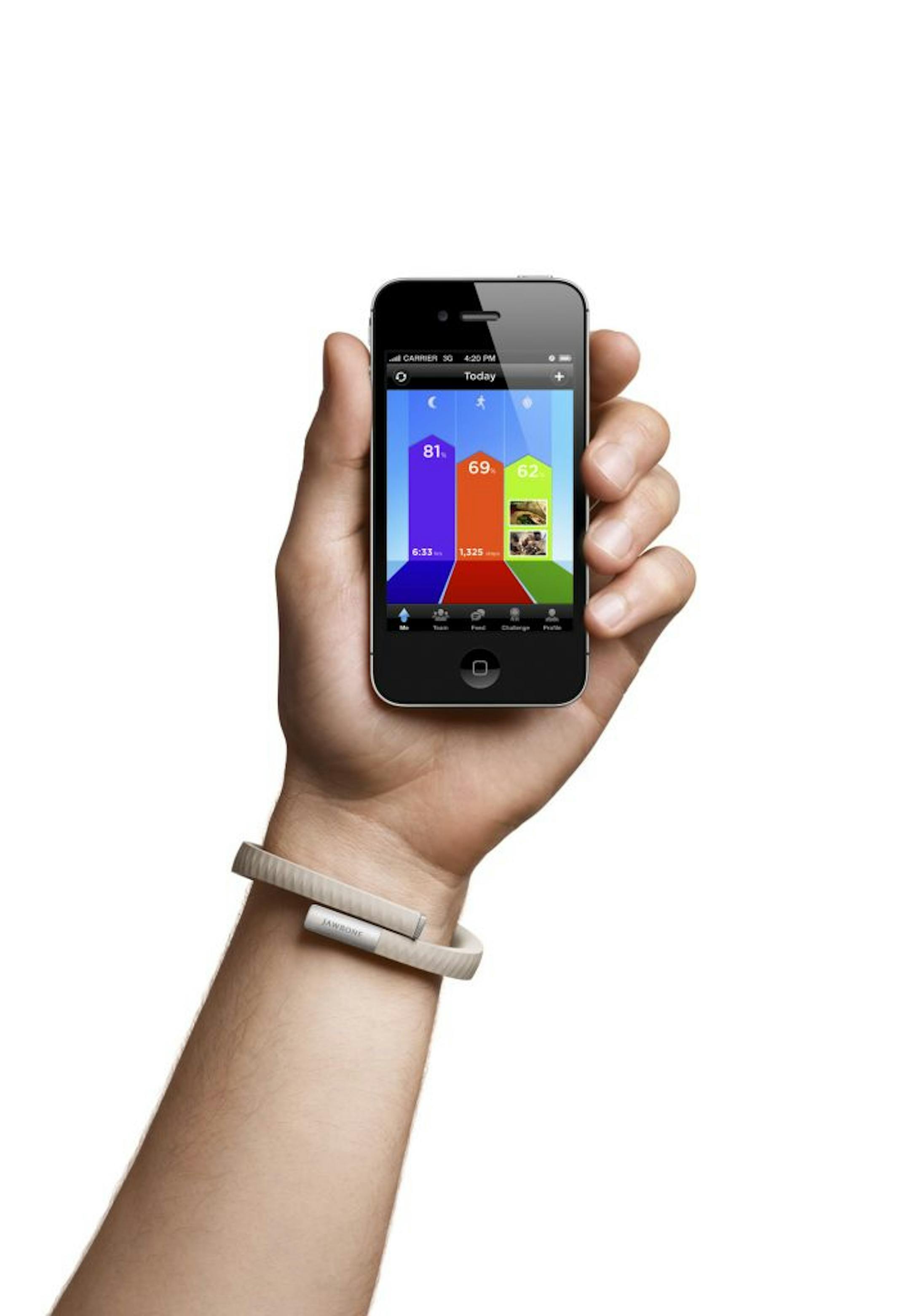
The Up band syncs with the iPhone, and aims to gently -- and stylishly -- prod us into making better choices.
The Up band syncs with the iPhone, and aims to gently -- and stylishly -- prod us into making better choices. (Jawbone/The Minnesota Star Tribune)

Get up and move. That candy bar isn't going to feel like such a good idea in a couple hours.

These are reminders most of us need from time to time.

The Up band, a stylish band that syncs with the Apple iPhone, aims to gently prod us into making better choices.

Up syncs with an app that tracks sleep patterns, food intake and general physical activity.

Its motion sensors tell you what percentage of your night was spent in deep and light sleep and chart it on a graph. In the morning, you can see a sleep quality ranking from zero to 100.

This is where Up is at its most useful -- a window into a part of our lives that many of us know little about.

During the day, it tracks movement, telling you how many steps you've taken. It can also vibrate to tell you when you've been sedentary for too long -- a reminder to get up and move.

The Up band comes from Jawbone, the maker of supremely stylish Bluetooth headsets for cellphones and the Jambox, a portable wireless speaker.

The Up is more of a cheerleader than a coach. It pushes you in the right direction, but doesn't necessarily tell you how to get there.

It uses a very general metric to track food consumption. You're asked to take a photo of the meal and name it. Three hours later, the app will ask how you're feeling.

Feel great? Excellent. Feel not-so-great? Try better next time.

The app doesn't attempt to give you any more information about the food you eat -- no insight on calories or nutritional content.

There's certainly a shame component, too, that's meant to incentivize better choices -- it's not all that fun to take a photo of a combo from McDonald's.

And, knowing that the Up is tracking how much a user moves might lead to a parking spot a bit farther away from work or the grocery store.

But don't expect Up to replace more specialized exercise tracking systems like Nike+ or apps like RunKeeper.

In reality, the Up doesn't know if you're power-walking at the mall, erasing a whiteboard, shampooing your hair or waving atop a convertible in an hourlong parade.

Jawbone says the battery will last 10 days. After seven days of use, my battery was at less than 10 percent. It charges through a USB attachment.

The most useful part of the Up was the alarm function. The band quietly vibrates to wake you gently. If you set an alarm for 6 a.m., the Up will wake you up between 5:30 a.m. and 6 a.m. and vibrate when it senses you're sleeping lightly, which is intended to make the alarm less jarring.

It feels good on the wrist and it's light enough to quickly fade away from attention.

Its profile is a bit higher than desirable. Putting on a suit coat proved to be quite cumbersome, with the band snagging with each time my arm passed through.

My biggest issue with Up is that it feels like a transitional device -- one that will very soon come repackaged in a simpler, more powerful form. Up's functionality could soon be embedded in a line of watches or even in a smartphone we already have in our pockets all day.

The software also feels half-baked. The syncing process, which is not wireless, is done by plugging the band into the iPhone's headphone jack. The app didn't always recognize that I had plugged in the band.

The bar graphs displaying movement and sleep patterns are only very general depictions. It's not possible to zoom into them and see, for example, what time in the middle of the night you were snapped out of a deep sleep.

The Up's motives are sound, but the execution is not.

With each step, I wanted the Up to do more.

The Jawbone Up is $100 and available from Apple, AT&T, Best Buy and Target.

about the writer

about the writer

MARK W. SMITH, Detroit Free Press