
Would-be candidates make most of fundraising rule

Would-be presidential candidates make the most of fundraising rule.

April 6, 2015 at 10:21PM
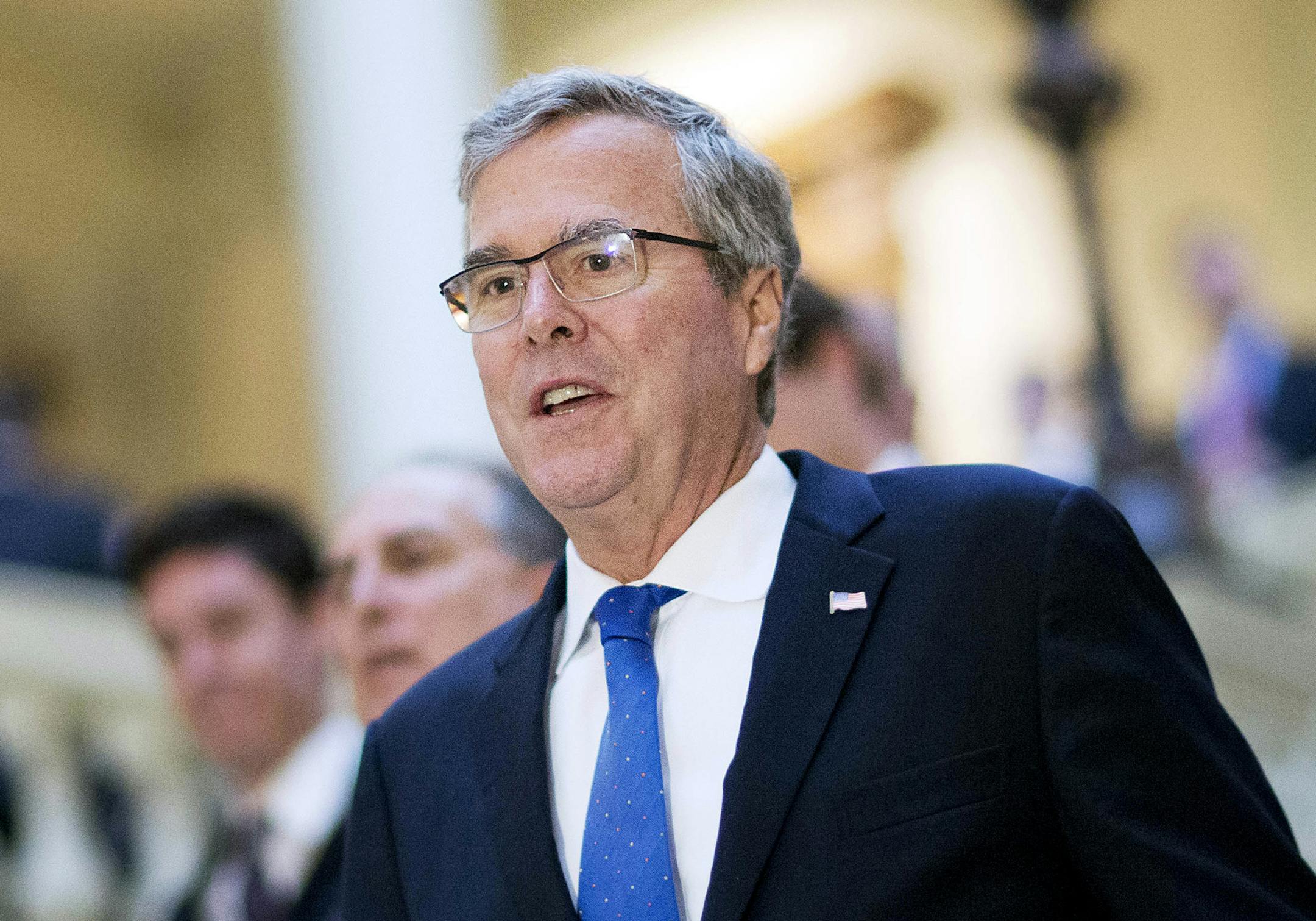
FILE - In this March 19, 2015 file photo, former Florida Gov. Jeb Bush visits the Georgia Capitol in Atlanta. Republicans hoped to avoid a debate over social issues heading into the next presidential contest. Yet the backlash over a so-called religious freedom law in Indiana is highlighting the party’s overwhelming opposition to same-sex marriage and forcing the GOP’s leading presidential contenders to weigh in. “I think Gov. Pence has done the right thing,” former Fl
FILE - In this March 19, 2015 file photo, former Florida Gov. Jeb Bush visits the Georgia Capitol in Atlanta. Republicans hoped to avoid a debate over social issues heading into the next presidential contest. Yet the backlash over a so-called religious freedom law in Indiana is highlighting the party’s overwhelming opposition to same-sex marriage and forcing the GOP’s leading presidential contenders to weigh in. “I think Gov. Pence has done the right thing,” former Florida Gov. Jeb Bush said in a March 30, radio interview. He said the law was "simply allowing people of faith space to be able to express their beliefs.” (AP Photo/David Goldman, File) (The Minnesota Star Tribune)

WASHINGTON – The charade comes to an end this month for many of the 2016 presidential contenders, who have long avoided saying they are running — while they are so obviously running — in order to sidestep rules that burden declared candidates.

Ted Cruz is already in. Rand Paul is expected to follow suit Tuesday. Marco Rubio has a big announcement planned a week later.

The timing, like most things in politics, is driven by money. April marks the start of a sprint to raise as much of it as possible for an official candidacy before the summer reporting deadline, which lands as televised primary debates are about to get underway. Candidates who fail to show that the early big money is flowing into campaign accounts could quickly falter.

One big exception is Jeb Bush. Although he is perhaps the least coy of the pre-candidates about his plans to run — and among the most aggressive fundraisers — his announcement may not come for a while.

Because of his support from big donors and the fact that he holds no federal office — unlike Cruz, Paul and Rubio, all Republican senators — the former Florida governor is ideally positioned to take advantage of massive holes that have been poked in campaign finance laws in recent years.

So long as he doesn't say the magic words "I'm running," Bush contends that he can raise and spend unlimited sums through a so-called super PAC under his control.

His ability to do so reflects the extent to which long-existing federal constraints on raising political cash that had eroded badly by 2012 have melted away. Though super PACs are supposed to operate independently of candidates, even that prohibition on the group's activities disappears because Bush has not explicitly announced he is running for president.

Instead of assembling an official campaign apparatus, Bush is trailblazing into a new frontier of super PACs. It is a place off-limits to most of his GOP competitors, who are inhibited by conflict-of-interest rules that limit how much money lawmakers can solicit and from whom.
"This is entirely new ground," said Paul Ryan, senior counsel with the nonprofit Campaign Legal Center. "No candidate or prospective candidate has ever done this before. … The boundaries are getting pushed further and further."

Bush did declare he would impose a total cap on how much each donor could contribute, the Washington Post said. But it wasn't the $5,000 maximum that those in the race are limited to asking for by law. It was $1 million.

While Bush is moving into uncharted territory, he is also following a family tradition. Both his father, former President George H.W. Bush, and brother, former President George W. Bush, built their primary victories around robust early fundraising.

The other star pre-candidate positioned to vacuum up so much cash, so quickly, is Hillary Rodham Clinton. Clinton, though, is on a different timetable. The Democratic primaries are shaping up to be a mere formality for her, with no serious opposition. She has yet to start fundraising aggressively.

FILE - In this March 19, 2015 file photo, former Florida Gov. Jeb Bush visits the Georgia Capitol in Atlanta. Republicans hoped to avoid a debate over social issues heading into the next presidential contest. Yet the backlash over a so-called religious freedom law in Indiana is highlighting the party’s overwhelming opposition to same-sex marriage and forcing the GOP’s leading presidential contenders to weigh in. “I think Gov. Pence has done the right thing,” former Fl
Bush (The Minnesota Star Tribune)
about the writer

about the writer

Evan Halper, Tribune Washington Bureau

More from No Section

See More
FILE -- A rent deposit slot at an apartment complex in Tucker, Ga., on July 21, 2020. As an eviction crisis has seemed increasingly likely this summer, everyone in the housing market has made the same plea to Washington: Send money — lots of it — that would keep renters in their homes and landlords afloat. (Melissa Golden/The New York Times) ORG XMIT: XNYT58
Melissa Golden/The New York Times

It’s too soon to tell how much the immigration crackdown is to blame.