

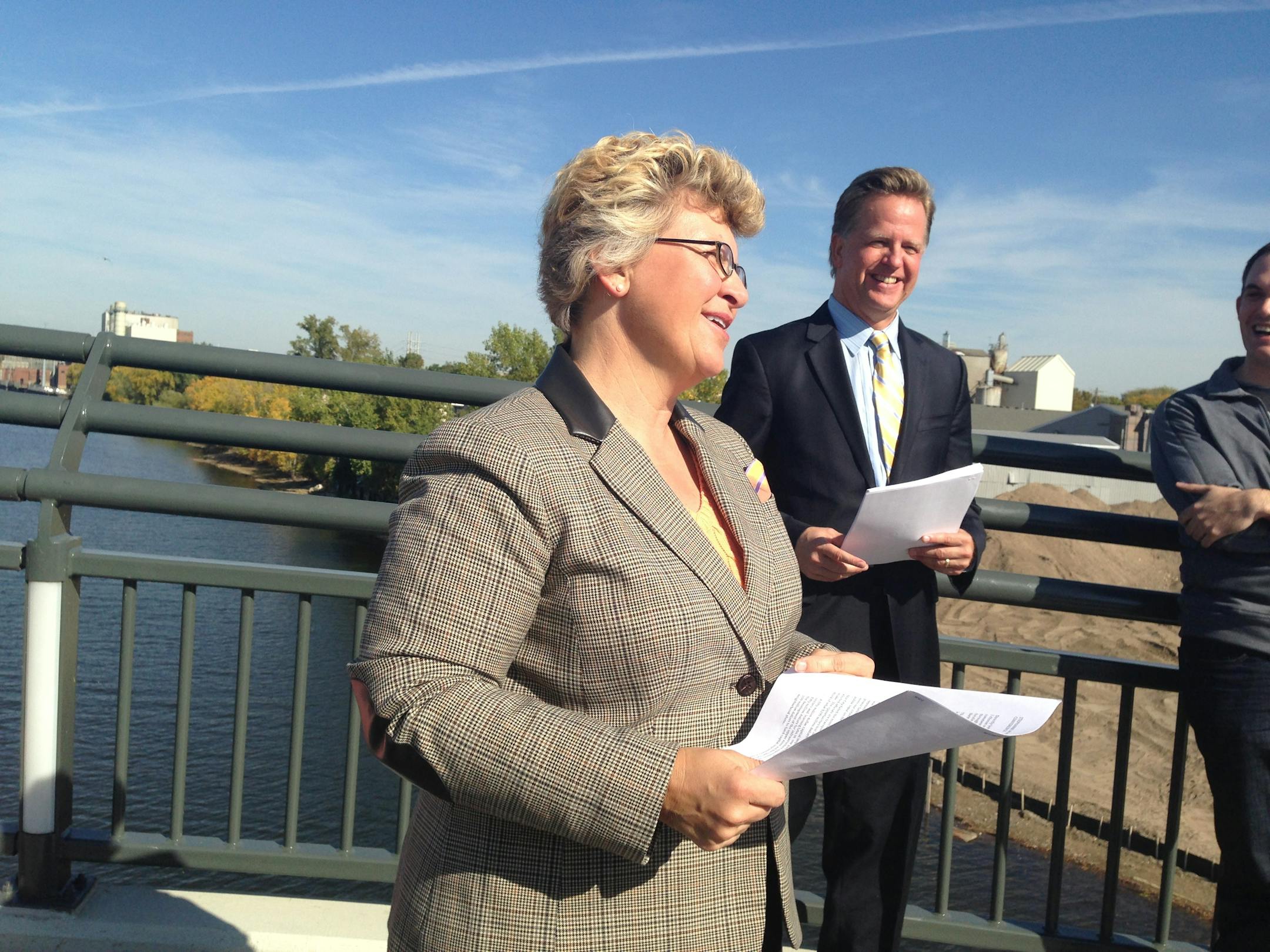
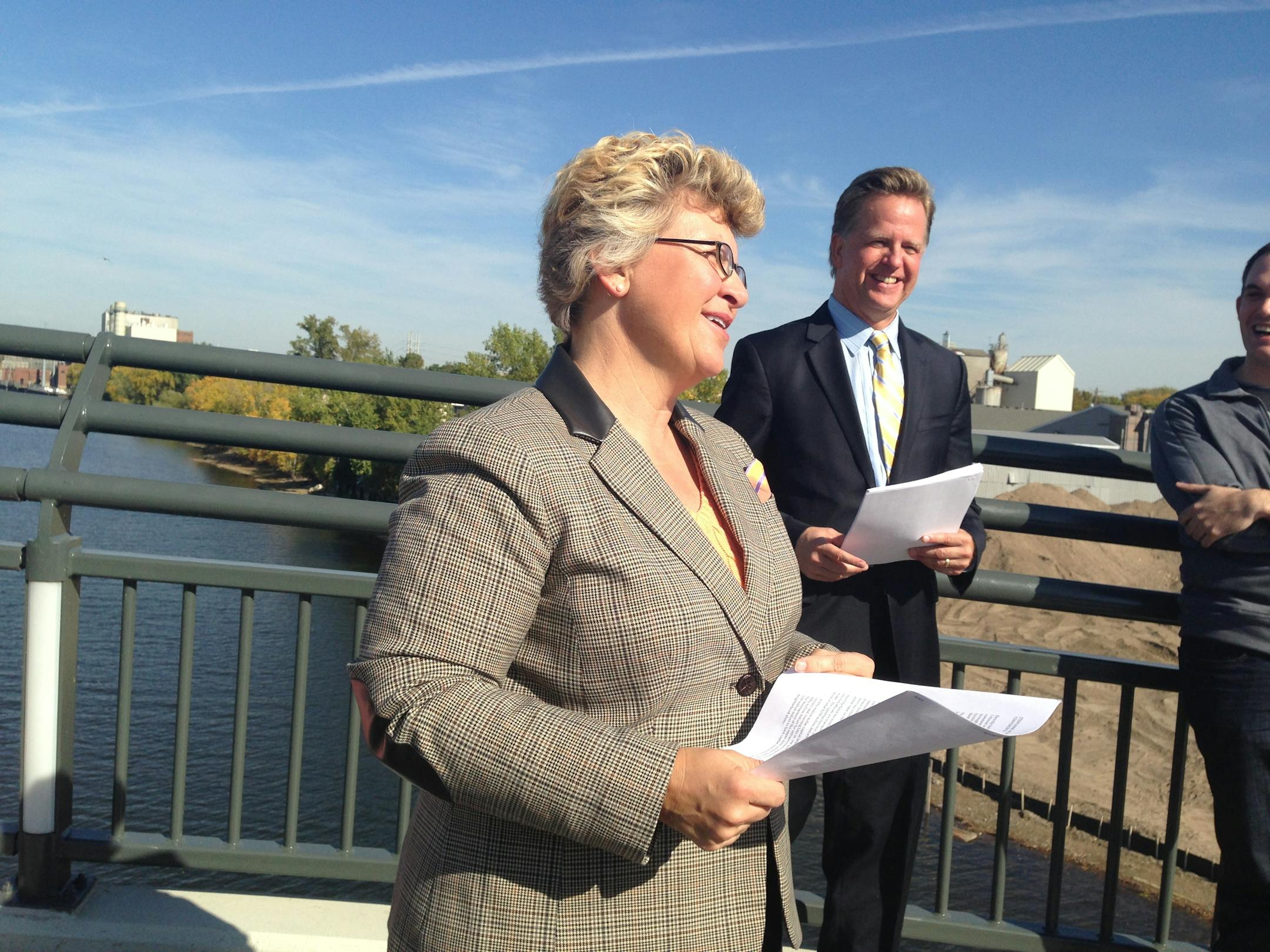
Mayoral candidate Stephanie Woodruff said Thursday that Vikings stadium boosters at City Hall misled the public during the 2012 debate, adding that city spending should be more transparent.
At a press conference on the Lowry Bridge, Woodruff observed that the taxes now committed to the Vikings stadium could have been used for other city projects -- counter to what the public was "led to believe," she said.
The suite of taxes -- a citywide sales tax, downtown liquor and restaurant taxes and a hotel tax -- currently pays down debt on the Convention Center, a process that will likely be complete in 2020. The Vikings stadium bill locked them in until 2045, directing much of the money to stadium costs and leaving excess for Target Center improvements and other city initiatives.
Rybak argued during the stadium debate that "the Legislature has the power simply to take [these taxes] from Minneapolis at will" and the city had no control over how to spend the money -- both of which, he said, be solved by the Vikings stadium bill.
He has since said that the Vikings stadium deal lowered taxes by $5 million a year by allowing the city to renovate Target Center (a process that has not yet begun).
Woodruff noted Thursday that they were never set to expire, however, and could have been used for other city priorities prior to the bill's passage. That statement resurrects an argument made by Rep. Diane Loeffler, DFL-Minneapolis, during the stadium debate.
"The people of Minneapolis were led to believe that the Vikings stadium deal would lower their taxes," said Woodruff, a software executive and member of the city's audit committee. "By dedicating $675 million dollars in future revenues to the Vikings stadium, they guarranteed further pressure on property taxes for decades."
State law prior to the Vikings bill said that the city "may use the excess revenue in any year to fund capital projects to further residential, cultural, commercial, and economic development in both downtown Minneapolis and the Minneapolis neighborhoods."


