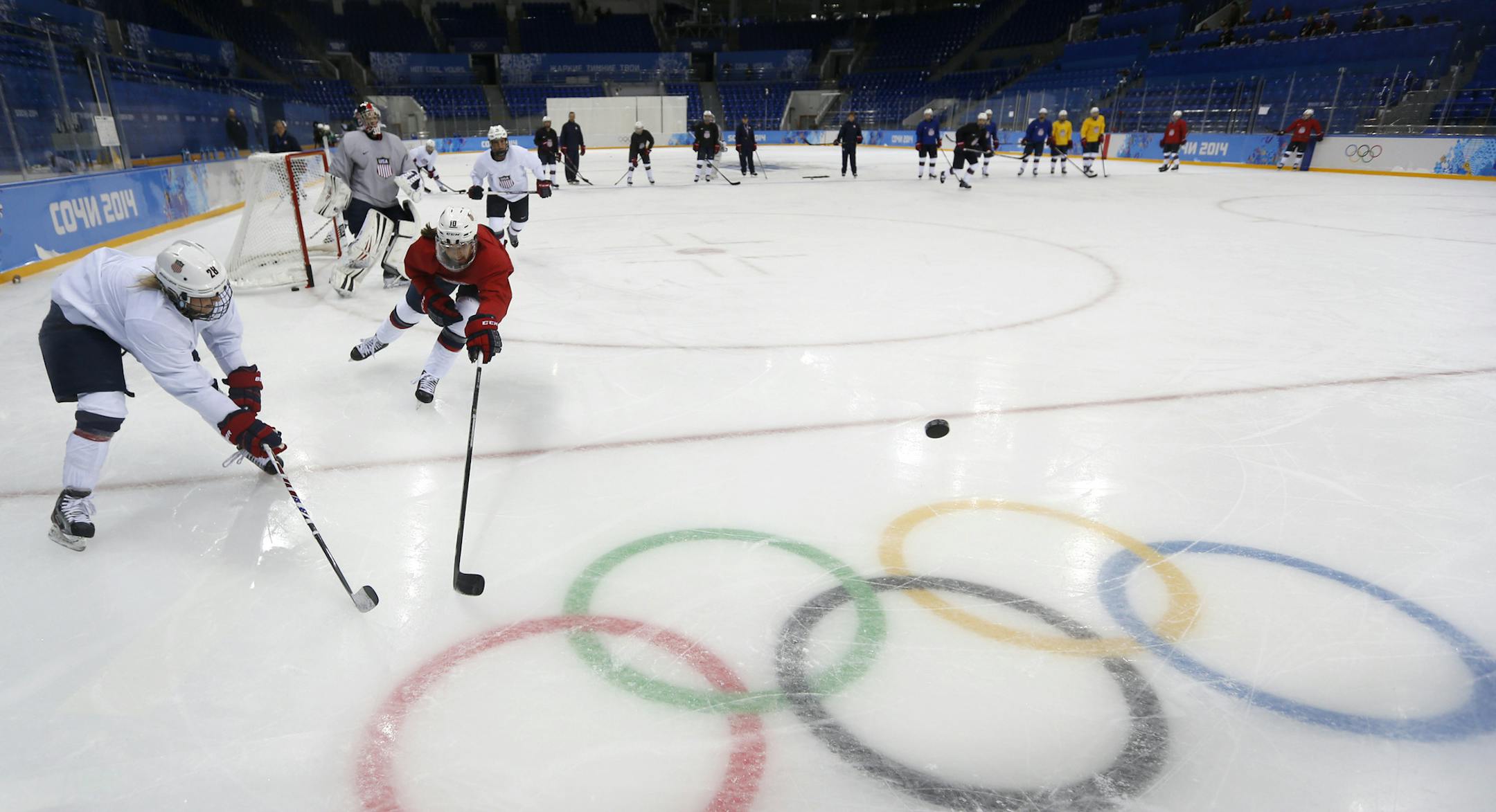
SOCHI, RUSSIA - It might seem downright un-American or un-Canadian, as the case may be, for Shannon Miller to root for Russia when the Olympic women's hockey tournament begins Saturday. But the Minnesota Duluth coach has a vested interest in the success of the home team at the Sochi Winter Games for reasons both personal and universal.
Miller has been mentoring the Russian women's hockey program for the past three years, as part of her sport's effort to bridge a chasm that threatened its Olympic survival. Either the United States or Canada has won the gold medal in every Olympic Games and world championships in women's hockey history, and they are heavy favorites to face off for another title in Sochi. But since the Vancouver Games, when the North American titans outscored their opponents 86-4, they have combined forces to give a helping hand to the nations struggling to catch up.
International Olympic Committee President Jacques Rogge issued a warning to women's hockey after the 2010 Olympics, saying "we cannot continue without improvement." The International Ice Hockey Federation (IIHF) responded with a four-year, $2.1 million campaign to pursue that goal, including mentoring programs, coaching symposiums and annual camps in which North American players tutor women from other nations.
Since Miller began advising the Russians, they have increased funding for women's hockey, sent the team to train in Duluth for two weeks and won the bronze medal at last spring's world championships. Several other nations have taken similar steps forward, and Miller said she expects to see even more progress in the years leading toward the next Winter Games.
"This was critical even without Jacques Rogge's comment," said Miller, a Canadian who coached her home country to a silver medal in 1998 in the sport's first appearance at the Olympics. "Women's hockey is a small world. We have to help the game grow.
"In the next four years, I think we'll see the biggest growth since the very beginning. The pieces are in place, and we won't go backward. We'll only go forward."
Some of the advances will be on display in Sochi. The Olympic tournament adopted a new format in which the top four teams and bottom four teams play in separate pools in the preliminary rounds, which should reduce the number of early blowouts. Japan, which has made huge strides with North American help, qualified for the Olympics for the first time since 1998; Switzerland and Russia, which also have seen sharp improvement, are expected to contend with the U.S., Canada, Finland and Sweden for medals.
That is a relief to American and Canadian players who understand they must share the wealth to ensure the long-term health of their game.