

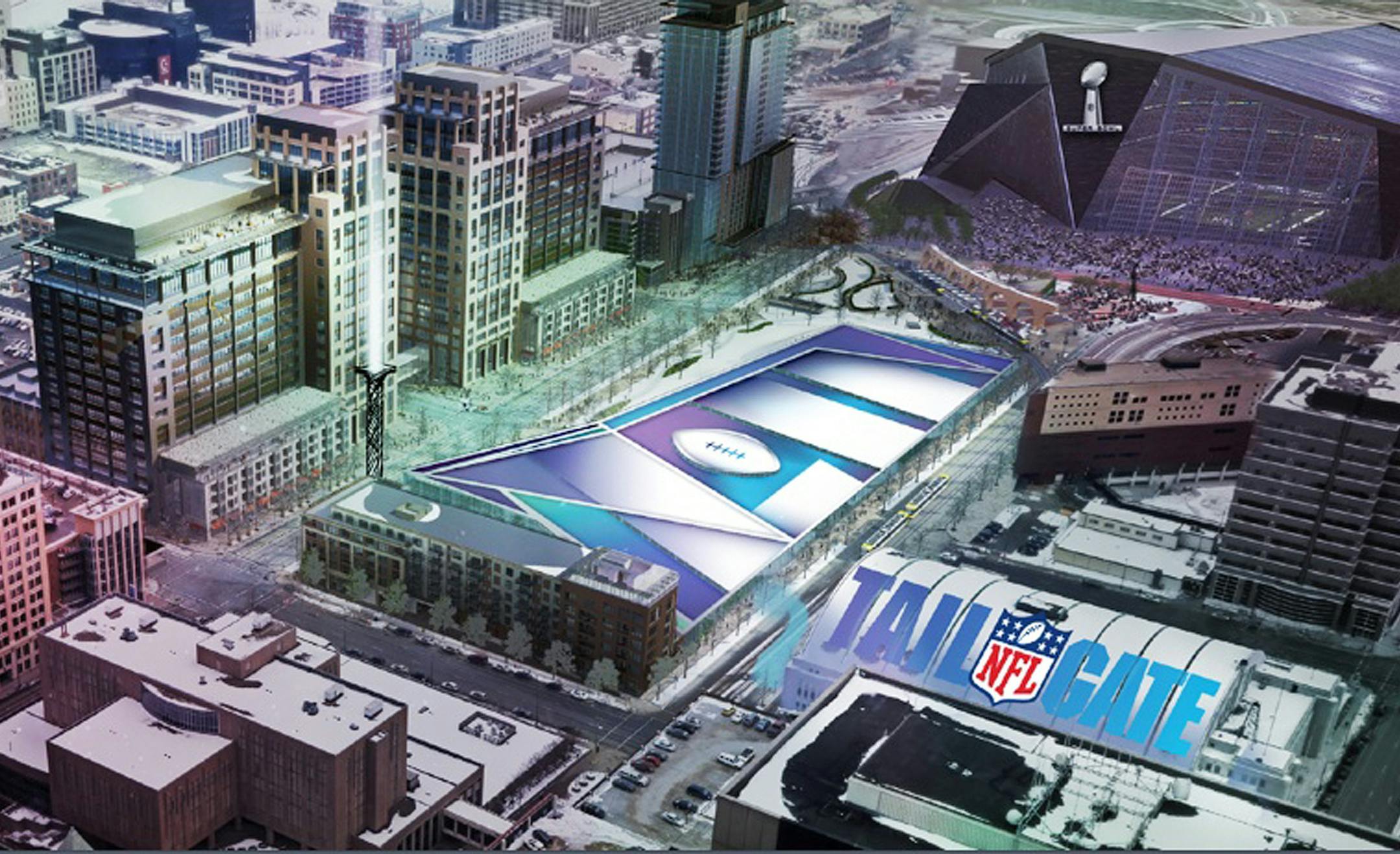
"Collaboration across sectors" is one of those insipid phrases that turns up in almost every major undertaking nowadays. That's because it's nearly impossible to accomplish anything big — say, a Vikings stadium in downtown Minneapolis or an adjacent park — without the financial contributions and willing cooperation of various governments, private companies and nonprofit groups, all with competing interests. The result is often a compromise that doesn't measure up to every expectation.
Such might be the case with "The Yard," the two-block-long park that will link the new stadium to the downtown core. Considering the intense competing interests of all the main players — the city, the Minneapolis Park and Recreation Board, Hennepin County, the neighbors, the team, the Minnesota Sports Facilities Authority (MSFA), the developer (Ryan Cos.) and a major corporate partner (Wells Fargo) — the Yard may emerge as a more flexible space than originally imagined, both in design and governance.
The public first glimpsed the Yard as depicted in Ryan's initial renderings: a lush public expanse of grass and trees framing the city skyline. Even in winter, with snow on the evergreens and skaters on a pond, the Yard was to be the "money shot" that defined our city and state to viewers worldwide, as well as a bustling activity zone for fans on game days and for neighbors and downtown workers on the other 355 days of the year.
But a newer image adds tents of various sizes and exclusive activities for Vikings ticket holders for at least 10 days a year, plus events sponsored by the MSFA on part of the park for as many as 40 additional days. During rare mega-events like the Super Bowl or the Final Four, garish tents could cover nearly the entire park space, largely to accommodate national security requirements.
The upshot is that, yes, the Yard still aims to be both active and attractive, but unfortunately with fewer trees and fewer permanent amenities (public art, fountains, cafes, etc.) than originally imagined, and with more open space for flexible programming, most of it public but some private.
While that doesn't rule out public skating in winter or soccer and outdoor movies in summer, all of the setting-up and tearing-down of tents and platforms will damage grass and other natural features and, more than that, will consume beauty and time that the public had expected to get. The Vikings, aside from their 10 gameday events, will be allowed 20 additional days for raising and striking tents, meaning that the team will control the park for at least 30 days during the football season.
As for the Yard's governance, the battle between City Hall and the Park Board appears headed toward compromise. The board may be willing to own the park as long as it doesn't have to pay the cost of operating and maintaining it, which would subtract from its neighborhood mission. As with heavily used downtown parks in other cities, operations and programming may fall to a conservancy made up of public and private partners.
That's a reasonable model to pursue. Former Minneapolis Mayor R.T. Rybak makes the point elsewhere in these pages that the same conservancy might also govern a newly remodeled Nicollet Mall, Peavey Plaza and the Gateway park envisioned just north of the downtown library. The Downtown Improvement District, already in place, seems a likely candidate for maintaining all of those spaces.


