

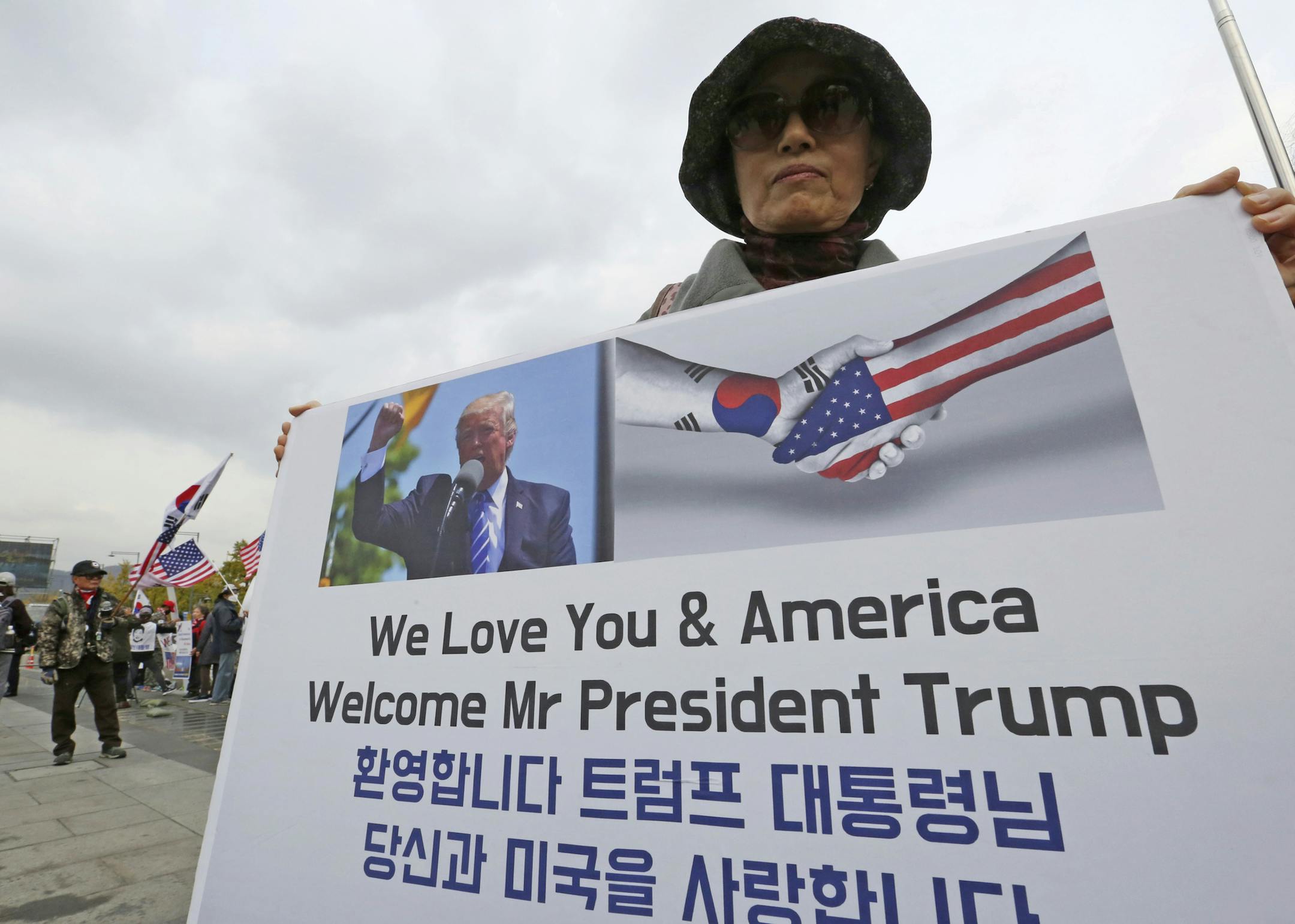
President Donald Trump's 12-day, five-country trip to Asia that begins Friday will include stops in Japan, South Korea, China, the Philippines and Vietnam. But Russia will loom large, as the continuing controversy over the 2016 election erodes the president's international standing.
As distracted, if not consumed, as Trump is over multiple investigations, he must focus on a unified international response to North Korea's nuclear weapons and ballistic missile development. Trump can also use the trip to improve the geopolitically crucial U.S.-China relationship as China rises as a global superpower.
The trajectories of the two countries' leaders couldn't be more different: Trump, buffeted by the Russian investigation and other domestic political challenges, is a beleaguered leader, feuding with members of his own party. China's Communist Party, conversely, just gave President Xi Jinping a new five-year term, did not name a successor and elevated him to Mao-like status in the country's Constitution. And while Xi is certainly no democrat, he is a capitalist, confidently embracing globalism at a time of U.S. retrenchment symbolized by Trump's strategically unwise decision to pull out of the proposed Trans-Pacific Partnership trade pact. Similarly, Trump sends the exact wrong message at exactly the wrong time by threatening to renegotiate the free-trade agreement between the U.S. and South Korea.
U.S. involvement in the TPP won't be resuscitated by Trump, but he would be wise to realize the benefits of multilateralism as he attends an Asia-Pacific Economic Conference summit in Vietnam and an Association of Southeast Asian Nations event in the Philippines. Indeed, Trump should have planned on staying one day longer to attend an annual East Asia Summit. Xi will be there, sending an important signal at a time when Southeast Asian allies look to Washington as a bulwark against Beijing's bellicose approach to territorial disputes in the East and South China Seas.
Asians yearning for reassurance that the U.S. abides by its historic support for human rights and rule of law need a signal, too. Accordingly, when Trump meets Philippine President Rodrigo Duterte he should not appear to condone Duterte's brutal rule and should specifically condemn his government's campaign of extrajudicial killings of suspected drug dealers and users, a policy that is an international scandal.
Given the current geopolitical gravity, Trump should work to bolster Asian alliances and work to further establish a balance with China. "We're not going to give up our alliances with our interests, but we're not going to stop China from growing more influential and more capable," Douglas Paal, vice president for studies at the Carnegie Endowment for International Peace, told an editorial writer.
Based on his hostility to his presidential predecessor, no one expects Trump to adopt former President Barack Obama's "pivot" to Asia. But Trump needs to prioritize diplomacy with allies and adversaries alike during, and beyond, this trip.


