

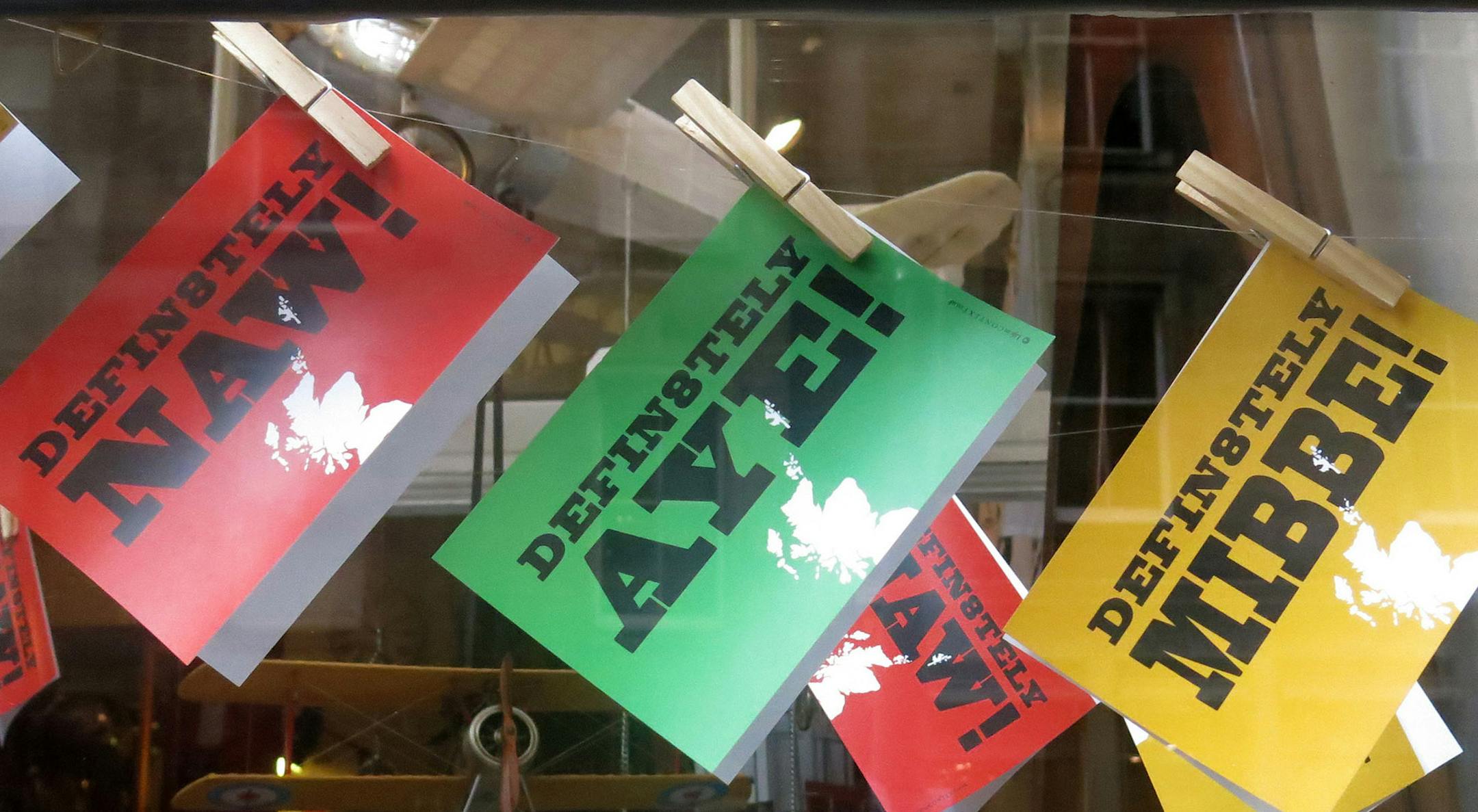
On Sept. 18, residents of Scotland will head to voting booths to answer the question, "Should Scotland be an independent country?"
The most recent poll suggests that they will say no — the pro-union Better Together campaign leads by 53 percent to the independence campaign's 47 percent. But why did Scotland feel the need to ask itself this question in the first place?
As long ago as 1962, President John F. Kennedy called for a global Declaration of Interdependence to complement the United States' Declaration of Independence of 1776.
Yet even today, in an era of global markets and global brands, nationalism has failed to disappear. Instead, by reworking the old idea that "small is beautiful," secessionist movements from Scotland and Catalonia to Flanders and Lombardy are campaigning for the rebirth of small independent states whose greater adaptability and cultural homogeneity, they claim, will make them economic success stories and paragons of social justice.
It has taken the Scottish National Party only a half-century to move from irrelevance — securing 0.5 percent of the Scottish vote in 1955 — to center stage as the majority government in the devolved Scottish Parliament.
What changed in the interim was not Scotland's sense of "Scottishness" — the country's distinctive identity has been a constant feature of its cultural and civic life throughout the Union With England, which dates from 1707. Scotland never became "North Britain," but equally, for three centuries, Scottish patriotism did not demand expression in a separate state.
What is new is the impact of global change. Scotland has been transformed from one of the workshops of the world to a service economy. At one point, Scotland's shipyards produced a fifth of the world's ships, and its manufacturing and mining sector employed more than 40 percent of Scottish workers. It now employs just 8 percent.
Scotland had to embark on a 50-year search for new skills, new jobs and a new prosperity — its real quarrel should be with globalization, rather than England. But just as, during the Industrial Revolution, nationalist movements sprang up as people tried to protect and shelter their communities against uneven and inequitable patterns of growth, Europeans are once again mobilizing around traditional identities, this time amid the insecurities of globalization.


