
Why is Minnesota's Democratic Party called the DFL?

We're the only state with a Democratic-Farmer-Labor Party. But why is that so?

January 25, 2020 at 7:37PM
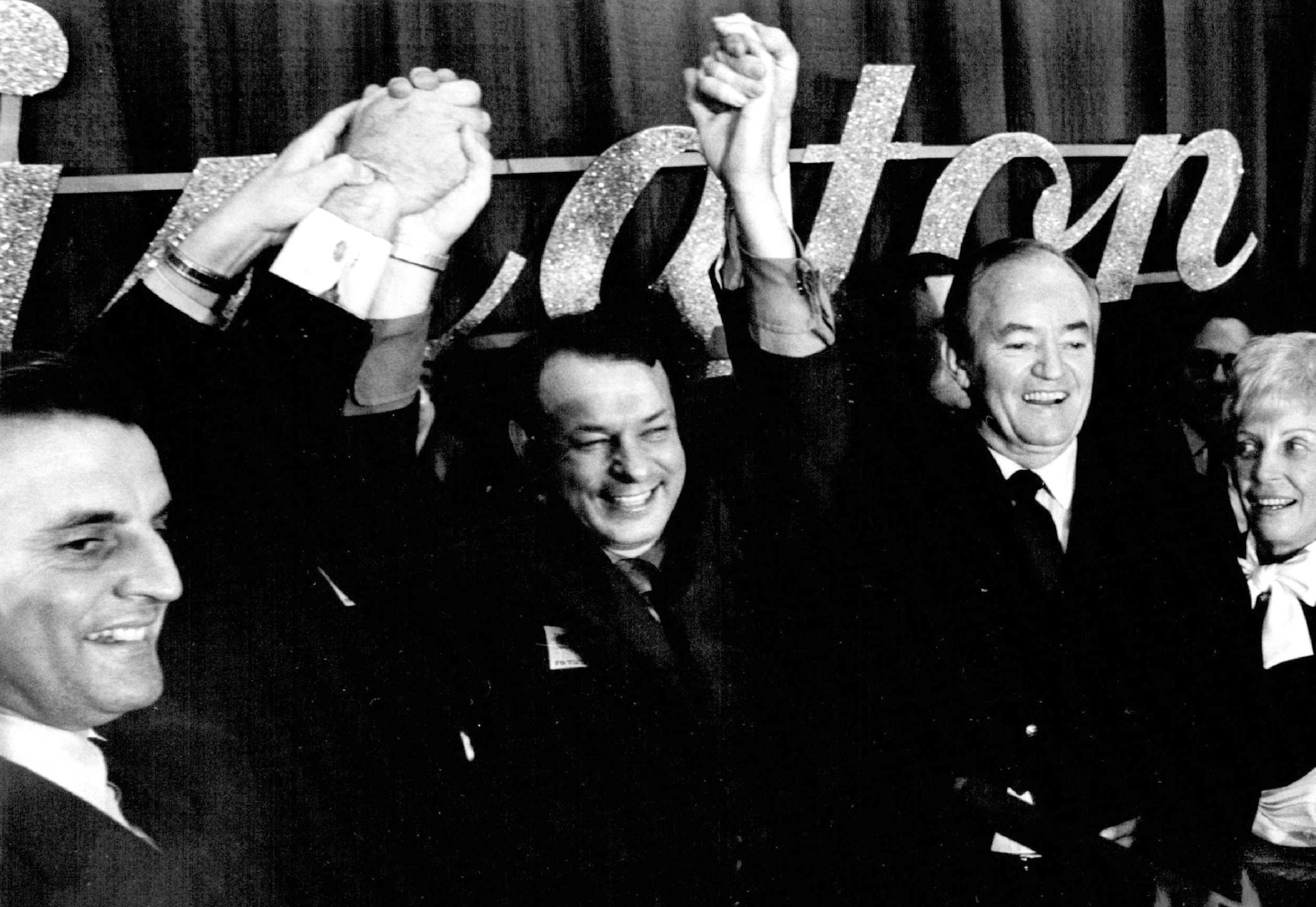
In this Nov. 4, 1970 photo Democratic Farmer Labor Party candidates Rep. Donald Fraser, second from left, and Hubert Humphrey hold each other's hands aloft in a victory sign at the Leamington Hotel in Minneapolis. Sen. Walter F. Mondale, D-Minn., grins at left. Fraser, a former congressman from Minnesota and Minneapolis' longest-serving mayor, has died. He was 95. Son Tom Fraser says his dad died Sunday, June 2, 2019, at his Minneapolis home. (Earl Seubert/Star Tribune via AP)
DFLers Sen. Walter Mondale, left, Rep. Donald Fraser and Hubert Humphrey represented their party on Nov. 4, 1970. (The Minnesota Star Tribune)

For most of his life, Damon Moss had really known only two major political parties in state politics: Democrats and Republicans. Until he came to Minnesota.­

When Moss first moved to Minneapolis in 2009, he recalled hearing references to the DFL on Minnesota Public Radio. "I couldn't quite follow along with what they were talking about," he said.

Wondering about the back story, Moss turned to Curious Minnesota, the Star Tribune's community-driven reporting series, to ask: Why is the Democratic Party in Minnesota known as the Democratic-Farmer-Labor-Party, or DFL?

The DFL that Minnesotans know today, which boasts two senators, five representatives and a governor, exhibits few signs of its radical history. While DFL U.S. Sen. Amy Klobuchar remains one of the more moderate Democratic candidates in the presidential race, her party used to have more in common with left-wing candidates like Sen. Bernie Sanders of Vermont.

The Democratic Party of Walter Mondale and Hubert Humphrey was also the party of a determined faction of Minnesota communists who infiltrated the organization after World War II in vehement opposition to President Harry Truman.

Although the DFL officially formed in 1944, the result of a merger between the Farmer-Labor Party and the Democrats, the party's radical roots are much older.

In the decades after Minnesota's inception as a state in 1858, the Republican Party maintained a firm advantage over Democrats and other parties in the Legislature from 1860 to 1931. The party also possessed the governorship for all but eight years during that span.

However, poor economic conditions for farmers and workers led to the emergence of the Farmer-Labor Party in 1918, one of many parties with socialist influences in the United States. Next door, Wisconsin sent Social Democratic Party of America founder Victor Berger to Congress, while North Dakotans started a socialist political organization called the Nonpartisan League.

Despite their initial exclusion from the Farmer-Labor Party, communists curried favor with its politicians, including former Minnesota Gov. Floyd B. Olson, with their strong criticism of fascism in the 1930s.

"I think what helped them align with the Farmer-Labor camp was the Soviet Union getting involved with [World War II]," said Brian Pease, the State Capitol site manager for the Minnesota Historical Society. "It did later become a problem for the merger because the Democrats pretty much were anti-communist."

In a unification born more from necessity than alignment, Democrats and the Farmer-Labor Party merged on April 15, 1944, in order to present a united front against Nazi Germany during WWII, creating the Democratic-Farmer-Labor Party.

Henry Erlandson • 612-673-4789

about the writer

about the writer

Henry Erlandson

Intern

Henry Erlandson is a senior at Northwestern University studying journalism and economics. He is a reporting intern on the Star Tribune’s digital team.

See Moreicon

More from Minnesota Star Tribune

See More
card image
J. SCOTT APPLEWHITE, ASSOCIATED PRESS/The Minnesota Star Tribune

The "winners" have all been Turkeys, no matter the honor's name.

In this photo taken Monday, March 6, 2017, in San Francisco, released confidential files by The University of California of a sexual misconduct case, like this one against UC Santa Cruz Latin Studies professor Hector Perla is shown. Perla was accused of raping a student during a wine-tasting outing in June 2015. Some of the files are so heavily redacted that on many pages no words are visible. Perla is one of 113 UC employees found to have violated the system's sexual misconduct policies in rece