

Germans have never liked President Donald Trump, and the backlash against his actions is stronger than ever after he pulled the U.S. out of the Iran nuclear deal last week. But there's a growing gap between the German establishment and German voters: The former may be anti-Trump but the latter are increasingly anti-American.
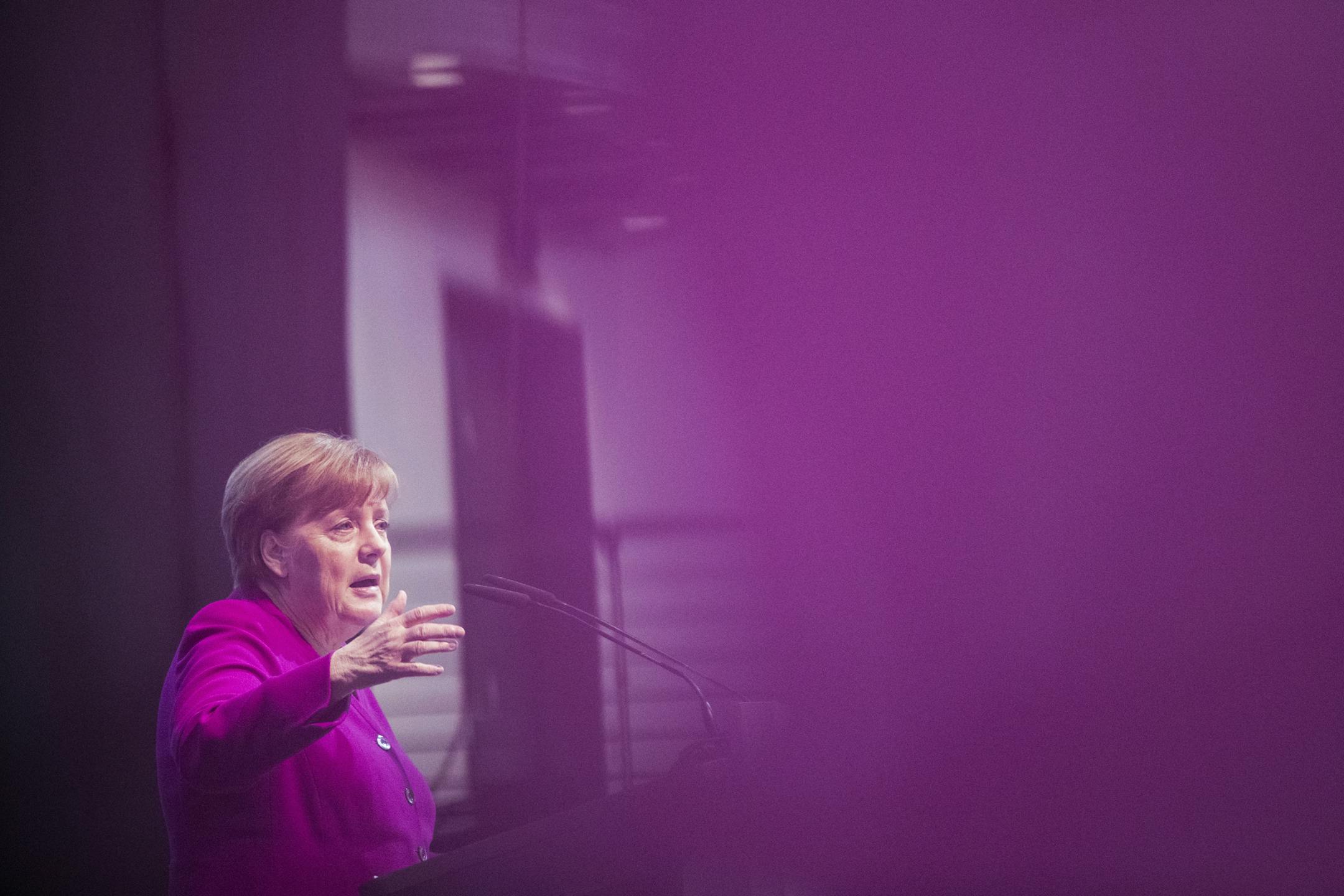
German Chancellor Angel Merkel vented her frustration with Trump on Friday in a speech in the North Rhine-Westphalia city of Muenster, saying his Iran decision "undermines trust in the international order." "If everybody does just what they want, that's bad news for the world," Merkel said.
This outburst coincided with one of the most provocative covers Germany's highly respected weekly Der Spiegel ever published — an outstretched middle finger bearing Trump's likeness, with the English caption, "Goodbye, Europe!" Spiegel's editorial to go with this image called on Europe to join the anti-Trump resistance:
"The West as we once knew it no longer exists. Our relationship to the United States cannot currently be called a friendship and can hardly be referred to as a partnership. Trump has adopted a tone that ignores 70 years of trust. He wants punitive tariffs and demands obedience. It is no longer a question as to whether Germany and Europe will take part in foreign military interventions in Afghanistan or Iraq. It is now about whether trans-Atlantic cooperation on economic, foreign and security policy even exists anymore. The answer: No."
These are strong words. But of course, there was nothing in Merkel's speech about dissolving Germany's alliance with the U.S., and the Spiegel editorial only calls on Europe to "begin preparing for a post-Trump America and seek to avoid provoking Washington until then." The German establishment appears to believe that Trump is the problem and that the time-honored European approach — waiting for the problem to go away, as Europe is already doing with its conciliatory plan to stave off Trump's threatened steel and aluminum tariffs, is the best bet.
Europe's defense dependency on America also serves as a reality check. No matter how many times Merkel may tell Trump that Germany plans to raise its military spending to the 2 percent of gross domestic product demanded by the North Atlantic Treaty Organization, her government's current budget proposal increases it only to 1.29 percent of GDP in 2019 from 1.24 percent this year — and envisions a drop to 1.23 percent in 2022. "One must say, quite simply, that Europe alone isn't strong enough to be the global peacekeeper," Merkel said in Muenster.
German voters, however, don't care so much about that. The Pew Research Center and Germany's Koerber Striftung recently compared Americans' and Germans' views of bilateral relations and found that while Americans say security and defense ties are the most important aspect of the relationship, to Germans economic ties and shared democratic values hold more significance.
In general, according to Pew Research and Koerber Stiftung, a majority of Germans — as opposed to only a small minority of Americans — appears to believe the U.S.-German relationship is "bad." That share has increased since Trump's election, but Germans were more negative about the U.S. than most Europeans even when Barack Obama — who was popular in Germany — was president.


