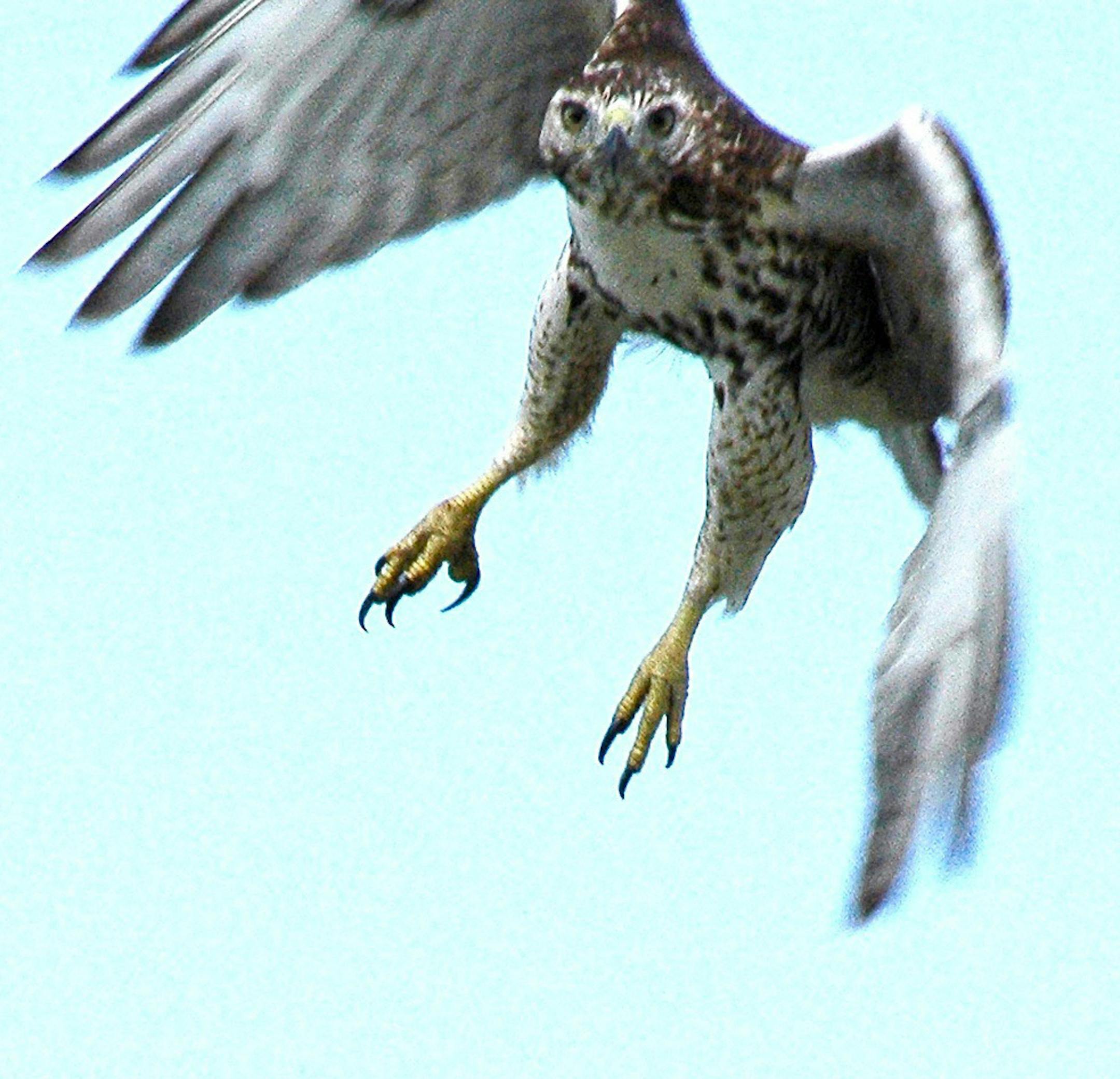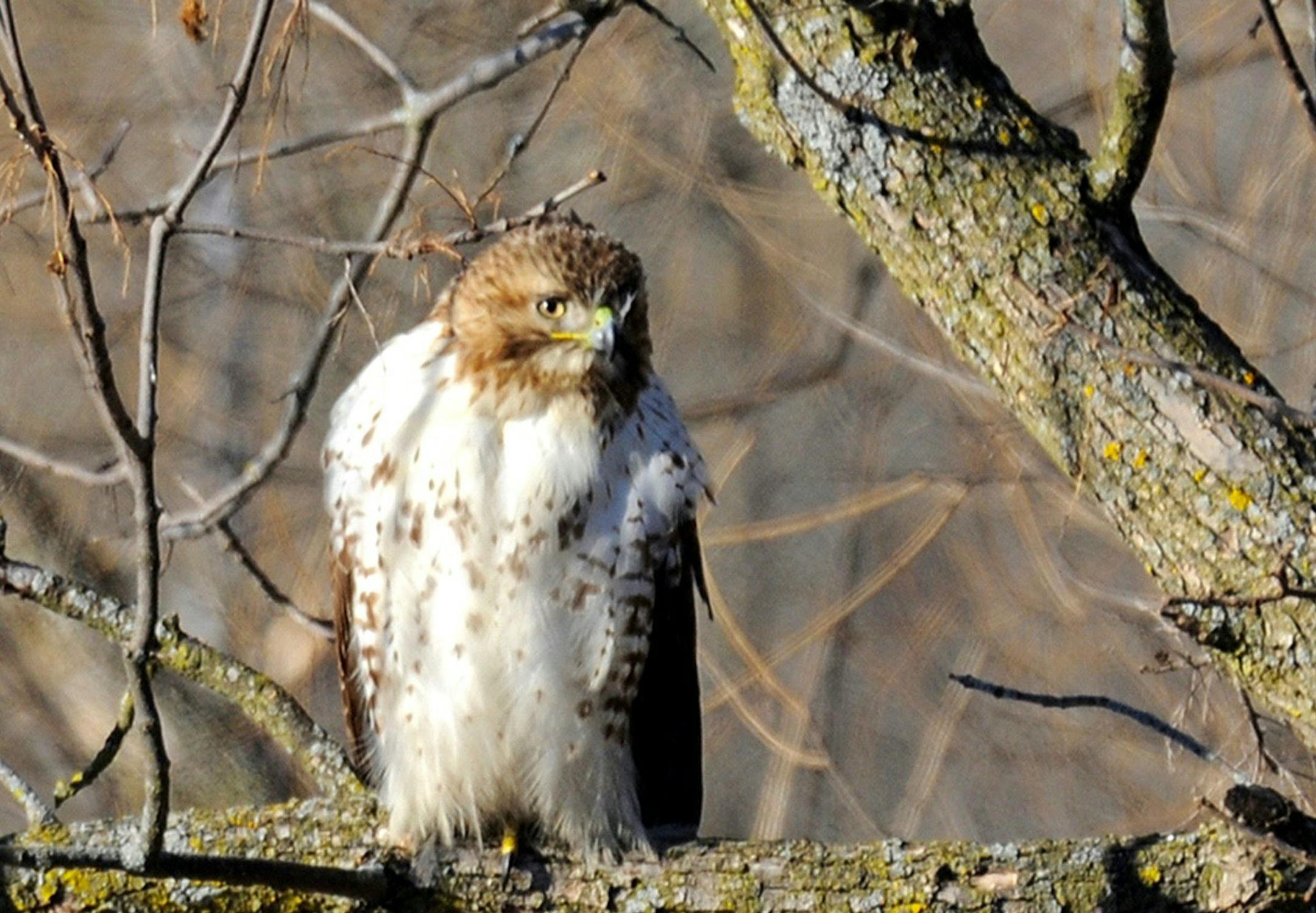
Q: I watched a turkey being harassed by a red-tailed hawk recently. The hawk would dive at the turkey without hitting it, which didn't seem to bother the turkey much. Is this normal behavior?
A: It seems unusual to me, since a red-tailed hawk almost surely couldn't carry off an adult wild turkey. This raptor probably had something else on its mind. It's possible that the turkey was a female protecting her brood of chicks and maybe they were hiding in the grass and not visible to you. The hawk also might have been trying to drive a youngster into the open so he could snatch it. Female turkeys are very good parents and work hard to keep their broods out of the clutches of predators. Her apparent lack of concern might have been hyper-vigilance. (If readers have other theories, I'd love to hear them.)
Beak too small?
Q: Looking at my backyard chickadees, it's hard to believe that they can drill a hole in a tree with those tiny beaks. Woodpeckers I can understand, but not these little guys.
A: Chickadees are cavity nesters, and are capable of carving out their own holes in trees. You're right that, unlike woodpeckers, they can't drill straight into wood; instead they search for a well-rotted snag or a tall stump. Their nest-building efforts involve pulling out decayed wood to form a hole, then carrying the sawdust some distance away (so predators don't catch on). Even better, from a chickadee's point of view, is to find a human-made nest box, ready for occupancy.
Hoping for hummers
Q: I didn't see any hummingbirds last summer and wonder if I should bother putting up the sugar-water feeder this year.
A: I'd recommend hanging out your feeder this spring, because it's entirely possible that some hummingbirds might stop by during migration. You'll have the most success in attracting hummingbirds if you consider your feeder one element of a complete habitat. The tiny birds spend a lot of time perching, so place the feeder near a small tree or arbor. They appreciate some shrubbery or evergreens for hiding, and they have an affinity for moving water, so a birdbath with a water feature is a good idea. Plant clumps of bright flowers in your gardens for natural sources of nectar.
Bluebird competitors
Q: How do I stop little brown birds from making nests in my bluebird house?
A: Those little brown birds are probably house sparrows, and bluebirds and sparrows are a very bad mix. Sparrows are cavity nesters, just like bluebirds, and will pierce eggshells and even kill female birds on their nest in order to commandeer a cavity. This has happened on my bluebird trail and it's terrible to see. You need to evict the sparrows each and every time they attempt to build a nest by tossing out nesting material as they bring it in. (Sparrows are not a native species, so are not protected by laws designed to protect migratory birds.)