

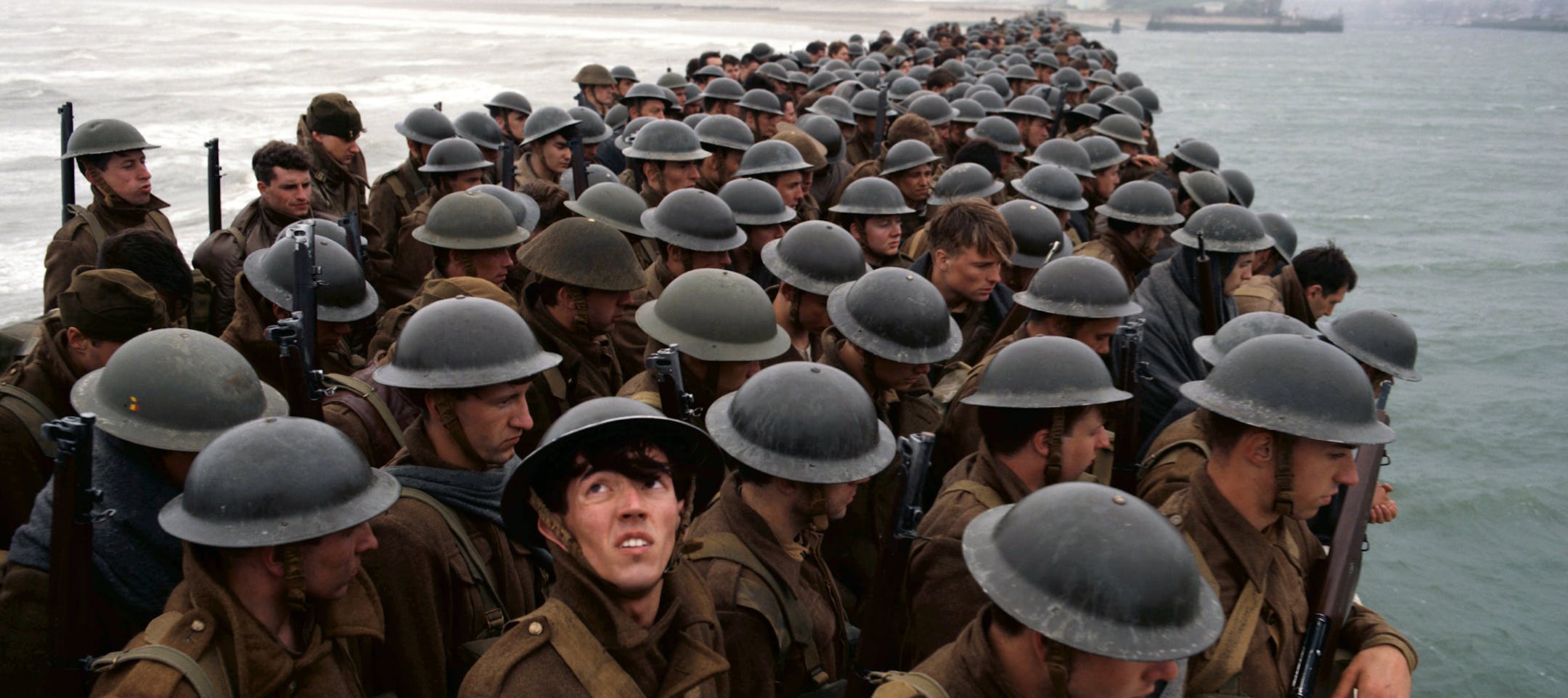
Christopher Nolan's "Dunkirk" is lighting up the box office, with star turns by Mark Rylance and Kenneth Branagh. One set of characters remains largely offstage, however: the Germans, who appear almost entirely in the form of faceless bullets, torpedoes, and bombs.
Yet without the initial German decision to hold back from launching an armored assault on the beachhead, the Second World War might have taken a very different course. The battered British and French troops would have been hard-pressed to turn back any such attack. In its absence, though, more than 330,000 allied soldiers were pulled off the beaches — nearly 10 times the number that the British initially hoped to evacuate. Via e-mail, I asked Robert M. Citino, the author of "The German Way of War: From the Thirty Years War to the Third Reich" and "The Wehrmacht Retreats: Fighting a Lost War, 1943," among others, and the Samuel Zemurray Stone Senior Historian at the National World War II Museum, to shed some light on the Wehrmacht's behavior.
James Gibney: Is there a consensus among historians about why the German military halted outside Dunkirk on May 24?
Rob Citino: No, and there never will be. The entire operational sequence is too complex, even convoluted, and it doesn't help that Adolf Hitler and the Germans themselves were all over the map in explaining it: bad terrain, a desire to let the Luftwaffe alone smash the beachhead, a desire to spare the Panzers, Hitler's desire to cut a deal with the "Aryan" British (this last one is utter nonsense). Both during and after the war, the Germans threw up so much chaff on this question that sorting it out is nearly impossible.
JG: What do you see as the most critical factor?
A: Remember, Hitler's May 24 Haltbefehl ("stop order") did not stop the Panzers from attacking the Dunkirk beachhead. They were already stopped by virtue of a "close-up order" from the commander of the Panzer Group, General Ewald von Kleist, on May 23rd. Kleist's Panzers were badly strung out and worn down as a result of the high-speed chase across northern France. Some of the other army commanders wanted to keep moving forward. The Army Group commander, General Gerd von Rundstedt, backed Kleist, while the Chief of Staff, General Franz Halder, disagreed with Rundstedt, and actually took the Panzer Group out from under his command. It was a mess of the worst sort! When Hitler flew to the front on May 24, it seemed as if the commander he respected the most, Rundstedt, was being sidelined. It also seemed (and this was actually true) that decisions of the highest order were being taken by commanders without looping in Hitler at all — and that was something the Führer was determined to stop. That was the origins of the May 24 "halt order" — an attempt by Hitler to reassert his control over events at the front.
JG: A few days later, Hitler rescinded his decision. What had changed to precipitate that?
A: Two days later (May 26). Hitler had made his point. He was being urged by many of his commanders to let them go ahead. Once again, he was at the focal point of command. The infantry divisions — ordinary foot soldiers with horse-drawn transport, a lesser version of their fathers in World War I — were making no headway at all against British defenses that had been sketchy a week ago but were now coalescing. Luftwaffe bombers, despite the boasting of their chief Hermann Goering, were getting shot out of the sky by British RAF fighters. The air, I feel, was decisive. German bombers had a long run into the fight, flying from improvised airfields; the RAF was hopping over the Channel in many cases — a much shorter approach a lot closer to their bases.


