

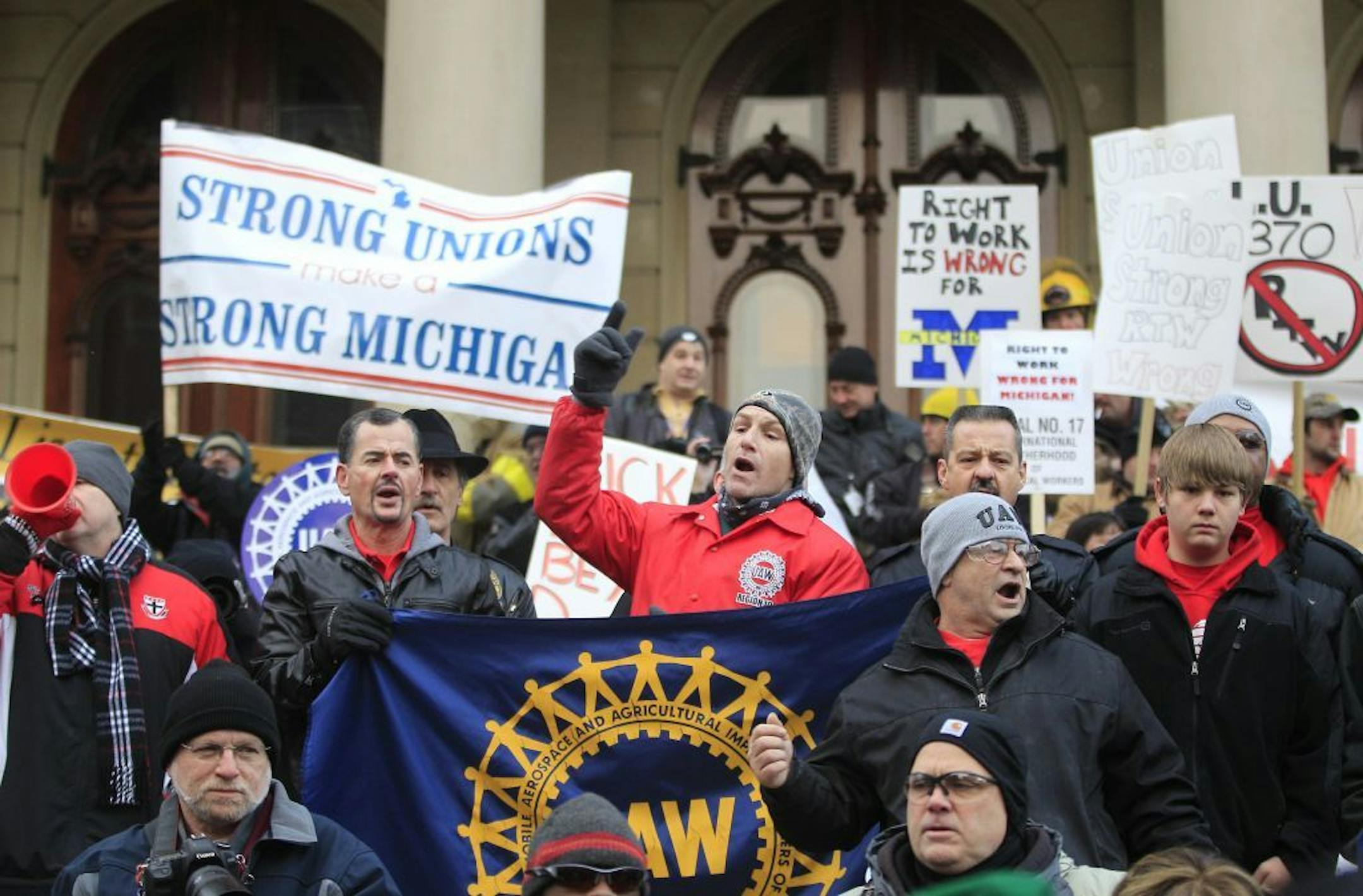
Some 2,500 protesters packed the Statehouse to capacity as an additional 12,500 milled outside. But that raucous opposition didn't stop lawmakers from giving final approval Tuesday to right-to-work legislation in Michigan. Yes, Michigan, a cradle of the labor movement and a once impenetrable bastion of the United Auto Workers union, founded 77 years ago in Detroit.
With Gov. Rick Snyder's signature, Michigan became the third of the six states bordering Illinois - with Indiana and Iowa - to join the right-to-work camp. Nationwide, Michigan is one of 24 states that have put right-to-work language in their statutes or constitutions.
Words such as "astounding" ought to be used sparingly. But a declaration from Michigan that workers can't be forced to join unions, or to pay union dues, as a condition of employment? Does the Vatican next lop off some Commandments? Only four states have higher shares of union members than does Michigan, where 17.5 percent of workers belong to organized labor: New York (24.1 percent), Alaska (22.1) Hawaii (21.5) and Washington (19.0).
In Illinois, according to these U.S. Bureau of Labor Statistics figures from January, 876,000 of the 5,408,000 workers are unionized. That's 16.2 percent, higher than the national total, 11.8 percent. That U.S. percentage has been contracting, and if Michigan workers choose to stop paying dues as many public sector workers in Wisconsin have done, it will shrink further: Nationwide, 37.0 percent of public sector workers are unionized - five times the share (6.9 percent) in the private sector.
We offer this elaborate context for a reason: As Democratic and pro-labor a state as Michigan historically has been, what's occurring there may well spread to other states with low job creation and high taxpayer debt - much of it unfunded public pension liabilities. No one who follows the economics and politics of Michigan can say this abrupt legislative action comes as a shock. Or that Michigan voters didn't authorize it.
In 2010, Michigan citizens fed up with spending and debt handed total control of state government to Republicans. When Wisconsin Gov. Scott Walker succeeded in restricting collective bargaining for most public employees, Michigan's Snyder said a push for right-to-work legislation wasn't on his agenda. Too divisive.
In this year's election, though, unions in Michigan overreached. They aggressively promoted Proposal 2, a ballot measure that would have given public and private workers a constitutional right to organize and bargain - but also would have nullified current or future laws limiting that ability to organize and bargain. President Barack Obama defeated Mitt Romney in Romney's native Michigan by nearly 10 points, 54.3 percent to 44.8 percent. But the same voters crushed Proposal 2, 57.4 percent to 42.6 percent, and left Lansing in Republican hands. After the election, The Detroit News editorialized, "The defeat of Prop 2, an audacious bid for union power that sought to forever ban right-to-work legislation, may prompt labor opponents to push for just such a bill."
That's precisely what happened. Proponents cited evidence, including from Indiana, that right-to-work states have faster job growth. We've read decades of these studies, and have reached a conclusion: You can twist data to prove beyond doubt that right-to-work legislation helps - or hurts - a state's economy and workforce. Decide which truth you want. You'll find it.


