

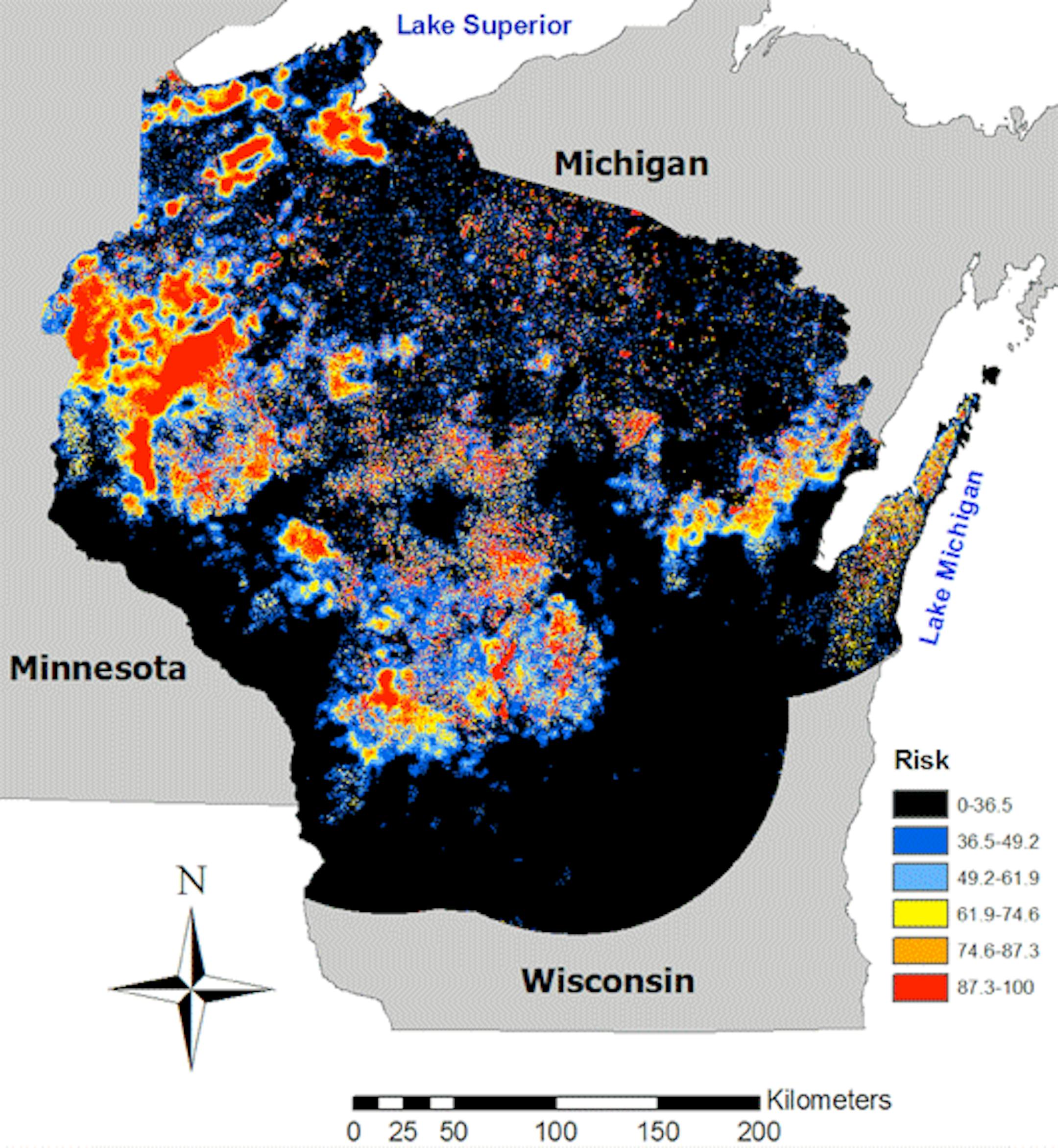
Future risk can be predicted from the past. That's true of traffic accidents, disease -- and now wolf attacks. Researchers at the University of Wisconsin and the Wisconsin Department of Natural Resources have created a new tool to help manage conflicts between wolves and people. They call it a risk map.
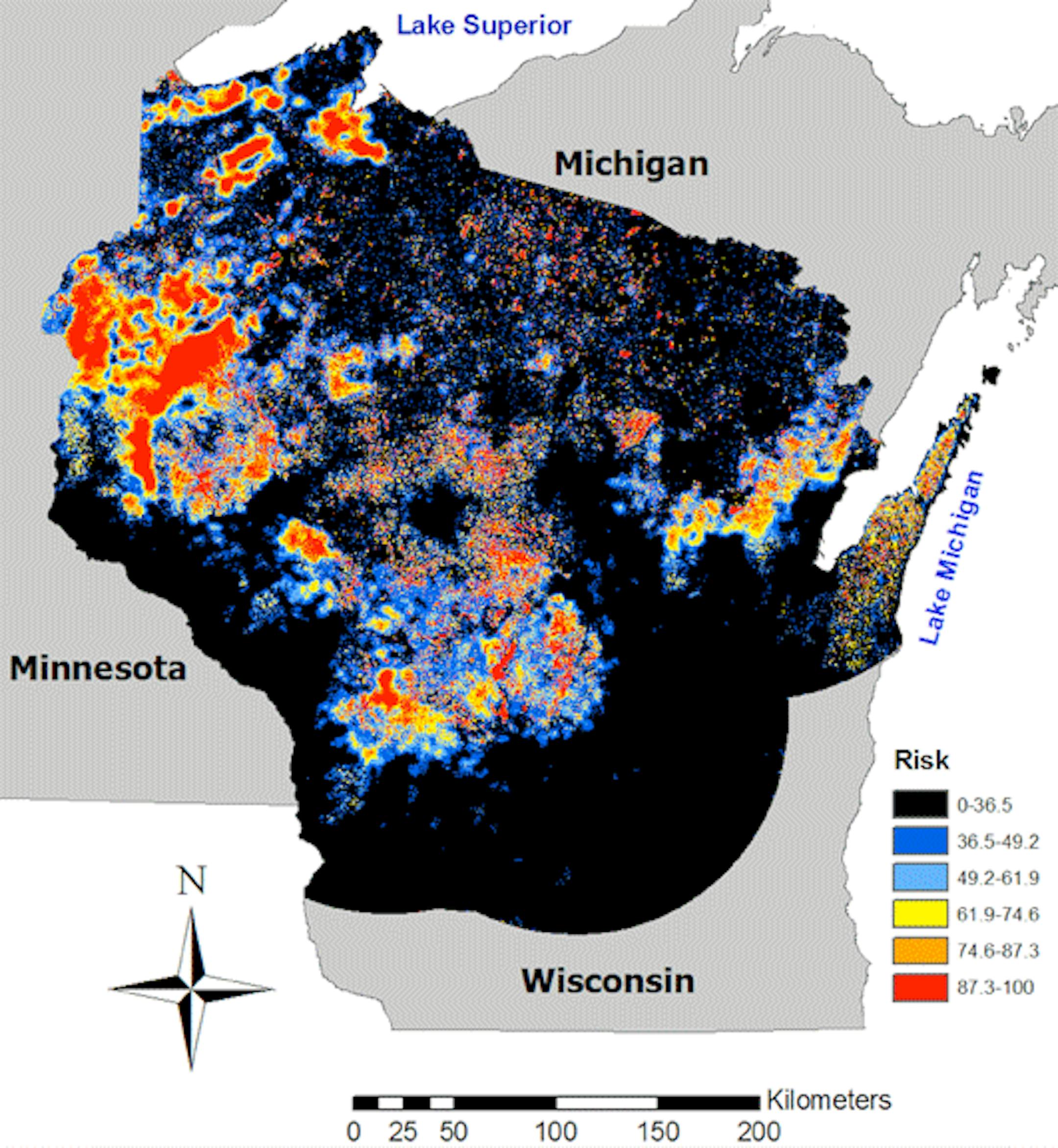
Credit: Adrian Treves, University of Wisconsin. atreves@wisc.edu.
Using data on past wolf attacks on livestock and pets, they were able to accurately predict where almost all subsequent attacks would occur. They also found that almost all of them occurred in only 10 percent of the area where Wisconsin's 700-plus wolves roam. In short, only a few wolf packs are likely to be problems, they found.
Strategies to resolve human wolf conflicts will be critical next year when wolves in Minnesota, Wisconsin and Michigan are taken off the endangered species list. That means people can kill wolves who threaten their property. Historically, people have viewed all wolves as equally predatory.
"Around the world it is common for people to kill wildlife indiscriminately when they perceive them as threats," they said in the article published this week in the journal BioScience. "To date, people have been largely unable tor unwilling to discriminate between individual culprits and nonculprits when addressing problems with wild animals. As a result, indiscriminate killing has been perceived as cost effective."
In fact, it often doesn't work, they said.For example, decades of government-financed, lethal coyote control have not succeeded in reducing sheep losses, they said.
Targeting intervention in problem areas, and problem wolves, will be a far more effective strategy, they said.
Minimizing conflicts between humans and wolves serves a dual purpose - it conserves biodiversity and, more importantly, the carnivores who are the top of the food chain and which perform a critical role in maintaining ecological balance around the world. And it would protect human life and livelihood.


