

In the Democratic primary, the establishment candidate ran against a left-leaning opponent far better able to connect emotionally with the party's base. The Republican nominee ran as an outsider against a crowded field of insiders. He won the Republican primary because he connected directly with primary voters by transcending his party's usual political platitudes.
In the post-convention general election campaign, the Democratic nominee called the Republican candidate simple-minded and unprepared for the job. One Democratic campaign ad says "I just can't imagine him being president. It's too complex a job." Another says that he has the same problem he has always had, "namely that he always shoots from the hip." Another is more specific: "I'd hate to see him involved in a Mideast peace agreement and come up with one of those ill-informed, shoot from the hip type of comments."
These are not one-off campaign spots. The Democratic nominee's campaign staff announces its strategy clearly and directly: It is to brand the Republican candidate as "simplistic" and "not equipped to be president." The strategy is to change the subject of the campaign away from the record of the incumbent president by painting the Republican nominee as outside the pale of acceptability.
The Democratic attack focuses on racial issues, suggesting the Republican will turn back the clock on civil rights. It also focuses strongly on foreign policy issues. It trumpets the fact that the Republican nominee said that nuclear weapons proliferation is not necessarily America's problem, painting the Republican nominee as "dangerous."
Relentless negative branding is beginning to have an effect on the Republican candidate's own campaign staff. They worry aloud that their candidate spends far too much time trying to "explain away a series of bloopers." They fear "there is a possibility that the caricature of (their) candidate will become a reality." To address this problem, the staff has begun to insist that their candidate no longer speak off the cuff and instead "stick to the typed pages."
All of this reinforces voters' negative impressions about both candidates. Both candidates' negatives are unusually high. Fully 43 percent of the Republican candidate's likely voters say they are "really voting against his opponent." And 34 percent of the Democratic nominee's likely voters say the same about their votes. Third-party candidates are predicted to do unusually well because of the leading candidates' negative ratings.
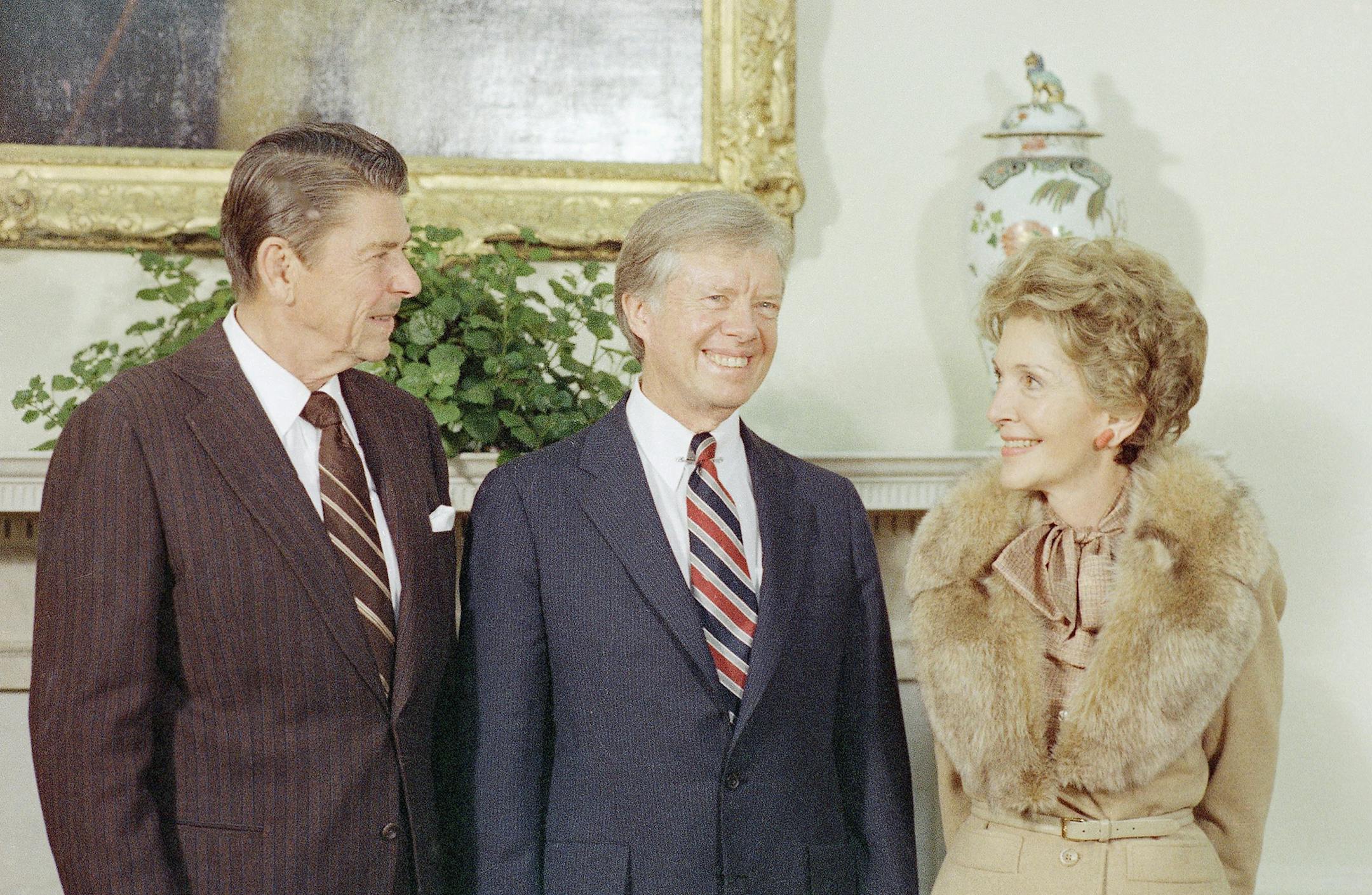
Who are these candidates? The Democratic candidate is President Jimmy Carter and the Republican candidate is Ronald Reagan. And the quotations are all from the 1980 presidential election campaign.
This of course is not to say that Donald Trump is a latter-day Ronald Reagan. But it is to say that we have seen this playbook before.


