

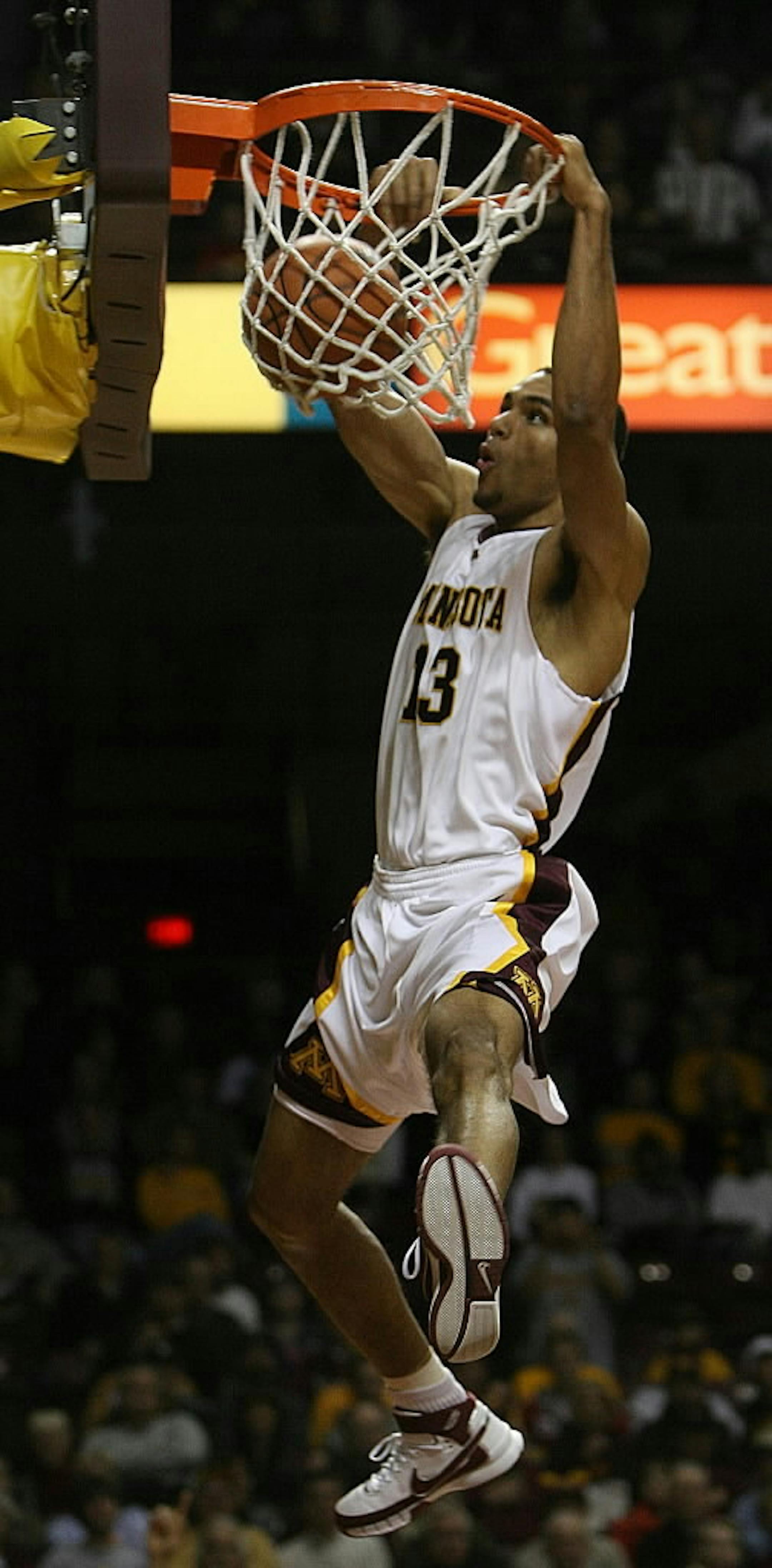
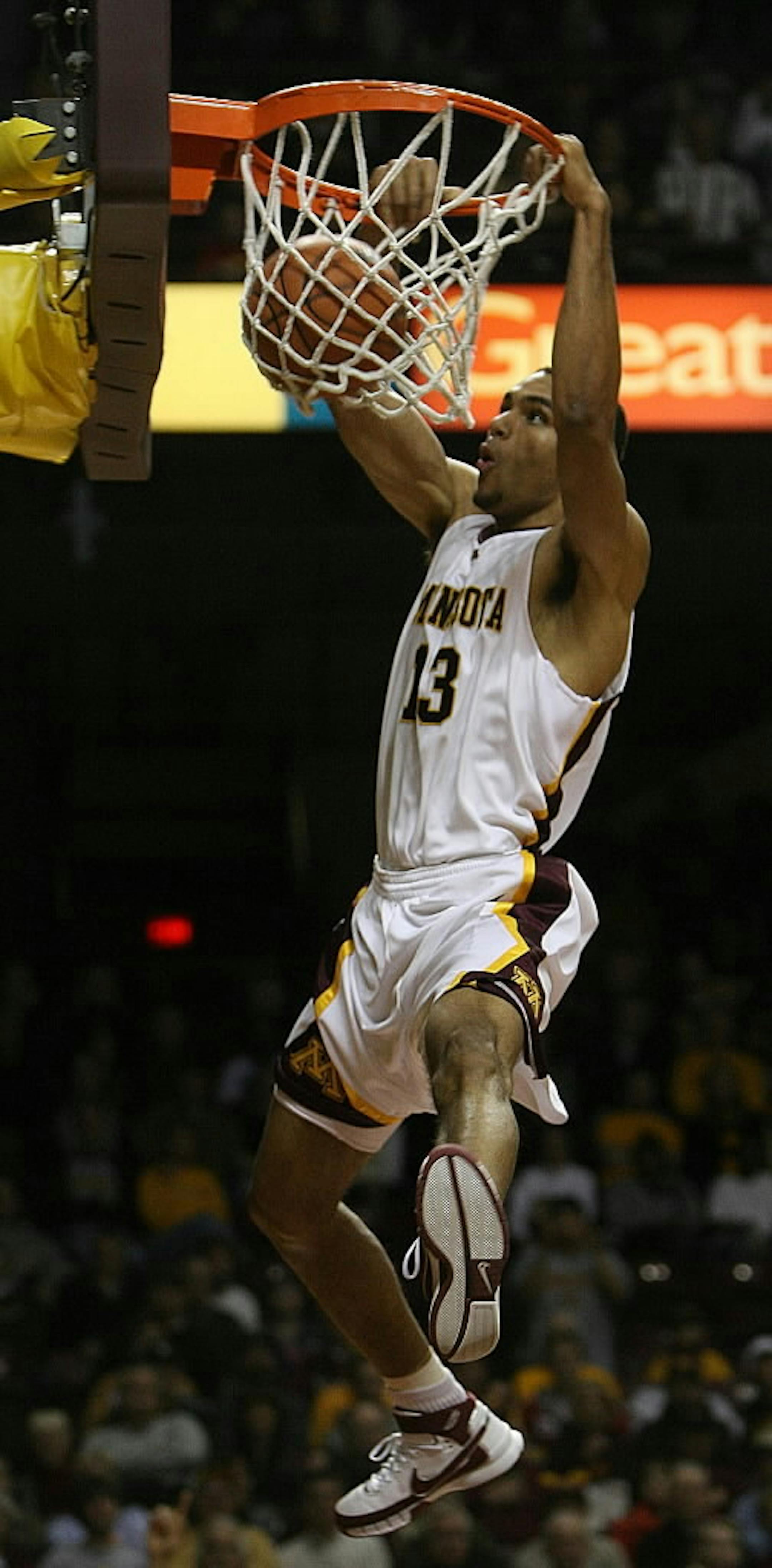
This is the second in an occasional series catching up with former Gophers players.
Dan Coleman is far away from home, but still pays close attention to the Gophers – after all, his brother, freshman Joe Coleman is the latest to join the Coleman legacy at Minnesota (his uncle, Ben Coleman also played there). I caught up with Dan Coleman – who now plays in France -- over Skype about what he's been up to since graduating and what he thinks about his little bro and this year's squad.
AR: I know you just started with a new team (recently). Could you fill us in on how the free agent/trading process works over there? Is it similar to what we're familiar with in the NBA?
DC: It's completely different than the NBA. The open market is during the summer. And in Europe, unless you're from that country, you usually only sign one or two year deals. Every one or two years, you'll mostly likely be somewhere else. This will be my fourth year. My rookie year I played in Portugal and the last three years in France. (He's on his third European team).
AR: Can you give us a rundown of what happened post graduation?
DC: I went to work out with the Timberwolves and then I played (in their) summer league team in (Las) Vegas (in 2008). I signed a deal in September in Portugal. We made the playoffs and I was the MVP over there – it was a big year. And after that, I signed a deal with JL Bourg, and I had a good season there, we made the playoffs and they re-signed me back and I was there last year.
AR: So you were initially without a deal this season?
DC: I kind of gambled a little bit with the NBA lockout. It was kind of messing up the deals for everybody. So I wasn't really happy with all that top heavy action, as far as good players, it was pushing down my value. There's 450 jobs in the NBA, suddenly everybody's available. And then all the players that would have been in D-league -- well, the D-league lost its allure. I don't know how many but I'm just going to throw out a number – 700, 800, 900 players – that would be occupied in the United States … they're just not. So I waited it out and then as soon as the lockout was done, an offer came up (with his current team, Vichy) and I took it.
AR: You were without a job for seven months. Were you panicking?
DC: It wasn't a situation where there were no opportunities, it was more of a situation where I was turning things down. There's no need to rush out here unless it's just a great deal or a great situation.
AR: What if the lockout had continued for the entire NBA season?
DC: Well, what people don't understand with playing professionally, there's so many different leagues and they start at so many different times. There's America, you can play in Brazil, Puerto Rico, Japan – all over. So it really depends more on your agent's ability to put you in front of decision-makers. So if the NBA lockout would have continued, it would have been different. There are a lot of leagues where you can't play – if you have certain experience they don't want you. There are some that have height restrictions. So I still would have had a job. But I was just wanting to come back to Europe and not do the Asia thing or something different.
I had a lot of interest at the end of the season, but every week that the NBA lockout became more real, teams started to change their focus. So for a guy like me, I had strong interest, but if a team thinks he can get an NBA player for low six figures, which some guys came over for not that much. Everybody knows your body is like a perishable good, so everyone just wants to take the money. So it just changed everything. It was a different year. I had two offers, one in Hungary, one in Israel that I could have done, but I didn't.
AR: What didn't you like about those?
DC: You can go to new countries and certain countries have more or less a bad reputation as far as business and so on, so going to a country where you don't know 100 percent whether you'll get your money – that's not worth it. I had an offer in Portugal, I had an offer in Hungary. I mean, I played in Portugal and there were, you know, late payments, it was not always on time. And then they spoke of Hungary being a possible country – it really has to do with the labor practices, because each country has different labor laws. And countries with the stronger labor laws have to have checks and balances. They can't just tell you what you're going to make and then not have it in the bank.
AR: Playing in Europe sounds like an even crazier lifestyle than playing in the NBA -- more movement, sketchier practices. Do you like it?
DC: Yeah, it's good, it's a nice career, it's got a lot of perks. I mean, it's way different than the NBA. It's actually a lot more solitary than the NBA because you only play one game a week. People who play in the NBA and come over here a lot of times don't like it, because it's not the same lifestyle at all. There's a lot more practice, too, you practice twice a day for one game. Some people get really bored or homesick, but if you do it for enough years, it just becomes second nature, almost. You don't think about it as much.


