

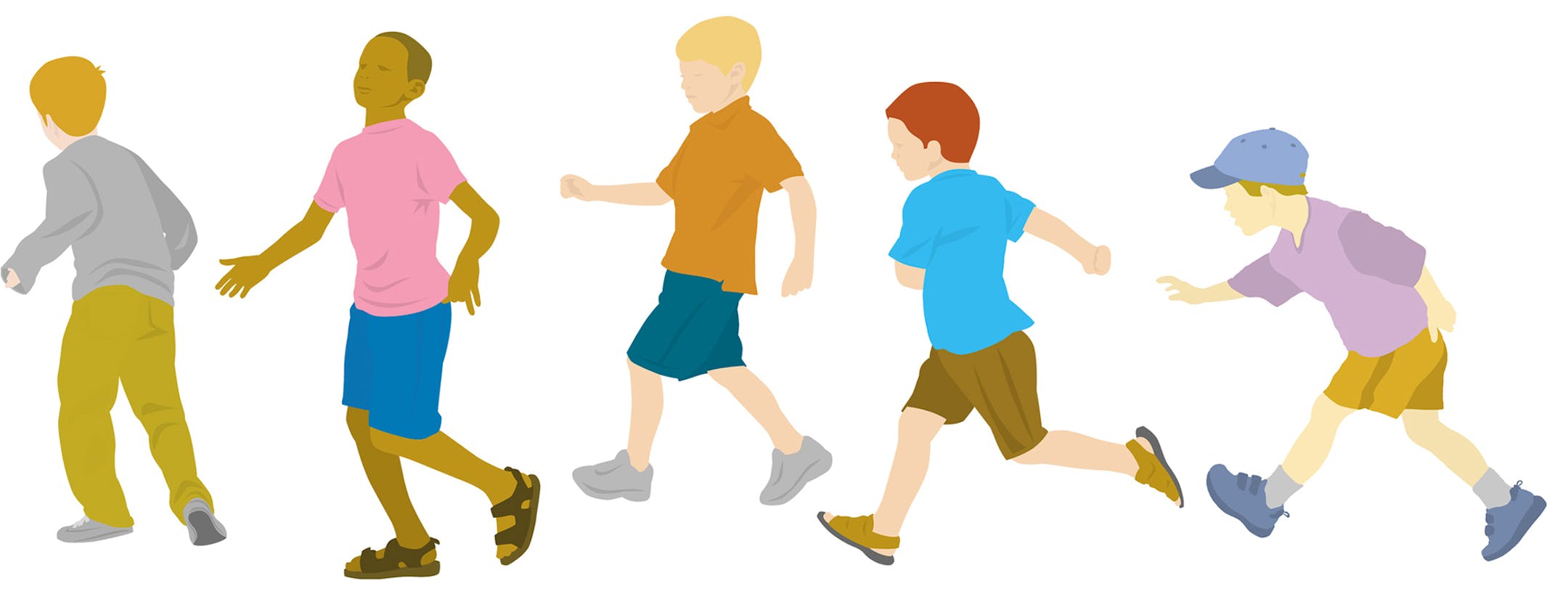
No roughhousing. No superhero games. No turning your fingers — or your Pop-Tart — into a make-believe gun. No tag. And certainly no dodge ball.
Stories of zero-tolerance play-policing by schools are a well-established news genre. Most recently, parents in Washington state mounted a successful campaign to force the Mercer Island School District to reverse its ban on playing tag during "unstructured playtime," or what used to be called recess. In his backpedaling news release, Superintendent Gary Plano puzzlingly insisted that "asking students to keep their hands and feet to themselves at all times, including recess" wasn't a ban on tag. Perhaps he envisions tag by telepathy.
At any rate, Mercer Island isn't the first school district to prohibit tag and it won't be the last. Bans on physical contact and pretend violence are the norm on U.S. school playgrounds.
"The majority of school districts in the U.S. have 'zero- tolerance' policies on 'any form of violence,' " says Jennifer Hart, who teaches early-childhood education at the University of the Sunshine Coast in Australia and has published research on "playful aggression" among children. Kids who wrestle, pretend to fight or play superheroes face punishment, as do teachers who tolerate such old-fashioned antics.
Behind these policies is the superstitious belief that vigorous physical contact and make-believe violence will beget immediate and future real physical harms — magical thinking that fundamentally misunderstands how children play and learn. Prohibiting rough-and-tumble play doesn't make recess safer or kids less apt to hurt others. To the contrary, the bans deprive children of the very experiences they need to master peaceful social interactions.
Roughhousing is more than good exercise. Psychological research shows that it's essential to childhood development. Rowdy, physical play teaches kids to communicate verbally and nonverbally; to take turns; to negotiate rules, and to understand when they can use their full strength and when they need to hold back. It may sometimes look like fighting, but it isn't. Kids smile and laugh, return voluntarily to the game, take turns in dominant roles and wear distinctive "play faces."
In a chasing game like tag, children "learn how their bodies move, how their playmates will respond when a change to the game is made, how to negotiate these changes to games, what to do when one of the children falls and how to express their thoughts to the others involved in the game," writes Michelle Tannock in the Journal of Early Childhood Education, summarizing the developmental-psychology literature. When she interviewed kids at two child care centers in British Columbia, Tannock found that they all said rough-and-tumble play was prohibited — yet they engaged in it anyway.
"To simply forbid it is like telling children, 'We're not going to let you eat today, because the food might be contaminated,' " says Frances Carlson, author of "Big Body Play," a guide published by the National Association for the Education of Young Children. "Children can't live without it, so they do it in hiding." Over the past three decades, as the research into its importance has mounted, the association has gone from hostile to supportive of full-body play. Unfortunately, laws and schools haven't kept up, hurting kids' development.


