

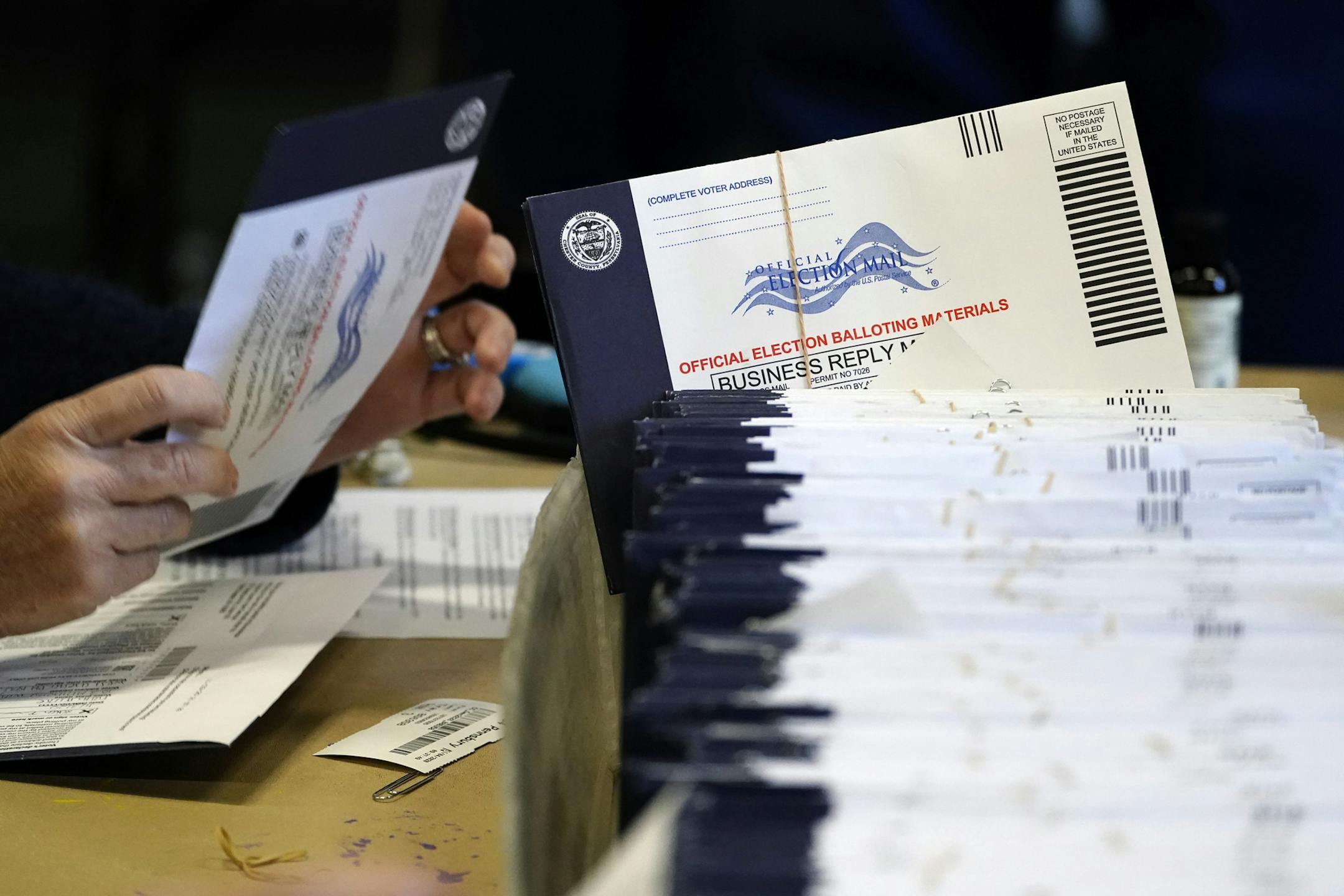
An election is supposed to be a reality check. It promises the finality of decision, in which the back-and-forth of political argument gives way to the undeniability of a particular outcome on a particular day.
Scoff at the possibility that Donald Trump could ever be the Republican nominee (as I did, once upon a time), and a succession of primaries will reveal the hollowness of your supposed expertise. Insist on the certainty of polling or political science, or some variable (rally size, yard signs, boaters) of your own choice, and the election result will put your certainty to a decisive test. Claim that your particular obsessions are shared by the American people, and on Election Day the people in their majesty will render a verdict on your claim.
But that finality is still socially and politically constructed. And democracies can fail — a scenario on many people's minds these days — when that constructedness dissolves, when it becomes possible to deny the finality of election results outright, to continue the contest outside the system or to substitute a different form of decision for the verdict of the ballot box.
We are not there yet in America, but people are right to sense that we're in a liminal place, where a combination of factors has made our election results much less decisive than in the country's past.
One factor is the increasingly immersive power of ideological narratives and virtual realities. If you can react to an election loss by retreating immediately into a storyscape where the outcome was a cheat, carried about by means of voter fraud or Russian interference, then the decisiveness of any given outcome will inevitably diminish.
Another factor is the interaction of political polarization with America's two-party system and constitutional design. A country with two parties that are increasingly ideologically consolidated, and a narrowing band of swing voters in between, will produce fewer landslides and more nail-biters, and more swings back and forth from election to election, than a country with looser and more fluid coalitions. If that country's electoral system also allows candidates to win the nation's highest office with a minority of the popular vote, then under polarized conditions this scenario will become more commonplace, decoupling the official decision of the election from the apparent preferences of the voting majority.
The irony is that historically, America's Electoral College tended to produce more decisive-seeming outcomes, both because it magnified the scale of a geographically well-distributed victory and because the possibility of losing even with a slight popular majority created incentives to seek supermajorities — to overwhelm countermajoritarian redoubts with nationwide landslides.
You can think of the 2020 campaign as a test of whether that kind of incentive structure can be made to work again. The 2016 election, as I wrote over the weekend, was an example of a shocking but non-decisive-seeming result, in which all the weirdnesses associated with Trump's minoritarian victory gave people in both parties reasons not to learn any lessons from the experience.


